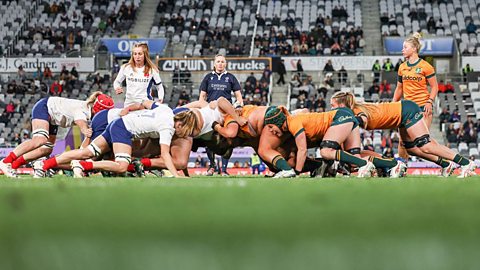
One of the biggest sporting events on the planet - the Super Bowl - takes place on Sunday 8 February.
A highlight of the American Football season, Super Bowl LX sees the New England Patriots facing the Seattle Seahawks.
The Super Bowl is the culmination of a season's worth of competition, with teams having to make the play-offs at its end to stand a chance of making the final.
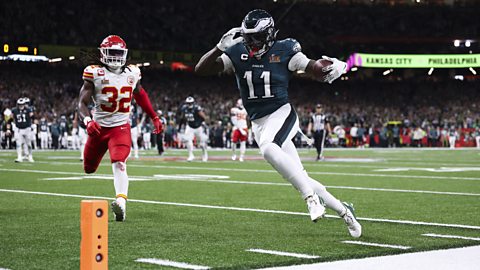
The National Football League (NFL) is made up of two conferences - the American Football Conference (AFC) and National Football Conference (NFC). The winners of each conference meet to contest the Super Bowl - and are declared the world champions. More than 115m viewers watched the Super Bowl in the USA in 2015, so it's a pretty big deal.
Even half-time isn't boring. Advertising breaks tease forthcoming movie blockbusters and on the pitch itself, massive music acts perform memorable slots - Bad Bunny will make history as the first Spanish-language musician to perform the prestigious half time slot in 2026.
The celebration of a game which is part of American life can also be confusing to newcomers tuning in out of curiosity. Why is a first down so significant? What’s a fumble? BBC Bitesize is here to talk you through some of the terms and phrases that might come from the commentary mic on the way to a touchdown.
The basics
American Football matches take place between two teams of 11 players on a pitch 100 yards long. Each team comes from a squad of 53 players, separated into offensive and defensive players and those who take up special positions (especially when kicking the ball is involved), all of which can be called upon to play during the game.
Positions within an American Football team include:
- Quarterback: Directs the team and ensure they score as many points as possible.
- Wide receivers: Quick, nimble, and catch passes that are thrown to them.
- Running backs: Rush the ball forward after receiving them from the quarterback.
- Nickelback: Not a rock band, more part of a team's defence.
This is by no means an exhaustive list, but it should give you an idea of the positions in a team.
First down
Downs are what keeps American Football going. To a British eye, the sport probably looks closer to rugby than football in that the ball is carried more than it’s kicked.
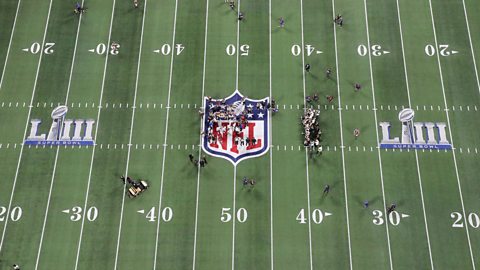
The pitch is visibly divided into sections, with a central line of 50 yards and the lines either side decreasing in units of 10 down to the scoring areas at each end, handily called end zones.
It’s the 10-yard sections which drive the flow of the game. When a team with the ball is on the offensive, they have four attempts to advance 10 yards. If unsuccessful, they must surrender the ball to the opposing team, usually by giving it a good kick (or ‘punt’) down the field - or between the opposition’s posts to get a field goal for three points. Alternatively, they can make one last glorious effort on that fourth attempt to advance those 10 yards.
If the attacking team does move the ball forward more than 10 yards within its four attempts, then it has earned a first down, is closer to the end zone, and continues with play. Advancing the ball happens when a quarterback on the team throws to a receiver, or a running back moves forward with the ball in their hand.
Touchdown
First downs are good, touchdowns are even better. If a player runs into the opposition’s end zone with the ball, it’s called a touchdown and puts six points on the scoreboard. In the same way a rugby try can be converted, teams can score further points after a touchdown.
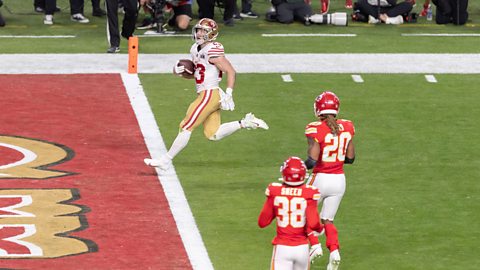
One more point can be earned from kicking the ball between the posts found at either end of the pitch (making it even more like a rugby conversion). Two further points can be scored if the team is able to get the ball back in the touchdown area once more from the two-yard line. The ball has to be in play in order for any points to be scored. When the ball isn't in play (for example, right after a foul has been committed), it is called a dead ball.
Line of scrimmage
This only exists in the mind, but that doesn’t make it any less vital. When the teams line up facing each other, the ball separating the two, an imaginary line passing through that ball and extending to each side of the pitch is the line of scrimmage.
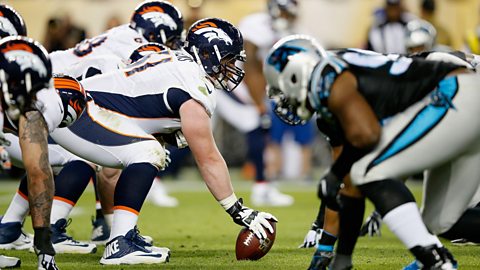
Each team must keep to its own side of the line of scrimmage until the ball is played. Once it’s in play, if a quarterback is tackled behind the line by the opposing team, it’s known as a sack. If the quarterback drops (or fumbles - see below) the ball behind the line of scrimmage, it's called a strip sack. If the opposing team retrieves it, it's a turnover, which means they have taken possession of the ball without it being kicked.
Huddle
Ever had a quick discussion in school, or at work where everyone gathers away from their desk? If you call that a huddle then you may be pleased to know that American Football players do the same thing. If you see them in a huddle on a pitch, they’re gathered together to talk tactics as discreetly as possible.
Fumble
Nobody wants to be a fumbler on the field - this is a player who loses possession of the ball. Once a player has fumbled the ball, it is live and can be picked up by players of either team.
When a player, regardless of team, unsuccessfully attempts to take the ball once it’s been fumbled, it’s called a muff.
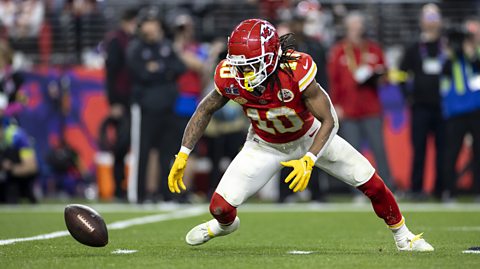
American Football has many rules and this is an introduction to just some of the basic terms. If you are interested in the game and want to learn more, the best thing to do is immerse yourself in a few matches.
This article was published in January 2020 and updated in February 2026
The origins of football jargon
From hat-trick to volley, learn where some of the most popular football lingo comes from.
A beginner's guide to F1 jargon
What's bottoming? And tankslapping even?
The Six Nations: What's a ruck? And other rugby jargon explained...
Know the difference between your rucks, mauls and scrums