Hard hitting, fast-paced, brutal sporting action? Must be time for the men's and women's Six Nations Championships .
If you’re a complete newbie to rugby union but still want to cheer on your team when the first whistle blows, it can help if you understand some of the jargon. When the match commentator mentions recycling, are they talking about bin day? When are there scissors on a rugby pitch? Take a look at our guide to the jargon which may come your way as the home nations as well as Italy and France do battle.


What is a scrum?
Whenever play has to re-start in a rugby union match after a minor rule infringement, it comes by way of a scrum.
There could be all sorts of reasons for play to stop. The ball may have been thrown forward, there could have been an accidental offside incident (a deliberate offside move results in a penalty to the opposing team), or a ruck or maul may have failed to bring the ball back in to the field of play.
The eight players in the forward positions from each team take part in a scrum. It is formed on the part of the pitch where the incident which brought about the restart took place. Each set of players make a three-four-one formation of three rows, then bind together to create a sixteen-strong huddle.
A player called the scrum-half, who does not form part of the scrum itself, feeds the ball into the ‘tunnel’ created at the point where the front rows of each team meet. The scrum-half then moves round to the back of their team’s half of the scrum, with the intention of getting the ball once it emerges.

The three players in the front row of each team can fight for possession of the ball as soon as it touches the ground. They can use either foot to hook the ball into their half of the scrum and work it towards the player at the back. Once the ball is at the foot of the player at the back of the scrum, the scrum-half can then collect it.
It’s not just about regaining the ball, the scrum is also an opportunity for a team to push their opponents back down the pitch at the same time. The scrum ends when the ball re-enters the pitch.

When is a Blood-bin used?
Not as gruesome as it sounds, the blood-bin in a rugby match isn’t on the pitch.
Any player who has an injury that has produced blood must leave the field and head for the blood-bin.
It’s here that they receive treatment for their injury. A temporary sub can come on for the injured player while they’re in the blood-bin but, once they’re out of the bin and back on the field, then back to the bench that sub must go.
How does a maul form?
Rugby is certainly what you’d call a contact sport and there’s few better examples than the maul.
If your opponent has the ball, you’d better do your best to get it off them. A maul is when you see a player, or players, from an opposing team grabbing on to a player in possession of the ball. As soon as three players are involved in this situation, you have the minimum requirements for a maul - but the two players going after the ball carrier must be from opposing teams to officially make it one.
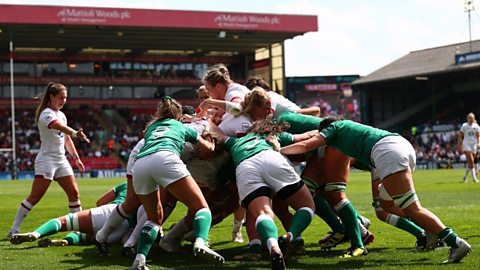
When the ball carrier's teammate holds on to them to help retain possession, it's called binding.
Once teammates are involved in a maul, players can pass the ball to each other, and even leave the maul while carrying the ball to a safer or more advantageous part of the pitch.
What is rucking?
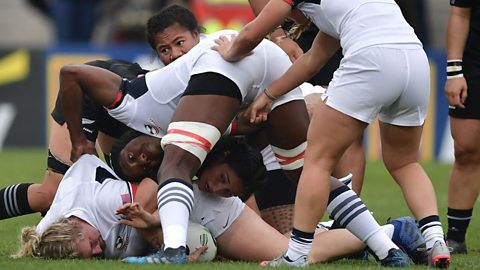
Whenever a player is tackled, they must release the ball. From the moment the ball hits the ground, it’s open for possession by either side and a ruck forms so a team can take advantage.

How is the rugby ball recycled?
Now you're up to speed on the ruck, this makes the recycling explanation a lot easier.
If your team goes into a ruck with the ball and comes out of it with the ball, that’s recycling.
During a ruck, the ball must remain on the ground and players can only use their feet to win control of it. Once a team clearly has control of the ball, the referee will order them to ‘use it’ and they then have five seconds to clear it away from the ruck.
Along with the scrum, the ruck is a complex move in rugby.

What is a Scissors Pass?
Passing the ball forward isn’t allowed in rugby, the ball always has to be thrown behind you towards another player. But that doesn’t mean you can’t get nifty in your passing.
A scissors pass is where players from the same team, one of whom is in possession of the ball, run towards each other. As they cross paths, the player with the ball passes it legally to their teammate.
The scissors element comes in when the players are running towards each other at diagonals (think of the way the lines cross on the Scottish flag). At the crossing point, it’s a small pass to the player coming the other way and the ball is set off in a different direction. A variation of this is known as the switch pass.
If you want to know even more about rugby union, take a look at our Bitesize guide. It could answer even more of your questions as the Six Nations get underway.
This article was published in September 2019 and last updated in February 2026.
Seven rugby questions you were too embarrassed to ask
The difference between league and union - and just who was William Webb Ellis?


The origins of football jargon
Read this to learn about even more sporting lingo.