Think you know all things K-pop?
The impact of K-pop extends major-ly beyond the music. But what are some of the key features of K-pop? Where did K-pop come from? And what is a K-pop idol? Keep reading and learn how to take your karaoke performance from K-pop trainee to K-pop idol.
1. What does K-pop mean?
Originating in South Korea, K-pop (or Korean pop) is a genre of music which has grown in popularity over recent years, evolving from a localised genre to a global phenomenon. K-pop music encompasses a wide range youth culture and musical styles including pop, hip-hop, R&B, electronic dance music and traditional Korean music.

2. When did K-pop begin?
K-pop originally emerged in the 1950s in parts of South Korea, but transformed in the 1990s into a more modern genre. Through the formation of boy bands such as Seo Taiji and Boys, their fusion of hip-hop sounds with dance, created the new dynamic and formation of K-pop that we are most familiar with today. Their popularity led to the emergence ofA person who is a fan of K-pop or Korean pop music. in parts of East and Southeast Asia, paving the way for a new generation of K-pop groups to be formed.
Throughout the 1990s, agencies such as SM Entertainment were established, who forged a "trainee system" of intensive training for young artists. From this, acts such as Girls Generation and Super Junior began to dominate the Korean pop scene and helped to firmly embed the K-pop subculture.
One iconic K-pop song you may recall is thanks to the artist PSY. This artist was responsible for the global ear-worm ‘Gangnam Style’ which dominated music charts and became the first video on YouTube to hit 2 billion views in 2014.
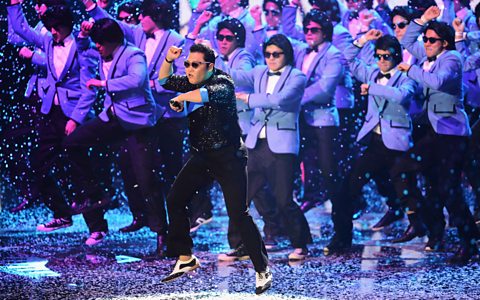
Today, K-pop continues to attract new audiences, through the power of social media. Popular groups such as BTS, BLACKPINK and TWICE can use platforms to easily connect with their millions of K-fans and firmly position themselves as some of the world’s most beloved K-pop idols.
3. What are some of the main features of K-pop music?
There are lots of different elements in K-pop that go into creating these high energy performances, but are they and what is their purpose? Let's find out…
Choreography
One thing that sets K-pop apart from other musical styles is the big focus on choreography. In many music videos you will see groups dancing in a way that match both the style of the song and the branding of the musician. No simple ‘two-step’ will be found in K-pop choreography, with movements often involving precision, formation changes, synchronisation and above all else, energy!
Multilingualism
Many Korean pop groups and artists will incorporate The ability to speak, understand, or use multiple languages.within their lyrics. Whilst often a mixture of Korean and English, this extends to other languages such as Japanese or Mandarin. By incorporating multilingualism within their music and performances, artists can hope to connect further with their fans across the globe, which may bolster their appeal.
Visuals
In K-pop, a ‘visual’ typically refers to the artist or people who are viewed as the most striking in appearance, often aligning with Korean beauty standards, such as having a youthful appearance and ‘glass skin’. These individuals may be seen as the ‘face’ of the group or be featured more heavily on music videos. Though, it is not just physical appearance that contributes to the visual appeal of these K-pop idols, their individual talents of singing and dancing, along with their charisma on stage adds to their status.
K-pop idols
Whilst the Korean pop industry has made significant strides in recent years, so has the musical output of ‘idols’, mostly in the form of girl groups and boy bands. Whilst the definitive answer to ‘who is the biggest K-pop idol?’ is debated by K-fans, factors such as popularity, vocal talent, appearance and global recognition, can influence responses.
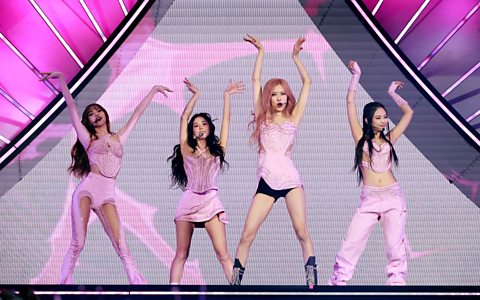
To become a K-pop idol, artists undergo vigorous training - sometimes taking years! This training incorporates elements of skill development in singing and dancing, as well as lessons in public speaking, learning modern foreign languages and how to build and sustain a positive personal brand. Some of the most popular idols include Junkook from BTS, Jisoo from BLACKPINK and Hyunjin from Stray Kids.
Fun fact - The fastest time to reach one million followers on TikTok is 2 hours and 18 minutes, achieved by K-pop artist, LISA. (Talk about being pop-ular…)
4. The power of K-pop beyond music
The popularity of K-pop idols is not just limited to the music industry and has firmly embedded itself as a cultural phenomenon. It’s standing has generated more interest in Korean culture, fashion and cuisine which has spread worldwide. Moreover, the popularity of this sensation has led to more people taking an interest in learning the Korean language, with many fans using it to help them better understanding of the lyrics and to connect more with Korean culture.

The influence of K-pop can also be seen on screen across the globe, with some idols starring in A Korean drama, specifically a television programme produced in South Korea that are in the Korean language. and inspiring musical animations. One example that seems to have taken centre stage is the animated film 'K-pop Demon Hunters' in which the two fictional groups (the Saja Boys and Huntr/x) have topped the charts in the United States with the songs 'your idol' and 'Golden' beating the records of real-life K-pop groups! Clearly the Korean pop music genre is just as powerful in fiction as it is in reality.
5. K-pop terms you may not have heard of
- Aeygo – When an idol acts cute.
- Bias – A fan’s favourite member of a K-pop group.
- Bias-wrecker – A member of a K-pop group that makes fans question their favourite member or steals away attention.
- Comeback – When a K-pop group or artist releases new music.
- Maknae – The youngest member of the group.
- Nugu – A new or relatively unknown group or artist.
- Stan – An enthusiastic or dedicated fan.
- Visual – A member of the group known for their appearance, usually based on Korean beauty standards.
So, if you ever find yourself wondering “is K-pop any good?” we may be bias-ed, but we’d certainly think so!
