What is this poem about?

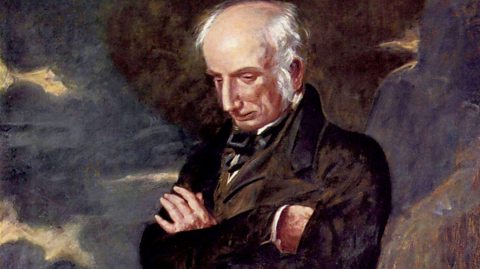
The Prelude is an A description of a person’s life written by that person. poem written by William Wordsworth.
Wordsworth began writing The Prelude in 1798 and continued to add to and edit it throughout his life.
He never completed it, and it was published after his death in 1850.
Extract from the Prelude is a short section from this A long poem which tells a story. and is about Wordsworth’s memory of stealing a boat as a child.
Comparing poems: 'Extract from the Prelude' and 'Exposure'
Listen to a podcast comparing 'Exposure' by Wilfred Owen and 'Extract from the Prelude' by William Wordsworth.
ANNOUNCER: BBC Sounds: music, radio, podcasts.
[music plays]
TESTAMENT: Hello and welcome to the Bitesize poetry podcast. I'm Testament, a writer, rapper and poet, and in this series I'm talking poetry. In this episode we're comparing 'Exposure' by Wilfred Owen and an extract from 'The Prelude' by William Wordsworth. We're looking at language, form, structure, theme and context – some of the things you will need to write about in your exam. Make sure you've listened to the first three episodes in this series on BBC Sounds 'cause this is where we take you through the basics.
[music plays]
TESTAMENT: Today, though, I am joined by poet extraordinaire Owen Sheers, who is gonna help us compare the poems. What's up, Owen? Are you good?
OWEN: Hey, Testament. I'm very good. Thanks for having me here.
TESTAMENT: Absolute pleasure. We're gonna talk through three key points today: the theme of the power of nature; technique – both poems use personification to show that power; and how the narrators in each poem respond to that power. Right, first, let's just quickly run through what these poems are about. Both 'Exposure' and 'The Prelude' are autobiographical. They are based on the poet's lived experience. Wilfred Owen, who wrote ‘Exposure’, was a war poet and died in World War I. Owen, what happens in ‘Exposure’?
OWEN: 'Exposure' is about a group of soldiers in the First World War in the trenches. But what Wilfred Owen writes about is not a moment of fighting; it's a moment of waiting. And it's in the middle of winter. So what they're really suffering from is that extreme cold and that fear of what's to come.
TESTAMENT: I'm gonna talk now about William Wordsworth. William Wordsworth was a romantic poet. The Romantic Movement happened in literature, art and music in the late 18th and early 19th centuries, and one of its main themes was nature and the power of nature. Remember to check out the Bitesize website for loads more information on the Romantic Movement.
You don't need to know everything about ‘The Prelude’. Owen, can you tell us what happens in this extract?
OWEN: So, essentially, we've got Wordsworth as a young boy. He borrows/steals a boat.
TESTAMENT: Cheeky.
OWEN: Very cheeky. On the lake. And at the start of this extract, you know, nature feels quite safe. But as he rows out across the lake the mountain peaks start to rise above him. And he finds it quite frightening.
[music plays]
TESTAMENT: Okay, now we've got some context, let's get into our first key point, because while 'Exposure' is a war poem and 'The Prelude' is a romantic poem, both of these poems are about the power of nature. The first quote I wanna talk about is from the first line of Wilfred Owen's ‘Exposure’: 'Merciless iced east winds.'
OWEN: It's a really strong first line, isn't it? Because it sets us immediately in that cold winter landscape. It's the sound world of this first line. If you listen to that, "The merciless iced east winds."
TESTAMENT: There's a lot of "sss" going on.
OWEN: A lot of "sss". It feels like those really cutting winter winds.
TESTAMENT: And in 'The Prelude' we've got the speaker out in nature, but nature is something huge and scary. This is a great quote: "The grim shape towered up."
OWEN: Yeah. And it comes in the middle of this extract. And it's as if the line itself suddenly rises up. He says "towered up." You see all of your associations with towers, but you feel as if all the towers you've ever known have suddenly got movement. So, you know, even as I'm talking to you I'm sort of leaning back 'cause it's as if something huge is rising in front of me.
[music plays]
TESTAMENT: [makes rapping sounds] Okay. So, for our next key point we're staying with the mighty power of nature. And we're building on that, because both poems share a technique. They both use personification to show this power. Owen, can we dig more into personification?
OWEN: This is a device that poets use. And what they do, essentially, is they give something that isn't human, like a cliff or the wind, they give this non-human element human qualities.
TESTAMENT: I love the personification in ‘Exposure’. You've got "air that shudders". You've got "mad gusts". Obviously, gusts of wind, but they can't be mad or, you know, lose sanity. You know what I mean? "Mad gusts." And then, of course, that first line that we talked about, "the merciless iced east winds that knive us." It's like a person, isn't it?
OWEN: That personification, it builds on itself. So first of all the wind is "merciless," which—
TESTAMENT: What does "merciless" mean?
OWEN: To act without mercy. So, with real intent to cause harm. And this is—
TESTAMENT: And no-, no kindness there being shown.
OWEN: Exactly. No kindness. Kind of a relentless cruelty. But then it-, the line continues to say that the wind is "kniving" us. "The merciless iced east winds that knive us."
TESTAMENT: Ouch.
OWEN: Yeah, exactly. So you're feeling that pain. But also what's interesting is that you're probably coming to this poem knowing it's about the First World War; you're expecting the violence to come from the fighting in the war. And here it is: it's coming from the wind. 'Cause really, we know the wind isn't choosing to be cruel, it's not choosing to hurt them. But in the poet's way of describing this moment it feels as though everything is out to get them.
TESTAMENT: And in ‘The Prelude’, about halfway through, something really interesting happens. And nature, which has been fairly normal so far, suddenly changes. And we get this mountain that turns into a person and starts coming for him. We get lines like, "Up reared its head." So, lifted his head. And "towered up." And this great quote, "Strode after me." Imagine that. A mountain striding after you. To be clear, a mountain hasn't actually turned into a person. This isn't a horror movie. This is a literary device.
OWEN: So he's rowing out into the lake. And as he does, the mountain appears – as you say, appears – to rise up. It's not really rising up. Wordsworth uses personification in all the ways that you've spoken about to really turn the volume up on that sense of awe and fear. You know, so the idea of it striding after him I'm sure is again the poet projecting their own guilt upon the mountain.And the way that he describes it that really works for me is using this word "towered". It's a very powerful, visual word, isn't it? But it's a moment that also marks a turn in the poem, doesn't it? A shift—
TESTAMENT: It's like there's a-, it's like a gear shift. It's like all of a sudden it's one kind of speed or tone and then… twitch.
OWEN: It is, it is. And if you want to in your exams, there's a really useful word that you can use here, which is "volta". So "volta" is the Italian word for a turn. And it's become the term that people use for that shift in a poem.
[music plays]
TESTAMENT: For our final comparison we're gonna talk about how the narrators in both these poems feel about the power of nature – because they have different responses, don't they?
OWEN: Yeah, they do. I think from the very start of 'Exposure' you can tell that they feel hopeless. And that it isn't just them. You know, all the way through the poet is using the collective pronouns of "we" and "our" and "us". Whereas in 'The Prelude' there's a shift. At the start there's a real confidence in the young Wordsworth as he nicks the boat, you know, and he feels quite comfortable in nature. But then as he rows out into the middle of the lake there's a real shift and he experiences that awesome power – that dark awesome power.
TESTAMENT: Yeah, there's a great quote near the beginning of 'The Prelude' which sort of shows this sort of young arrogance. The speaker says, "Proud of his skill." But this pride crumbles when faced with nature. Let's pick out some lines from ‘Exposure’, because in that first stanza we've got the word "wearied" and towards the end we've got the line "we turn back to our dying." It's pretty heavy.
OWEN: It is. The volume is turned up on that. Now, of course, on the one level, you know, dying is natural, everything dies. But because of everything that's gone before we have to feel that there's a sense of pointlessness. These soldiers aren't just living in fear of the fighting and in the pain of the natural weather but essentially they're facing their own death.
[music plays]
TESTAMENT: Okay, so to wrap things up, let's go over what we've learnt today. Both poems are autobiographical. 'Exposure' is a war poem and 'The Prelude' is a romantic poem, but both share the central theme of the power of nature. In 'Exposure' the speaker is being battered by what?
OWEN: "The merciless iced east winds."
TESTAMENT: And in 'The Prelude' we've got this huge mountain.
OWEN: "The grim shape towered up."
TESTAMENT: Both use personification to create images that show this power. Again, "The merciless iced east winds that knive us." And the mountain that gets a head and legs in ‘The Prelude’?
OWEN: "Strode after me."
TESTAMENT: Yeah, "strode after me." And finally, in "Exposure", the speaker submits to this power all along. They are…?
OWEN: "Wearied."
TESTAMENT: While in 'The Prelude' the speaker starts off "proud of his skill," but ultimately they have to acknowledge the power of nature. Thank you, Owen. That was awesome.
OWEN: Thank you, Testament.
TESTAMENT: And thank you for listening to this Bitesize poetry podcast. And if you want to be proud of your skill, we've got plenty of podcasts to help sharpen you up. Just search Bitesize on BBC Sounds. Peace!
In the poetry section of your English Literature exam, you will be asked to compare two poems. Listen to this podcast to hear an example of how you could approach this task.
In this episode, writer and rapper Testament and poet Owen Sheers compare the poems Extract from the Prelude by William Wordsworth and Exposure by Wilfred Owen.
Listen on BBC Sounds
What is 'Extract from the Prelude' about?

Context
Extract from the Prelude is taken from Book 1 which is about Wordsworth’s childhood. The other books focus on different periods in his life, such as his time living in France or falling in love.
Wordsworth experienced lots of difficulties during his life. These included the death of both parents when he was young and the loss of two of his children. These experiences influenced the The Prelude.
Wordsworth grew up in Cumbria, spending much of his life there. The natural beauty of the Lake District inspired much of his poetry.
The Prelude is an epic poem made up of 14 books that Wordsworth wrote as his A description of a person’s life written by that person.. This means that the narrator and the writer are the same person in this poem.
The poem
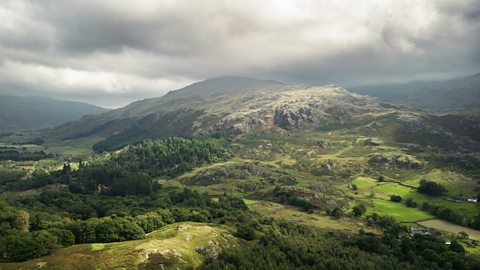
In Extract from the Prelude, Wordsworth describes stealing a boat when he was younger. He rows it out into a lake and sees a mountain which troubles him due to its sheer size.
At the beginning of the poem, Wordsworth is a confident young man, comfortable with his place in nature and his surroundings. He describes the beauty and peace of being on the water. However, there is a shift in mood when he comes upon a huge mountain and feels frightened by its size and the imposing power of nature it represents.
In the poem, he cannot stop thinking or dreaming about the mountain in the days that follow.
Question
Extract from the Prelude, is from Book 1 of Wordsworth’s autobiographical poem. What does Book 1 focus on?
Answer
Book 1 focuses on Wordsworth’s childhood and his time in school. Book 2 continues to focus on his school days.
Themes
The power of nature
Wordsworth was a Romantic poet. This means that he wrote during the Romantic era in the late 18th and early 19th century. The rapid Changes in the way products are made, usually involving factories where the work is increasingly done by machines. of towns and cities inspired many artists and poets to seek escape. They focused on topics like nature, creativity and individuality, often while still hinting at the hardships and difficulties faced in everyday life.
Extract from the Prelude is a Romantic poem as it focuses on nature’s beauty and power.
An important feature of Romantic poetry was the The impact that art, nature or beauty can have on an individual.. The ‘sublime’ refers to the intense feeling of awe that art, nature or beauty can inspire. In Extract from the Prelude, Wordsworth’s feelings of powerlessness inspired by the mountain are an example of the sublime.
The experience could be something artistic, natural or spiritual. For instance, in Extract from the Prelude, the sublime can be seen when Wordsworth sees the mountain and remarks:
The horizon's bound, a huge peak, black and huge,
As if with voluntary power instinct,
Upreared its head.
Inner conflict
Wordsworth is not in physical danger but is still affected by the imposing presence of the mountain. He describes it as a “grim shape” that “towered up” over him, suggesting the feelings of fear and insignificance he felt in its presence. He repeats “huge” twice in one line to emphasise his shock.
He also describes how there “hung a darkness” over his thoughts for days afterwards. This could also be a Words or phrases that describe something by saying it is something else. for the shadow the mountain created on the natural landscape.
The fact that Wordsworth is so affected by something which cannot harm him suggests that he is experiencing a conflict between emotion and reason.
It can be inferred that Wordsworth uses the mountain as a metaphor for A term for situations or events that cause feelings of fear, humiliation, vulnerability or rejection. because he cannot forget the impact it has on him. Likewise, the experiences of death that he has experienced during his lifetime were a trauma he couldn’t forget.

Memory
The fact that Wordsworth chose to recount this experience of encountering the mountain suggests that the memory is very strong. Even though, at first, it might seem like an insignificant event to the reader.
Wordsworth remembers the discomfort he felt more than the beauty of the lake and mountain. He says that, after being out on the lake, he recalls that the mountain:
moved slowly through the mind
By day, and were a trouble to my dreams.
The fact that the mountain is even present in his dreams highlights how strong the memory is, and the power of nature’s effect on hisA term for the mind’s deepest thoughts, feelings or beliefs.. Wordsworth does not, or perhaps cannot, explain why the mountain disturbed him so much, but he can remember how it made him feel very clearly. He is reflecting on the power of emotion to evoke memory.
Mini quiz
Language
Figurative language is language which uses a non-literal meaning, examples include similes and metaphors.
Figurative language is used throughout Extract from the Prelude to describe the nature surrounding Wordsworth.
Activity
Read the quotations below and then the interpretations that follow.
Structure
In poetry, structure is anything to do with the layout and organisation of the poem.
Juxtaposition
To place two contrasting things closely together. is when two contrasting things are placed close together.
The first part of this poem is full of positive words to describe Wordsworth’s excitement at stealing the boat. For example, “home”, “pleasure”, “glittering” and “sparkling” create a positive Semantic field refers to groups of words which have similar meanings or are about a similar topic. that highlights the beauty of the natural world.
The second part of the poem has a darker, more serious feel. Wordsworth uses a negative semantic field to show the mountain’s impact. Words such as “grim”, “trembling”, “grave” and “darkness”.
This juxtaposition highlights the insignificance of humans in comparison to nature. There is also a juxtaposition between the positive and negative feelings that nature can inspire.
Volta
A volta is a dramatic change in thought or emotion. In Extract from the Prelude, this happens at the halfway point when the positive semantic field turns negative.
Wordsworth initially describes the beauty of the lake and his enjoyment as he rows across it. However, when he sees the “huge”, “black” mountain, the tone shifts and he starts describing his discomfort.
Form
In poetry, form refers to the type of poem that the poet has chosen to write.
Epic poem
The Prelude in its full form is an epic poem. This is a long A story. poem which tells a story, usually about an adventure. Epic poems, particularly in Romantic era, were often based on historical events or mythology.
Blank verse
Extract from the Prelude is written in Unrhymed poetry which uses a certain number of beats per line.. This means that it does not rhyme but does use a set number of syllables per line. This creates a more free, narrative effect – like Wordsworth is telling a story, unrestricted by a rhyme scheme.
Mini quiz
Top Tips (Edexcel)

Remember
Read the question carefully. Highlight the key words and focus of the question.
Make a plan. technical language relating to a particular subject. For English Literature, this includes words relating to language, structure and form techniques such as ‘metaphor’, ‘pronouns’, ‘ellipses’ and so on the poem or create a short list of points you could make, supported by evidence. This will help you to stay focused and relevant.
Analyse features. When you identify a feature, always consider why it has been used and what effect it creates.
Reread your answer. Keep checking that you are on topic throughout the writing process.

Making comparisons
You will need to write your response using comparative connectives, such as:
Similarly
Likewise
However
In contrast
In the exam
This poem could be assessed in the anthology poetry part of the exam.
You will be asked to compare a named poem with a poem of your choice.
The choice must be from the cluster of poems you have studied. The named poem will be provided.
This question assesses AO2 and AO3:
| AO2 | AO2 assesses your ability to explore the language, form and structure used by a writer to create meanings and effects. |
| AO3 | AO3 looks at how you can link the contextual background of the poem(s) into your ideas. |
Quiz
Test your understanding of this Extract from the Prelude by taking this quiz.
GCSE English literature revision podcasts. audio
Whether you're at home or on the go, listen to these podcasts by Bitesize and BBC Sounds to refresh your memory of key texts.

More on Poems
Find out more by working through a topic
- count5 of 5

- count1 of 5

- count2 of 5