Fun fact!
The longest word in any major English dictionary is 45 letters long! The word is pneumonoultramicroscopicsilicovolcanoconiosisand it is the name of a medical condition caused by breathing in particles of volcanic dust.
If you look closely you can spot several different words hiding in this colossal word. See how many words you can spot.
Introduction to memorising tricky spellings
Over the last one thousand years English spelling has been influenced by lots of different languages, including French, German and Latin. Because English has borrowed words from other languages, lots of complex spelling patterns have developed.
There are many different reasons a word can be tricky to spell. For example:
- Words can have silent letters, like the letter ‘b’ in the word ‘subtle’ and 'k' in 'knight'.
- Some words might have double letters that you also cannot hear, for example, in the words ‘disappoint’ and ‘accommodation’.
- Some words don’t follow a pattern or spelling rule, for example, the word ‘ancient’ does not follow the rule ‘i before e except after c’.
- Words which sound the same but have different spellings and meanings. might lead you to use the wrong spelling in your writing - for example, confusing the words ‘your’ and ‘you’re’.
Tools to help you remember spellings could include A pattern of letters, words, ideas or associations which help with memorising something., A poem or word puzzle in which the first letter of each line spells out a particular word or phrase., words within words and sounding it out.
A video about tools for tricky spellings
Learn how to use tools and techniques to help you memorise tricky spellings
The English language is thousands of years old and has borrowed words from Latin, French, German; the list goes on. This means a lot of words can be pretty difficult to spell.
There are plenty of weird and wonderful ways to help you remember how to spell these words. Whether they have letters that work in unusual ways. Accidental! Or they have silent vowels like 'Friend' or silent consonants like 'Gnome'.
Another word with a silent consonant is 'Mnemonic'. What does that mean? A mnemonic is a tool that helps you memorise something specific, like how to spell a word. M for memorise. M in mnemonic. You’ve got it! And there are loads more.
An island is land surrounded by water. The CIA are special agents.
You can also use an acrostic; a phrase you create from the letters that make up a particularly difficult word. For example, Rhythm. R-H-Y-T-H-M: Rhythm Helps Your Two Hips Move.
"I’ve got one. Big Elephants Can Always Understand Small Elephants. B-E-C-A-U-S-E."
You’ve got the hang of it. And you can create your own acrostic or mnemonic for any words that you find difficult to spell.
But there are some tricky words that acrostics might not work for.
"Are there?""That’s one.""What?""There."
Their, they’re and there are homophones; words that sound the same but have different meanings. And different spellings, so how are we ever going to remember those three?
A mnemonic of course.
*"Go on then.""Their is a possessive word, it has the word 'heir' in it, which is someone who may inherit lots of possessions.""Ah, that is helpful.""There has the word here in it, both refer to a place. You can even replace there in a sentence with the word here and it would still make sense.""Finally, they’re is the simplest. It’s short for the words they are.""Wow, I think I’ve got it now.""Great."
And when the words aren’t homophones, sounding out techniques can help.
"So, you mean saying it as you spell it.""Exactly. For example, you say Wed, W-E-D, nes, N-E-S, day, D-A-Y. Wednesday.""But that makes words sound ri-dic-u-lous.""But it helps you re-mem-ber.""True."
So, if you run into any difficult words, try out those mnemonics or try sounding it out.
"O-kay."
Mnemonic
A mnemonic is a tool that helps you to memorise something specific, like how to spell a word.
For example, the following is a mnemonic for the word ‘necessary’:
‘one collar and two sleeves’.
This mnemonic could help you remember that the word ‘necessary’ has one ‘c’ and two ‘s’s’, which are the tricky parts of this spelling.
Mnemonics can also be used to remember tricky homophone spellings. For example, ‘their’ is a possessive word - it has the word ‘heir’ in it - which is someone who may inherit lots of possessions.
Acrostic
You can also use an acrostic - a memorable phrase you create from the letters that make up a difficult word. Each word of the phrase begins with the letters of the word. So if you can remember the phrase then you can spell the word.
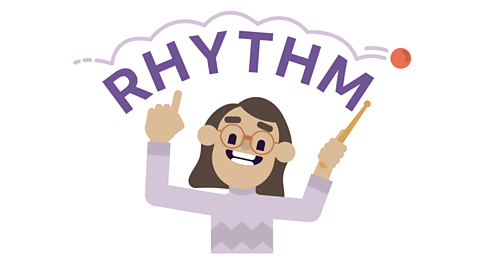
For example, for the word 'rhythm' take the letters 'R - H - Y - T - H - M' and make the phrase 'Rhythm Helps Your Two Hips Move'.
Rhythm
Helps
Your
Two
Hips
Move

Make your own acrostics
Have a go at creating your own acrostics for these tricky spellings:
- definitely
- embarrass
- sincerely
Words within words
It can also be useful to remember shorter words within the tricky spelling.
For example, the word ‘bra’ in library is a memorable way to remember the tricky part of this spelling.
It’s also useful to remember that the word ‘independent’ has the following smaller words inside it: ‘depend’, ‘dependent’, ‘dent’.
The word ‘conscience’ can be tricky to spell. However, if you remember to always include the word ‘science’, it becomes easier to remember the correct spelling.

Find the words within words
Which words can you find hidden within the tricky spellings?
- cupboard
- believe
- environment
- business
- shepherd
- cup - board
- be - lie - ve
- env - iron - ment
- bu - sin - ess
- shep - herd
There are even more than the answers shown, did you find any of the others?
Sounding it out
It can be helpful to sound out the tricky parts of a word, for example ‘Wed-nes-day’ or ‘Feb-ru-ary’. The word isn’t usually said like this, but giving emphasis to the sound can help it stick in your memory.
Sound out these words
Break these spellings into syllables and sound them out.
- mortgage
- colonel
- excited
- yoghurt
- mort - gage
- col - o - nel
- ex - ci - ted
- yog - hurt
The parts in bold contain the common mistakes that can be avoided by sounding the word out.
How to practise spelling
- Put aside time to work on difficult spellings.
- Everyone has some words that they find tricky to spell. Create a list of the words you personally find tricky.
- Invent your own tricks for remembering these words.
- Test yourself to check your progress.
- Come back to the lists regularly to make sure you can still remember the correct spellings.
Test your knowledge
Revise for your exams with BBC Bitesize
Get ready for the GCSEs with quizzes, past papers, flashcards, podcasts and more resources!

More on Spelling
Find out more by working through a topic
- count5 of 5
- count1 of 5

- count2 of 5

- count3 of 5