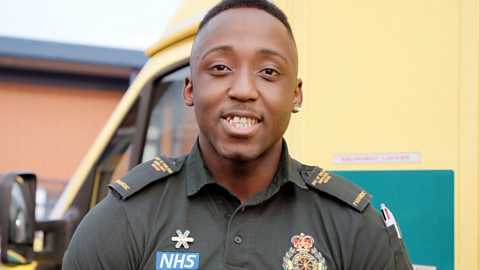
Meet Ray, who works alongside paramedics on emergency call-outs. Part of our Bitesize world of work series.
Ray
I'm Ray, I'm 26 and I'm an emergency medical technician with the ambulance service.
My first ever experience in an ambulance was when I was six years old. I just remember playing with my friend and wrestling and I jumped off the bunk bed, sprained my ankle. I ended up hopping home and my mum ended up calling an ambulance for me. The man that came for me, he scooped me up in his arms, carried me to the ambulance and I thought wow, this is what I want to do.
An EMT is an emergency medical technician who works alongside the paramedic. However, the paramedic would be the senior clinician on the vehicle. They can administer more drugs and provide more advanced airways to a patient in an emergency setting.
A lot of the times you would be assisting them in providing safe and effective treatment. We will go out to all sorts of jobs, whether that be an elderly fall or a major incident, such a large-scale road traffic collision. Every morning at the start of the shift, it's vital to make sure everything is working and we have the correct amount of stock levels. All the checks are all done. Vehicles all good to go.
Ray's colleague Rob "And the monthly drug expiries. Have they been done? So we know what we’re doing with the drug expiries, the pouches?"
Ray "Yeah."
Rob "Right. Okay. Thanks for that."
Ray
People know that as soon as you have that uniform on that they are able to look up to you as a symbol of help.
Ray to patient "You’ve been very, very brave haven’t you. Aw, look at that superstar sticker."
Rob
Ray’s excellent. He’s good at reassuring people. He can talk to people at their level. Doesn't matter what background, where they've come from, he’s good with everybody.
Ray
Prior to joining the ambulance service, I was doing a lot of volunteering with the British Red Cross. That then made me want to help people on a regular basis. In order to become an emergency medical technician, you need five GCSEs including Maths, English and Science. It's important to be flexible and adaptable as the role that you will be coming into is ever changing and it is dynamic.
Being an EMT has taken me on many journeys and this has opened my eyes up to valuing not only my friends, my family, but also life in general.
People know that as soon as you have that uniform on, they are able to look up to you as a symbol of help.
- EMTs (emergency medical technicians) like Ray work alongside paramedics on ambulances. They attend the same call-outs as paramedics, but the paramedic is the senior medic. This means there are some tasks the paramedic will do instead of the EMT, such as giving certain types of drugs to patients
- Ray was inspired to work on ambulances when he hurt himself as a child and a paramedic was called out to help him
- He volunteered with the British Red Cross, which made him want to help people on a regular basis as an EMT.

Another name for Ray's role is an emergency care assistant.
What to expect if you want to be an emergency care assistant
- Emergency care assistant average salary: NHS band [3-4]. Read more about NHS bands. Salaries will differ in private healthcare
- Emergency care assistant typical working hours: 37 to 42 hours per week. You work shifts, which could include evenings, weekends and bank holidays.
What qualifications do you need to be an emergency medical assistant?
You could get into this role via an apprenticeship, a college course (such as a T-level – England-only), or by applying directly if you have relevant experience.
Sources: National Careers Service, NHS Health Careers, GOV.UK.
This information is a guide and is constantly changing. Please check the the National Careers Service website and the NHS Health Careers website for the latest information and all the qualifications needed and the GOV.UK website for more on T-levels.
For careers advice in all parts of the UK visit: National Careers Service (England), nidirect (Northern Ireland), My World of Work (Scotland) and Careers Wales (Wales).
Work experience in your area
Find work experience placements with Workfinder.
Tips and advice
Help with interviews, writing a CV and all things work experience related.
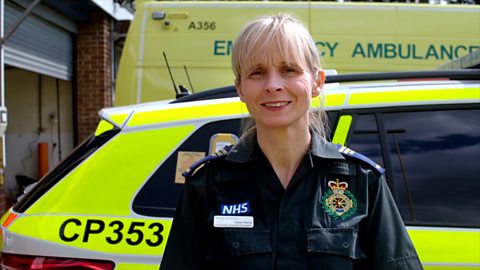
Sara: community paramedic. video
Sara's a community specialist paramedic.
Laura: 999 call taker. video
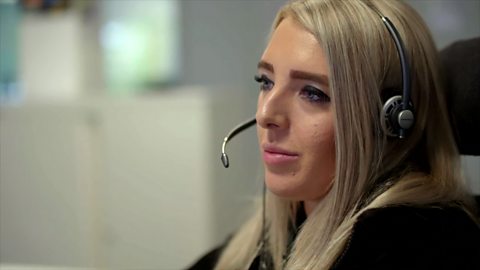
Laura and her colleagues are the first people you speak to if you call an ambulance.
Tanoh: paramedic. video
Tanoh's a paramedic in the NHS.