What you need to know about GCSEs
A major part of the education system in England, Wales and Northern Ireland for decades – no matter what secondary school you attend, you’ll likely have heard of or soon learn more about GCSEs. An essential part of Key Stage 4, the academic qualification has been taken by millions of students through the years, preparing them for their next steps in higher education or beyond.
There are a number of GCSE options you can take. Some core subjects are compulsory, whereas others, depending on your school, you can make your own decision to study.
But when did they originate and why are they so important? Here, BBC Bitesize takes a closer look at GCSEs, from when they started to what to expect in 2026.
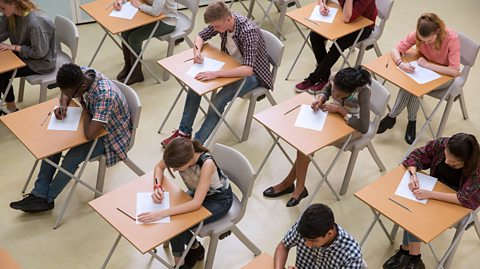
What is a GCSE and what does it stand for?
A GCSE is an academic qualification taken by teenagers, usually around the age of 15 and 16, to mark their graduation from the Key Stage 4 phase of secondary education in England, Northern Ireland and Wales. In Scotland, GCSEs are not common, and the closest equivalent is a National 5 qualification.
GCSE – which stands for the General Certificate of Secondary Education - is usually taken by students in Year 10 and 11 in England. Assessing your knowledge and skills, you can gain a GCSE qualification in various subjects, from Spanish to maths to history, art, computer science, religious studies, P.E. (physical education) and many more.
A great opportunity to explore what you’re interested in, when you choose your options varies depending on your school. Some secondary school students choose their options in Year 9, while other schools will ask you to start thinking about them a bit earlier.
What year did GCSEs start?
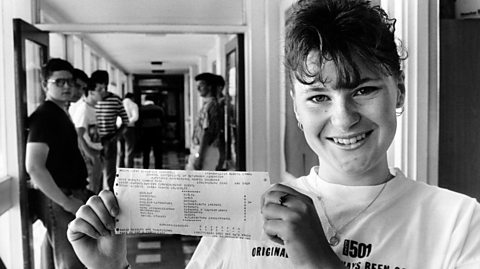
It may feel like they’ve been around for much longer – but pupils didn’t start taking GCSEs until the 1980s.
Introduced in September 1986, the first GCSE exams were not taken until 1988. Announced in 1984 by then Education Secretary Sir Keith Joseph, at the time GCSEs were a new system that “put all children on the same scale on a range of seven grades from A to G.”
GCSEs – a new qualification for school students
Originally broadcast on 19 June 1986, this BBC Archive video captures students first impressions of the then new GCSE exams. The footage was filmed at a school in Bracknell, Berkshire, for BBC's Breakfast Time show.
GCSE's marked a shift to more practical learning, with the qualifications going on to replace O‑Levels and CSEs in England, Wales and Northern Ireland in September 1986. This footage was filmed just months before the change.
BBC Archive offers a unique collection of thousands of archive films, capturing life and events across the UK since the 1940s.
Reporter begins their voice over on the news segment
They said: "There is now little doubt that the preparation for the GCSE will go ahead in September. Next year's fourth years face two years of continual assessment and a completely different style of study, with the emphasis on gaining practical experience. For years, education has centred on the blackboard."
Cuts to teacher pointing at the blackboard at the front of the classroom, teaching pupils
The teacher said: "We're actually looking at the ratio of the lengths. Then, Nazia, what would you use as the simplest form?"
The pupil replies: "5:6."
The reporter continues to narrate over the footage: "But even if it was boring stuck behind a desk, everyone knew what the O-levels and CSEs involved, and there was the security of knowing that thousands had already survived the ordeal. Now, third years feel the future could be an unknown quantity."
Cuts to classroom where pupils are being interviewed
In front of the class, a teacher said: "You, as young people, are very lucky."
The reporter continues to narrate over the footage: "These pupils at Garth Hill School in Bracknell are being briefed on the new system."
Pupil one said: "Well, I'll feel a bit apprehensive at first, but everybody in the country is doing it. So we're all in thesame boat."
Pupil two said: "I think that the examiners will be a bit lenient when giving grades because we'll be thefirst through."
Pupil three said: "I think it's a good idea because the CSE was underrated. Now this exam brings the O level and CSE together."
Reporter asks the classroom: "Do you think the lessons will now be more enjoyable?"
Pupil four said: "Yes, I think the lessons will be much more enjoyable as there'll be a lot more practical work in the lessons. Less of teachers telling the pupils what to do from a blackboard, and more of the pupils actually involving themselves with the class activities."
Pupil five said: "Because when you're writing off a blackboard, you don't really take it in, but when you're actually doing the experiment or practical, you always sort of think of what you're doing and you always know."
Reporter asks the classroom: "What do you think of the continual assessment?"
Pupil one said: "I think it's a good idea because it gives us more of a chance throughout, the whole course and it's not all relying on the last exam."
Pupil two said: "I think it's much better because when you're going to an exam normally you go in and you think 'oh no it's the exam' and you're really nervous. But with being assessed over the year and you're given a grade and then going into the exam if you still you know sort of make a mess up of that you've got the assessment grade to fall back on."
Reporter continues: "Do you think the new exam is going to help your job prospects?"
Pupil four replies: "Employers can see that everybody's done the same exam and everybody will get a fair chance of getting the job."
Pupil five said: "I think it's very much better because the employers will all know and then instead of just forgetting people with CSEs, they'll have to actually look at them."
Camera cuts to reporter interviewing businessman John McGill
Reporter narrates: "John McGill is responsible for recruiting new employees at 3M, one of Bracknell's biggest employers."
John McGill said: "Well, I think it'll be a bigger improvement over the previous two exams in that it brings them together. And employers, I think, have always had a problem in accepting the CSE examination. I think mainly because it wasn't sold properly, it wasn't marketed properly to the parents and the employers. I think, in fact, it was a very good basic exam, particularly for those with a practical bent. And I think the GCSE, in bringing together the theoretical and the practical sides of the GCSE and the CSE will make a very good product."
Camera cuts to another teacher leading a music lesson in the classroom
The teacher said: "Right, I'd like you to copy from the board, please, and do the exercise which I'll put up for you when you have finished, ok?"
The reporter narrates: "It's hoped that throughout, the GCSE will give pupils a sound background education that on its own will be relevant to modern-day needs. An example is the music lesson. Out goes the history of Beethoven and Mozart, and in comes 12-bar blues and improvisation. A welcome change for the pupils - f not the teacher."
End of news segment
What came before GCSEs?
While GCSEs have been a part of secondary education for decades now - your parents, grandparents and even teachers will remember their qualifications being different during their time at school. When GCSEs were introduced in the 1980s, it saw O-Level and CSE exams be abolished.
In 1984, Education Secretary Sir Keith Joseph said: “The system we propose will be tougher, but clearer and fairer. It will be more intelligible to users, better than O Levels, and better than CSE. It will stretch the able more and stretch the average more."
The General Certificate of Education (GCE) Ordinary Level, or O Levels for short, were academic qualifications introduced in the 1950s. An O Level would, like GCSEs, prepare you for the future and further education, acting as a pathway to A-levels (Advanced Level), which students usually take in their later teens.
The Certificate of Secondary Education, also known as a CSE, was developed in the 1960s, so students could take formal exams and receive certificates at the end to prove they had studied to that level of education. Assessed by a combination of coursework and exams, pupils could gain CSEs in both academic and vocational subjects.
Even today, taking A-levels into higher education is not the only route to success. A vocational qualification, which blends theory and practical learning, can often be the best of both worlds.
What GCSE subjects do I have to take?
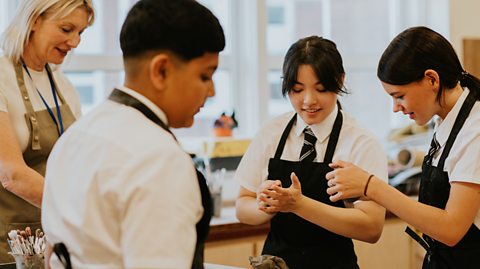
Usually, you can expect to take around nine subjects at GCSE – a number being compulsory subjects and others you will have the option to choose. In England, it is compulsory to take what is known as the core GCSE subjects, which are English, maths and science.
English language is compulsory in all schools and so is English literature in most schools in England, but there can exceptions. When it comes to science, it may be split into the three separate sciences (biology, chemistry and physics) or into two combined science GCSEs.
Sometimes, schools have other subjects that are compulsory, so it is always best to check before you start your GCSE qualifications. While the core GCSE subject must be done by all in England, you can also have fun choosing other subjects that you love.
You could study a modern foreign language, delve deeper into a humanity subject or get creative in the arts. Many schools also offer GCSEs in technical subjects and while all students must do PE in years 10 and 11, you can also take it as a GCSE option.
How are GCSEs graded?
How GCSEs are graded has changed a fair bit in recent years. In England, Northern Ireland and Wales, GCSEs are graded differently and in Scotland, there is a different qualification awarding body, known as Qualifications Scotland.
All GCSE subjects in England have been graded 1-9 since 2020, replacing the old A-G system. In the new system, 9 is the highest grade and 1 being the lowest, while U means "ungraded".
In Northern Ireland, grades are A* to G, with a new C* grade being introduced in 2019. Welsh GCSEs are graded A* to G – but some GCSEs are modular, meaning you have assessments throughout the year, whilst other GCSEs are linear, meaning you take all exams at the end of the course.
Why do I need GCSEs?

Part of the National Curriculum, GCSEs assess your knowledge and skills in various subject areas and are very much part of secondary school life. Choosing your options or officially starting your GCSEs can feel scary at first – but it is a great opportunity to shape your own future and pursue your passions and interests.
The qualifications are essential to further education and career development - and everything you learn and pick up along the way will help get you one step closer to your next chapter and dreams.
When do GCSEs start in 2027?
GCSE results day 2026 takes place on Thursday 20 August. And Bitesize has put together a guide of everything you need to know.
As for 2027, the official dates are yet to be announced - but are usually scheduled between the months of May and June. Exam dates are set by each exam board, but they might change closer to the exam period.
But don’t worry, as BBC Bitesize has you covered when it comes to learning, revision and exam resources and all things GCSE here.
This article was written in November 2025 and updated in August 2026
