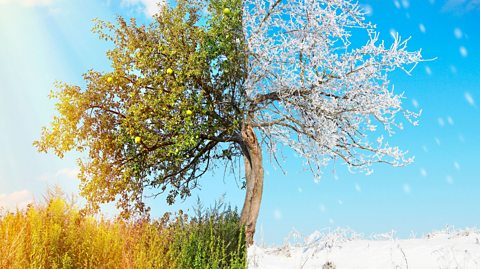
Some seasons tend to naturally speak to us more than others.
But regardless of whether you’d rather be putting on a pair of sunglasses or pulling on your warm coat, have you ever stopped to think how the seasons might effect how our brains work?
Some studies suggest that different times of year could impact us in more ways that we may think. Join BBC Bitesize as we explore the relationship between the seasons and the psyche.
Favourite season for a reason?
Seasonal preference varies from person to person. While some dread the end of daylight saving time, others embrace the dark and cold times ahead. According to a 2021 YouGov survey, 7% of people in the UK identified as a ‘winter person’, whereas 33% described summer as their favourite season.
Meteorological seasons can be characterised in a number of ways, including cyclical changes such as light and temperature.
But these aren't the only factors, there are also cultural influences that come into play.
For people in the northern hemisphere, national holidays like Christmas are synonymous (snownonymous?) with winter, while an annual celebration like Bonfire Night goes hand in hand with autumn.
Seasons can also be defined by changes in our surroundings or the way they alter the routines in our life. For example, you may associate having a big clear-out with spring or a long break from school with summer.
As a result, some researchers believe both the seasonal shifts and the associations we have with different times of the year may have an impact on the things that people think, feel and do.

How can the seasons affect us?
From attention span to risk-taking capacity, research has found that the time of year can have an effect on many different aspects of the human psyche.
In 2019, researchers at Cornell University led an analysis of 765 million streams on the music service platform Spotify by people in 51 different countries. They identified a link between day length and the ‘intensity’ of the songs that were streamed.
While more relaxed songs were popular with places with shorter days, more energetic music was associated with countries that have longer days.
The team of researchers concluded that these results reflected variations in mood, ranging from danceable music in warmer times and regions, to more subdued tunes in cooler, darker places.
Some scholars believe that the seasons can also impact our cognitive performance and even our generosity levels. A 2018 paper found a rise in charitable contributions in countries with Christian traditions during winter. By analysing more than 50 million charitable donations across a nine year span in Sweden, they found a 14% increase in unsolicited donations occurred during December.
A spike of public goodwill during the winter months was also found in a 2014 paper by Bocconi University in Italy. Researcher A.E Greenberg found that people are also more likely to tip their waiters generously during the holiday season.
Do our preferences change with the seasons?
Further studies suggest that our fondness for different colours are altered by different times of year. In a 2016 study, psychologists assessed the colour preference of participants in the north-eastern United States during autumn, winter, spring and summer.
Results demonstrated seasonal shifts in colour preference, with autumn being the most dramatic of all. In contrast with their responses during the rest of the year, participants liked dark, warm colours, such as dark red and orange, more in autumn.
Researchers believe that the findings fits the theory of ecological valence theory, the idea that people’s preference for a colour is a function of how strongly they associate it with different objects or experience. They theorised that the preference for warm, dark colours in this case was likely to have been influenced by the colour of leaves in autumn.
So whether you’re eagerly awaiting pumpkin spice season or the longing for a winter wonderland, the time of year may have more of an influence on us than it may seem.
This article was published in February 2025
Quiz: Can guess the wintery location from the image?
Think you can locate a snowy location when you see one? BBC Bitesize challenges you to this quiz all about wintery scenes across the world!
What is an oasis? Five outstanding examples of oases from around the world
Join BBC Bitesze as we travel around the world looking at five different oases
Five fascinating fountains from around the world
From the tallest and longest, to water features that use technology to dance in time to music, BBC Bitesize takes a look at the world’s most fascinating fountains.