What do you know?
Where is Brazil?
Brazil is the largest country in South America. It shares a border with 10 different countries, including Venezuela, Colombia and Peru. Its coastline lies alongside the Atlantic Ocean.
Key points
- Brazil is the fifth largest country in the world by area. It spans both the Northern and Southern Hemispheres in the continent of South America.
- It is the sixth most Having a large population. country in the world. The capital city is Brasilia.
- The most populous city is São Paulo, with 12.3 million people.
- The major language is Portuguese and the major religion is Christianity.
Activity: Explore Brazil
What are the physical characteristics of Brazil?
Brazil is the fifth largest country in the world by size. It covers an area of 8,515,800 km², which is approximately 35 times greater than the size of the UK.
Brazil spans the equator. Part of the country is in the Any part of the Earth that lies to the north of the Equator. and part is in the Any part of the Earth that lies to the south of the Equator.. Brazil’s The average weather conditions in a location based on the average weather experienced there over a period of time. is largely Hot areas found within the Tropics of Cancer and Capricorn., although the north-east experiences drier weather and the south experiences cooler temperatures.
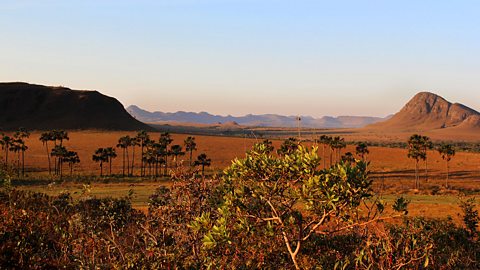
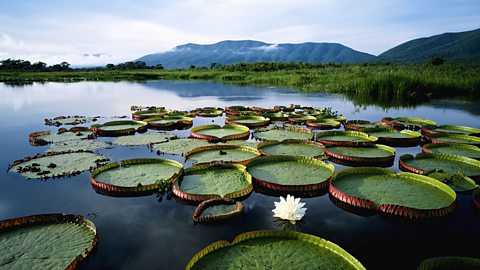
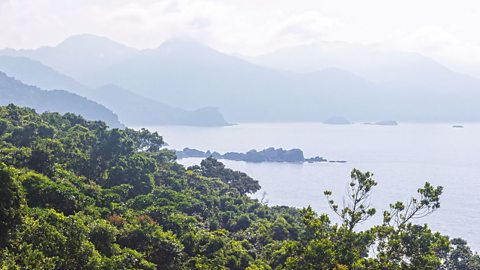
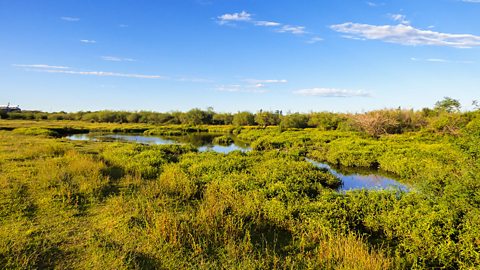
Brazil has six main A large region of Earth that has a certain climate and certain types of living organisms like a large-scale ecosystem eg. a tropical rainforest.:
- Amazon Rainforest
- Caatinga
- Cerrado
- Pampas
- Atlantic Forest
- Pantanal
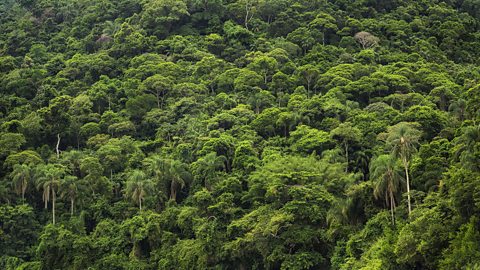
Image caption, Amazon rainforest
The Amazon is a tropical rainforest in the north west of Brazil. It is hot and wet all year round and is the largest rainforest in the world. Rainforests lie on or around the equator and have no distinct seasons.
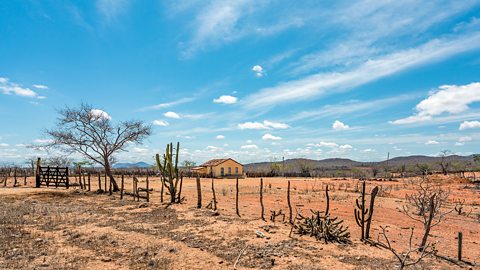
1 of 6
Question
Describe the distribution of Brazil’s biomes.
Brazil has six biomes.
- The largest biome is the Amazon rainforest in the north.
- The smallest biomes are the Pantanal and Pampas towards the south and west.
- Some biomes are coastal, such as the Atlantic Forest.
- Some biomes are inland, such as the Pantanal.
What are the human characteristics of Brazil?
Life expectancy and literacy rates
Brazil is the seventh most Having a large population. country in the world, with approximately 214 million people. The average age that a person is expected to live. This varies from country to country. is almost 76 years. The percentage of adults that can read and write. The literacy rate in the UK is 99%. are around 93 per cent, meaning most Brazilian people can read and write.
Population distribution
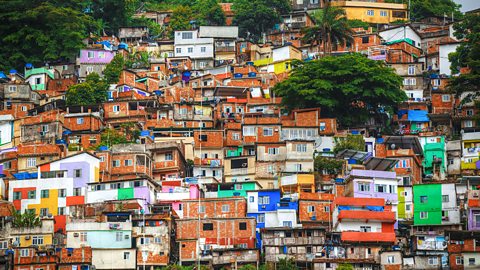
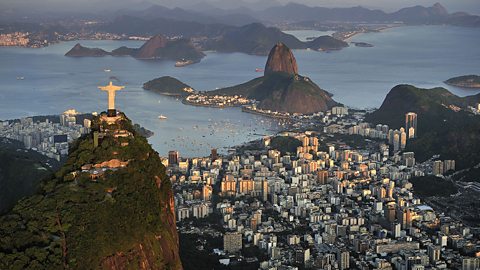
Most people live in the southeast of the country, with the highest numbers found along the country’s coastline. Around 87 per cent of Brazil’s population live in cities, such as Rio de Janeiro. Migration to these cities is popular due to job opportunities. However, many find themselves having to build informal settlements known as Informal housing built without permission and therefore neglected by the government., such as Rocinha in Rio de Janeiro. This type of housing is built without permission and is therefore illegal. It has resulted in the housing being unsafe and the residents lacking local services such as schools and hospitals.
Many of Brazil’s major cities are located along the coastline, including Rio de Janeiro (6.7 million people) and São Paulo (12.33 million people). Brasilia, which became the A city that is the administrative centre of a country. The country’s government may operate from the capital city, eg London. in 1960, lies further inland. This has the added benefit of being more Easy to reach, get or enter. for people around the country. Fewer people live in the northwest, where the Amazon rainforest lies.
Question
Describe the population distribution of Brazil.
Most people live in the south and east of Brazil. Greater numbers of people are found along the coast and around main cities, such as Rio de Janeiro and São Paulo. Few people live in the far north or west of the country.
Economy
Brazil is an upper Countries recognised by the World Bank as being neither high income or low income. This classification is reviewed yearly.. It is neither very rich nor very poor. It is also a An acronym of the countries experiencing fast economic growth. The countries are Brazil, Russia, India, China and South Africa. country, which means it is in a group of countries experiencing fast economic growth. Other BRICs countries include Russia, India, China and South Africa. Brazil is among the world's largest To sell goods to other countries and send them out of the country to them. The goods are known as exports. and To purchase (buy) goods from abroad and bring them into a country. The goods are known as imports.. Imports include petroleum oils and exports include soybeans, coffee and meat. Brazil is the largest exporter of beef in the world. Brazil’s main Countries that trade with one another. are China, the United States and the European Union.
Brazil’s international role
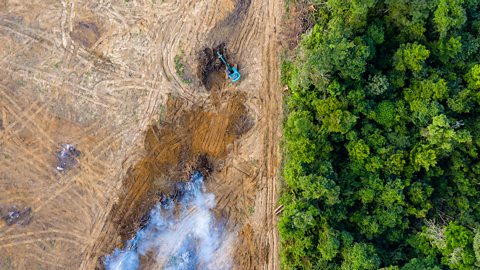
Brazil has been developing relations with some of the world’s strongest nations, such as the US and China. This is mainly due to Brazil’s power in global trade and energy issues. Brazil is the largest exporter of beef, coffee and soybean. This is also a major factor contributing towards The removal of trees. This is sometimes done to make land for farming, roads or settlement. and therefore makes Brazil a very important country when it comes to climate change.
Brazil was selected to host two major international sporting events:
- the 2014 World Cup (with 1 million visitors)
- the 2016 Olympics (with 6.6 million visitors)
This highlighted Brazil's ability to accommodate millions of tourists.
Question
What is Brazil’s international role when it comes to climate change?
Brazil is the biggest exporter of a number of products which require large areas of forests to be cleared in order to be farmed. Brazil must, therefore, work with their trading partners in order to address climate change.
Revise for your exams with BBC Bitesize
Get ready for the GCSEs with quizzes, past papers, flashcards, podcasts and more resources!

More on Regional study - Brazil
Find out more by working through a topic
- count2 of 2