What are they key learning points about mass and weight?
Mass is defined as the amount of matter in an object and is measured in kilograms (kg).
Weight is a force due to the pull of gravity on the object, on Earth the pull of gravity is 10 N on a mass of 1 kg.
The equation W = mg is used to calculate the weight W of an object in newtons when given the mass m in kilograms and the value of g in N/kg.
All objects in the absence of air resistance (friction) fall at the same rate regardless of their mass.
Due to gravity the speed of an object dropped from rest from a height will increase at the rate of 10 m/s every second as it falls.
Due to gravity an object allowed to fall freely from rest will accelerate at the rate of 10 m/s2 and this is known as the acceleration of free fall, ‘g’.
An object fired vertically upwards will experience a retardation of 10 m/s2.
What is the difference between mass and weight?
Mass is a measure of how much Any substance that has mass and takes up space there is in an object, while The force acting on an object due to the pull of gravity from a massive object like a planet. The force acts towards the centre of the planet and is measured in newtons (N). is a measure of the size of the pull of gravity on the object.
Mass is not a force, but weight is a force.
Key facts
Mass
Mass is the amount of matter in an object. Mass is measured in kilograms (kg).
Mass is a scalar quantity as it has no direction.
Weight
Weight is a force due to the pull of gravity on an object. Weight is a force and so is measured in newtons (N).
Like all forces, weight is a vector quantity as it has a direction (downwards).
How are mass and weight calculated?
On Earth, the downward force of gravity on a 1 kg mass is 10 N.
This is called the strength of gravity (g).
Strength of gravity g = 10 N/kg.
The relationship between the weight of an object in N, its mass in kg and the strength of gravity N/kg is given by the equation:
weight W in N = mass m x strength of gravity g
W = mg
W = weight in N
m = mass in kg
g = strength of gravity in N/kg
g = 10 N/kg
A mass of 1 kg has a weight of 10 N.
A mass of 6 kg has a weight of 60 N.
How big is a force of 1 N?
An average apple has a mass of 100 g or 0.1 kg.
The weight of the apple is:
W = mg
m = 100 g = 0.1 kg
g = strength of gravity g = 10 N/kg
W = 0.1 kg x 10 N/kg
W = 1 N
So, a force of 1 N is the force need to lift an average sized apple off the ground.
What is the Wmg triangle?
W = weight
m = mass
g = gravitational field strength
| W = mg | W = m x g |
| m = \(\frac{\text{W}}{\text{g}}\) | m = W ÷ g |
| g = \(\frac{\text{W}}{\text{m}}\) | g = W ÷ m |
Question
Find the The force acting on an object due to the pull of gravity from a massive object like a planet. The force acts towards the centre of the planet and is measured in newtons (N). of a person on Earth if they have a The amount of matter an object contains. Mass is measured in kilograms (kg) or grams (g). of 65 kg (g = 10 N/kg).
Answer
W = mg
m = 65 kg
g = gravitational field strength g = 10 N/kg
W = 65 kg x 10 N/kg
W = 650 N
The weight of the person is 650 N.
What is the gravitational pull on the moon?
The moon has a smaller mass than Earth and so the pull of gravity by the moon on an object is smaller than on Earth.
The moon has a smaller strength of gravity.
On the moon, g = 1.6 N/kg.
In other words, a 1 kg mass has a weight on the moon of 1.6 N.
Question
What is the weight of a 45 kg girl on:
- Earth, where g = 10 N/kg
- The moon, where g = 1.6 N/kg
Answer
1. On Earth
W = mg
m = 45 kg
g = gravitational field strength g = 10 N/kg
W = 45 kg x 10 N/kg
W = 450 N
The weight of the girl on the Earth is 450 N
2. On the moon
W = mg
m = 45 kg
g = gravitational field strength g = 1.6 N/kg
W = 45 kg x 1.6 N/kg
W = 72 N
The weight of the girl on the moon is 72 N.
The mass of the girl is the same on the Earth and the moon because the amount of matter in the girl is the same in both places.
However, the weight of the girl on the Earth is much greater than the weight of the girl on the moon because the Earth’s pull of gravity is much greater than the moon’s.
Question
What is the mass of a person who weighs 120 N on the moon? (g = 1.6 N/kg)?
What would the mass and weight of the same person be back on Earth where g = 10 N/kg?
Answer
The moon
m = \(\frac{\text{W}}{\text{g}}\)
W = 120 N
g = gravitational field strength g = 1.6 N/kg
m = 120 N ÷ 1.6 N/kg
m = 75 kg
The mass of the person on the moon is 75 kg
Earth
The mass of the person back on Earth will also be 75 kg as mass does not change from place to place.
W = mg
m = 75 kg
g = gravitational field strength g = 10 N/kg
W = 75 kg x 10 N/kg
W = 750 N
The weight of the person on the Earth is 750 N.
Summary
| Mass | Weight |
|---|---|
| A physical quantity that has magnitude (size) only. A scalar quantity does not have a direction. Examples: distance, speed, mass, time, energy, temperature. quantity | A physical quantity that has magnitude (size) and direction. Examples: displacement, velocity, acceleration, force, weight. quantity |
| Measured in kilogrammes kg | Measured in newtons N |
| A measure of the amount of Any substance that has mass and takes up space | The force of gravity acting on the object |
| Stays the same from place to place | Varies from place to place |
What is the acceleration of freefall? (Higher tier only)
The acceleration of a falling object can be calculated using Newton’s Second Law, F = ma
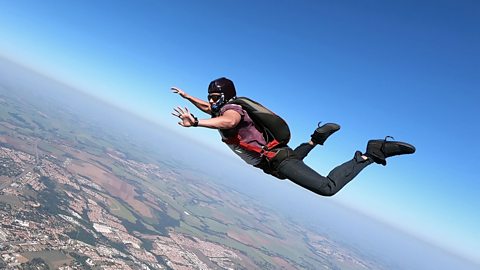
If a skydiver has a The amount of matter an object contains. Mass is measured in kilograms (kg) or grams (g). of 60 kg.
Her The force acting on an object due to the pull of gravity from a massive object like a planet. The force acts towards the centre of the planet and is measured in newtons (N). is found using:
W = mg
W = 60 kg x 10 N/kg
W = 600 N
If air resistance is ignored, the pull of gravity, 600 N, is the only force acting on the skydiver.
Her acceleration is found using:
a = \(\frac{\text{F}}{\text{m}}\)
F = 600 N
m = 60 kg
a = \(\frac{\text{600 N}}{\text{60 kg}}\)
a = 10 m/s2.
The same acceleration would be calculated for any mass in free fall (provided air resistance is being ignored).
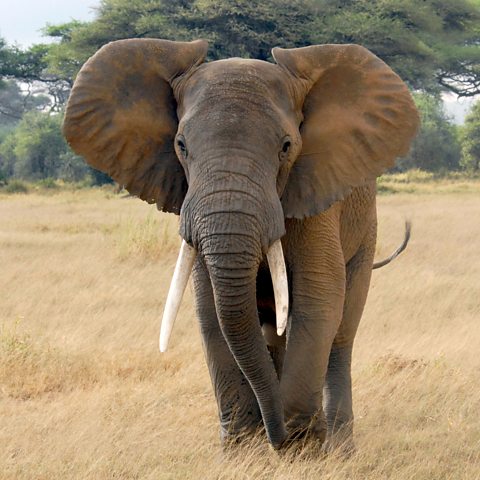
For example an elephant has a much greater mass than a skydiver, about 4000 kg.
The weight is found using:
W = mg
W = 4000 kg x 10 N/kg
W = 40 000 N
If air resistance is ignored, the pull of gravity, 40 000 N, is the only force acting on the falling elephant. The acceleration is found using:
a = \(\frac{F}{m}\)
F = 40 000 N
m = 4 000 kg
a = \(\frac{40 000~N}{4 000~kg}\)
a = 10 m/s2
It is often incorrectly believed that a more massive object falls faster than a less massive one.
The calculations above show that, if there is no air resistance, the speed of any falling object will increase by 10m/s every second, ie its acceleration is 10m/s2 .
This is known as the acceleration of free-fall, the symbol for which is ‘g’.
In a vacuum, where there is no air resistance, all falling objects accelerate at the same rate, even a feather and a bowling ball.
This means that all objects dropped from the same height at the same time in a vacuum will hit the ground at the same time regardless of their mass.
What happens to vertical motion under gravity?
If an object is fired vertically upwards then, provided we ignore air resistance, the only force acting on the object will be gravity.
In this case, the object’s upwards motion is slowed down by the force of gravity.
The The rate of change of displacement. The distance travelled in one second in a specified direction. Measured in m/s. of the object will decrease by 10 m/s every second until its vertical velocity becomes zero.
The object is said to have been decelerated by 10 m/s2.
Key points
In the absence of A force of friction produced when an object moves through the air. all objects fall at the same rate regardless of their mass. Near the Earth the rate is the acceleration of free fall, 10 m/s2.
Due to the Earth’s gravity, the speed of an object dropped from a height will increase at a rate of 10 m/s every second as it falls.
If there was no air resistance or drag, a feather and a hammer would fall at the same rate of 10 m/s2. Dropped from the same height, they would both hit the ground at the same time and travelling at the same speed.
An object fired vertically upwards slows down at a rate of 10 m/s2. It experiences a retardation of 10 m/s2.
WATCH: A bowling ball and a feather inside a vacuum chamber.
What happens when a bowling ball and some feathers are dropped together inside a giant vacuum chamber? Brian Cox finds out.
This is NASA's Space Power Facility near Cleveland, Ohio, and it is the world's biggest vacuum chamber.
It's used to test spacecraft in the conditions of outer space, and it does that by pumping out the 30 tons of air in this chamber until there are about two grams left.
Galileo's observation that all objects fall at the same rate is correct, but it's far from obvious.
In this case, the feathers fell to the ground at a slower rate than the bowling ball because of air resistance.
So in order to see the true nature of gravity, we have to remove the air.
Look at that.
They came down exactly the same. Wow.
Well, look how they get in there.
Now it's exactly, exactly the same.
Feathers. Don't move.
Nothing.
Look at that.
Question
A coin, a feather, and a brick are dropped from a bridge into a river.
In which order do they hit the water?
How would the order change if the experiment was repeated in a A volume that contains no matter.?
Answer
In open air, the coin would hit the water first, then the brick would follow and then the feather would hit it last.
The coin is more streamlined than the brick and the feather, so there is less air resistance on the coin.
The feather is light and has a relatively large surface area, and therefore is slowed down more.
Without air resistance, ie in a vacuum, all three objects would hit the water at the same time.
They all accelerate at the same rate, and this does not depend on their mass, shape or size.
Test your knowledge
More on Unit 1: Forces
Find out more by working through a topic
- count3 of 5
- count4 of 5

- count5 of 5
- count1 of 5