Some may say golf is a good walk spoiled, but for thousands of others, it’s the greatest sport on the planet.
Golf has transfixed its fans for centuries, although its exact origins are the subject of some debate. If you’re stepping up the the tee for the first time, it helps to know the lingo.
To aid you on the way to the green, BBC Bitesize has the background to some of the terms you may hear the commentators mention as the action gets underway on courses around the world.
Hacker
We couldn’t ignore a term that shares a name with a CBBC favourite.
On the golf course, a hacker isn’t a terrier with a cheeky glint and one-liners to match, but you may still hear plenty of comments popping out their mouth.
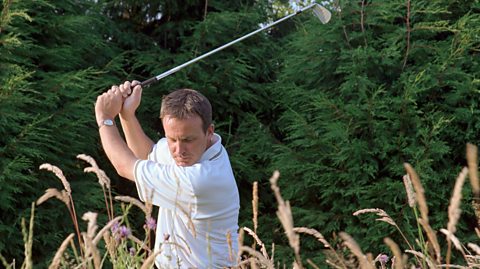
A hacker is usually a complete beginner in golf. When they first set foot on a course, there is a good chance their swings at the ball are more likely to make contact with the ground, producing chunks of earth that fly in all directions.
If you’re not sending the ball on a graceful glide towards the green from the off, unfortunately, you’re a hacker. But you’re not alone, and with enough practice, you won’t be one forever. The term has also been known to refer to a golfer who never improves, however.
Woods, irons and caddies
Golf requires a lot of equipment, from the tees that are poked into the ground to hold a ball at a more elevated position before it is struck, to the many clubs a golfer needs. That’s why you’ll see many professionals accompanied by someone carrying their clubs for them - a caddy. Clubs fall under different categories too - here’s a quick list of just some of you’ll find in a golf bag:
Wood: Sometimes, a golfer needs to give the ball a good (and accurate) wallop so it covers a long distance. A wood is a good club for this. They got their name because the head of the club used to be made from wood. Confusingly, they’re (mostly) made from metal these days.
Irons: This name isn’t so confusing - irons have always been made from metal. However, don’t be surprised if your iron has a head made, not from iron, but steel. Irons also have numbers on them. The lower the number, the further the ball should go when it’s hit.

Sand wedge (or sand iron): Golf courses are designed to challenge players, so they include a few obstacles. A bunker is a dip in the ground, usually filled with sand, which is tricksy to get out of and back onto the course. That’s when a caddy will hand over a sand wedge from the bag. These are designed with bunkers in mind, to get the ball out and back on course.
Putter: For the business end of each hole, it’s this club which is used when a ball is on the green (where the hole itself can be found, it’s easily spotted as the grass looks different to the rest of the hole). Putters do not have a set shape and size, it’s all down to player preference, but it will be the one they use to get the ball in the hole. Just remember to take the flagpole out of the hole before you putt - or ask your caddy to do it.
Addressing the ball
Good manners on the golf course are essential - you don’t want to be banned for being rude to the club captain. Those manners don’t stretch to formally greeting your golf ball though as it sits on its tee (the small peg in the ground where the ball is placed at the start of each hole). That would, frankly, be a bit silly.
Addressing the ball is more about finding the best position for your club. Getting the grip right, sorting out the angle at which you’ll make your stroke and perhaps adjusting your stance.
Get the address right and it will lead to a sweet spot, speaking of which…
Sweet spot
If you keep up that practice, it won’t be long before you reach the sweet spot. Perfect this and you’ll soon have the ball nearer the hole.

If you’re wondering where the spot is, it’s on the head of the club. It’s the exact point where a golfer must make contact with the ball to send it on a perfect trajectory down the course. if you can make it happen, you’ll be in no doubt why they call it sweet.
Par
Make a note about this one. Golf is all about completing an 18-hole course in the fewest shots, and this is - partly - where par comes in.
Par is how many shots a player is expected to take to get the golf ball from the tee to the hole. So while feeling below par in everyday life isn’t a good thing, the reverse happens on the golf course. Golfers want to be below, or under, par on each hole of the course to give them the best chance of winning. A hole is usually designated as three, four or five par.

If a hole is par four, and a golfer completes it in three shots, then they’re one shot under par. Complete the hole in 65 shots, and they’re 61 above par and probably not in contention to win this round. Golf is, among other things, a great way to brush up on your addition and subtraction.
Birdies and bogeys
Completing holes below par are such significant achievements, they even get their own names. Here’s a quick list:
Birdie: Finishing a hole one under par
Eagle: Finishing a hole two under par
Albatross: Finishing a hole three under par
You could also get a hole-in-one, where a golfer finds the sweet spot between club and ball so perfectly at the tee, the shot which follows plops the ball straight into the hole. Depending on the par, that hole-in-one could also be called an eagle or albatross.
And when things don’t go quite according to plan, there’s a name for that too. A bogey is finishing a hole one above par, and who wants a bogey on their scorecard?
The origins of football jargon
From hat-trick to volley, learn where some of the most popular football lingo comes from.
A beginner's guide to F1 jargon
What's bottoming? And tankslapping even?

The Six Nations: What's a ruck? And other rugby jargon explained...
Know the difference between your rucks, mauls and scrums