Key points about smart, modern and composite materials
- Smart materials and composites are key in modern product design. They have special traits that boost function and performance.
- Smart materials like shape memory alloys (e.g., An alloy of nickel and titanium in nearly equal amounts also called nickel titanium) and polymorph change with the environment, leading to new uses.
- Composites like glass-reinforced plastics and carbon fibre are strong, light, and durable, making them great for many uses.
- Knowing their benefits and uses is crucial for good product development.
Modern materials are covered in What are modern materials?
The differences between smart, modern and composite materials.
Narrator:
Mmm, breakfast time, I am so excited.
Nothing better in the morning than a fried egg sandwich.
Hey, I said fried.
Oh, so now there's none left.
Are you trying to unscramble them?
Yeah, I don't think that's going to work.
Okay then, just put them back.
Pretend like nothing has even happened.
I'm sure no one will notice.
Fortunately, there are some materials that can be returned to their original state.
Isn't that right, Alex?
Alex:
Yes, shape memory alloys are an example of a smart material.
They remember their original shape.
So even if you bend or distort them, they can return to that shape when exposed to heat, unlike scrambled eggs.
Smart materials, like shape memory alloys, have one or more properties that can be changed in a controlled way by things like stress, temperature, moisture, or pH.
Narrator:
So tell me, what are modern and composite materials?
Alex:
Modern materials are materials that have been developed through new or improved processes.
For example, titanium, which has a high strength-to-weight ratio, is tough, and has good corrosion resistance.
Composite materials are combinations of two or more different materials to create an enhanced material with improved functionality or properties.
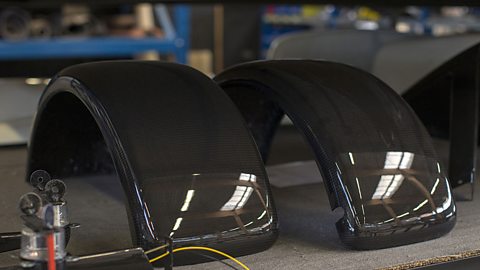
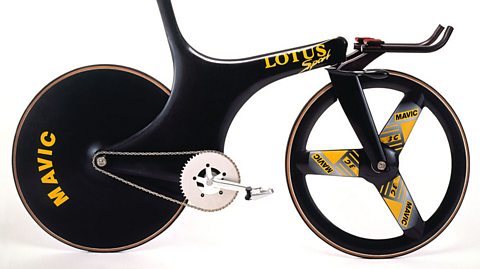
For example, carbon fibre, which is used to create sports cars, high-end sports equipment, and is increasingly used in aircraft production.
So within the automotive industry, we use smart, modern, and composite materials all the time.
Cars like the ones made here are made with a carbon fibre tub, around which the cars are built.
The carbon fibre makes them incredibly strong, light, and stiff, allowing us to strip out weight and boost handling, agility, and performance.
Narrator:
Thanks Alex, I feel enlightened, but still hungry—no fried eggs for either of us then.
Smart materials
Smart materials are materials that have properties which change reversibly. They can change easily but can then easily change back, depending on changes in their surroundings. Here are some examples.
Thermochromic pigments
Thermochromic pigments change colour at specific temperatures. Examples include colour-changing novelty mugs, colour-changing spoons, battery power indicators and forehead thermometers.
Photochromic pigments
Photochromic pigments change colour when exposed to light. This can be used in clothing but is most commonly found in photochromic lenses for glasses, which darken when exposed to ultraviolet light. This means that these glasses act as sunglasses on sunny days, but quickly change back to normal glasses when the lenses are no longer in sunlight.
Shape memory polymer
Shape memory polymer is a polymer that can be bent out of its original shape and then returned to its original shape when heated. Potential applications for this include sporting equipment, such as helmets and gum-shields or car bumpers, which can be heated to return to their original shape after a minor collision. In addition, medical stitches can self-tighten as a wound heals.
Shape memory alloy
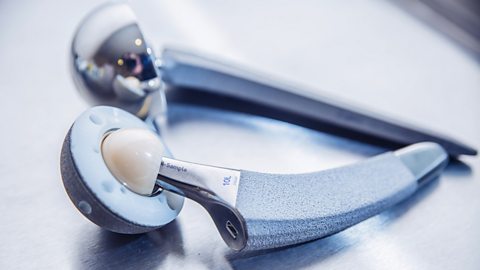
Shape memory alloys are mixtures of metals that return to their original shape when heated, similar to shape memory polymers. Again, this type of smart material could be used in sporting equipment and car bodies, as well as certain medical applications, such as surgical plates for joining bone fractures. As the alloy is warmed by the body, it applies a greater tension than normal plates, allowing for faster healing. For example, nitinol is a shape memory alloy of nickel and titanium.
Hydrogels
Hydrogels can absorb up to 1,000 times their own volume in water. After this water has been absorbed, it can be released when its surroundings are dry. Changes in temperature or pH can also cause the hydrogel to release water. Applications of hydrogels include:
- artificial muscles
- hair gel
- nappies
- ‘magic’ expanding snow
- granules added to soil to help retain water for plants

Shape-memory alloys (SMA) are metal a mixture of two or more elements, at least one is a metal. Many are mixtures of two or more metals and create a new material with improved properties that can remember their shape when heated. These alloys have been utilised on spectacle frames that spring back to shape if they are squashed.
Polymorph is a polymer that becomes Capable of being hammered or pressed into a new shape without breaking. when heated to about 62°C. When it cools down it becomes hard enough to drill and cut. This makes it perfect for modelling as it can be reheated and formed again. It is also excellent for creating ergonomic handles.
Composites
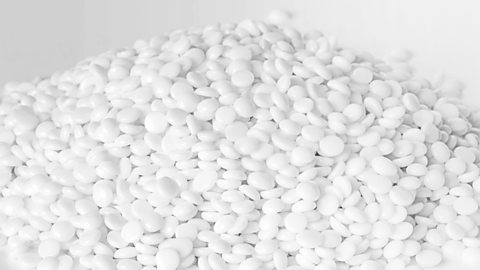
Built from more than one thing. materials are made up of different materials which are combined to improve their properties. They can be a combination of natural and synthetic materials and include A mixture of two materials - one part is a material in fibre strands and this is made stronger with a resin..
A mixture of two materials - one part is a material in fibre strands and this is made stronger with a resin. are reinforced with fibres. By mixing A thermosetting or thermoforming polymer that acts as a glue to hold fibres together. or concrete with fibres of glass or carbon we get the ability to mould complex shapes, but reinforcing them with the fibres makes them very strong.
| Fibre-based composite | Materials | Uses |
|---|---|---|
| Glass-reinforced plastic (GRP) | Glass fibres and resin | Boats, instrument cases |
| Carbon-reinforced plastic (CRP) | Carbon fibre and resin | Formula 1 car bodies, crash helmets, sports equipment |
| Glass-reinforced concrete (GRC) | Glass fibre and concrete | Street furniture, urban features |
Glass reinforced plastics
Glass reinforced plastics (GRP) are composite materials made by embedding glass fibres within a plastic matrix. This combination enhances the strength and durability of the plastic while keeping it lightweight. GRP is resistant to corrosion, making it suitable for various applications, including boat hulls, car parts and construction materials. It can be moulded into complex shapes and provides excellent impact resistance, making it a popular choice in industries where both strength and weight are critical considerations.


Carbon fibre
Carbon fibre is a lightweight and very strong material made from thin strands of carbon. These strands are often combined with a plastic resin to create a strong composite. Carbon fibre is used in many products like cars, airplanes and sports equipment because it is both strong and light. It is also resistant to rust and can be shaped into different forms, making it very useful in design and manufacturing.
How smart materials are used in renewable energy solutions
UNKNOWN MALE: 'Many of the things that we work on are mission critical. They save lives, they protect our troops.
ROB: QinetiQ work on classified government projects. So everybody is security cleared. At least as far as Restricted, often up to as far as Secret.
NARRATOR: 'QinetiQ is an international company that specialises in top secret government defence projects.
NARRATOR: 'But one of their current projects, involving smart materials as used in stealth technology by the military, is now being used in the production of wind turbines.
NARRATOR: 'By 2020, the UK must increase its green energy production from two to 15%. And as we're Europe's windiest country, harnessing this resource could be the key to helping us meet this target.
NARRATOR: 'A single on-shore wind turbine can meet the energy needs of 1,100 households a year.
NARRATOR: 'But there is a serious problem with them.
NARRATOR: 'Across the country, the construction of thousands of turbines, enough to provide power for 3.4 million homes, are on hold, because of the unique effect they have on aviation radar.
NARRATOR: 'Air traffic controllers use bounced radar pulses to locate moving objects.
NARRATOR: 'Because of their spinning blades, turbines reflect these pulses in the same way as an aeroplane. So air traffic control can't distinguish between a wind farm and a rogue moving aircraft.
NARRATOR: 'But now engineers believe they may have found the solution.
NARRATOR: 'Stealth technology.
NARRATOR: 'For over six decades, they've been working on ways to make boats and planes disappear from enemy radar. And now the team are applying these techniques to the wind turbine problem.'
GREG FIXTER:Ready?
UNKNOWN MALE #2:Yeah.
GREG FIXTER:Clear, yep.
UNKNOWN MALE #2:Looking good?
GREG FIXTER:Round about 30db.
GREG FIXTER:'Stealth is the shape of the vehicle' and it's the materials that it's made of.
GREG FIXTER:So you either reflect the signal
GREG FIXTER:away from the radar that's looking for it in a different direction, you do that by shaping the aircraft or ship, or you make it out of something that absorbs the energy that's been sent out by the radar.
NARRATOR: 'QinetiQ don't build wind turbines, so they're working with one of the world's biggest turbine manufacturers, Danish company Vestas, to solve the problem.
NARRATOR: 'It's been a hugely complex challenge.'
NARRATOR: 'because every inch of a turbine blade has been precisely engineered for maximum performance, the shape, weight or manufacturing process can't be changed.
NARRATOR: 'Engineers here are working on a special solution to add stealth material layers into the composite skins of the blades.
STEVE APPLETON:These guys are just measuring and marking the position of the various materials, so that we get them in the right place.
STEVE APPLETON:It's important that we put these materials in exactly to within a few millimetres, otherwise we could upset the later joining of the two parts of the mould.
STEVE APPLETON:It's nice to get away from computer models of what we're doing and actually work with these guys and see it coming together as a component.
NARRATOR: 'The composition of these layers is a closely guarded secret, but they work by absorbing most of the radar pulses, so only a very small amount is reflected.
NARRATOR: 'With the weakened returned pulse, the turbines become distinguishable from aircraft to radar operators.
NARRATOR: 'Initial tests are positive, and the teams are now building what will become the world's first stealth turbine.
NARRATOR: 'It is a breakthrough for QinetiQ, and a brilliant example of how a smart material developed for the military, is being utilised to enable the development of renewable energy sites.'
Test yourself
More on Materials, components and fabrication
Find out more by working through a topic
- count5 of 8