Challenge 6 - Television deal
Challenge 6 is all about prices and percentages.
Maths teacher Chris Smith and pupils from Grange Academy are here to explain.
The Maths Week Scotland Daily Challenges have been set by the Scottish Mathematical Council.
Mr Smith: This problem is all about prices and percentages.
Jamie has been saving up to buy a television he saw in a Black Friday sale.
But when he tries to buy it on the 1st of January, the price has gone up by 20%
He leaves buying the telly until he sees in in the Great March Sale, where the price has been cut by a quarter to £540.
What was the price of the television before 1st January?
Explain your answer.
Pupil one: It helps if you can change between fractions and percentages.
Pupil two: Try working through all the steps backwards.
Pupil three: Be careful about what you are multiplying and dividing by.
Pupil one: You got this!
So here's the challenge:
Jamie has been saving up to buy a television he saw in a Black Friday sale. But when he tries to buy it on the 1st of January, the price has gone up by 20%.
He leaves buying the telly until he sees it in the Great March Sale, where the price has been cut by a quarter to £540.
What was the price of the television before 1 January?

Need a hint?
- It helps if you can change between fractions and percentages.
- Try working through all the steps backwards.
- Be careful about what you are multiplying and dividing by.
Solution
Worked out the answer? Here's how you can do it.
Mr Smith: Did you work out the price of the TV before 1st of January?
Let’s look at how we got our answer.
The television cost £540 in the March sale, which was ¼ less than the full price.
So £540 equals three quarters of the full price.
The full price is four quarters so we can find it by dividing £540 by three and multiplying by four.
Which gives us £720.
But the price of £720 is 20% more than it was before the 1st of January.
So £720 is 120% of the price we want to get to.
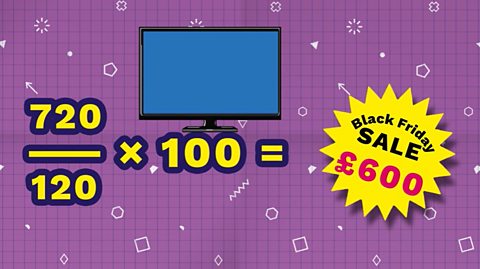
We can find that by dividing 720 by 120, and then multiplying by 100, which gives us the original Black Friday price of £600.
Well done if you found this no big deal.
Step 1
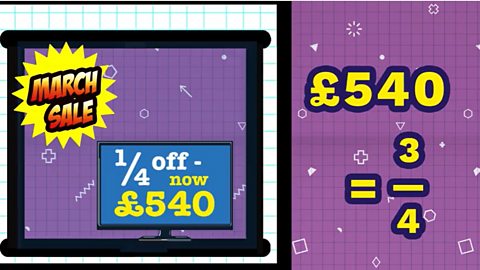
The television cost £540 in the March sale, which was \(\frac{1}{4}\) less than the full price.
So £540 = \(\frac{3}{4}\) of the full price.
Step 2
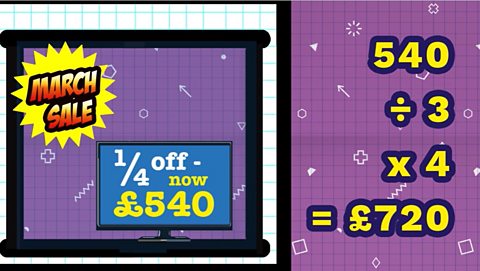
The full price is four quarters so we can find this by dividing £540 by 3 and multiplying by 4.
540 ÷ 3 x 4 = 720
The full price was £720
Step 3
But the price of £720 is 20% more than it was before the 1st of January.
So £720 = 120% of the price we want to get to.
Step 4
We can find that original price by dividing 720 by 120, and then multiplying by 100
720 ÷ 120 x 100 = 600
The original Black Friday price was £600.
Maths problem solving. collection
Try out Maths Week Scotland challenges from previous years.
Maths Week Scotland. External Link
Find more maths challenges and activities at the Maths Week Scotland website.
More on Maths Week Scotland 2025
Find out more by working through a topic
- count1 of 8