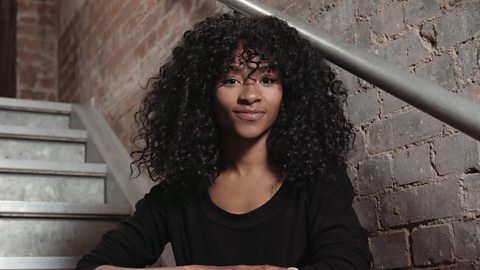
The rush I get from skiing is the best feeling in the world.
Menna: I'm Menna. I'm twenty years old and I'm a Alpine ski racer.
Menna: I have very low vision. Less than five percent in my right eye and nothing in the left. So I rely on my other senses, like, touch and hearing. Jen is my sighted guide. She wears a bright orange jacket and will tell me what's ahead, via a Bluetooth headset on her helmet.
Jen: She likes to call me an orange blob in front of her. Menna trusts me with her life and I have to trust that she's going to do what I ask her to do at speeds of over 70 miles an hour, which is faster than cars travel on the motorway.
Menna: Jen and I have to work on communication and trust to help the team work perfectly.
Jen: To do that we do lots of activities off the snow to help us for example, climbing or high ropes.
Menna: Trust exercises where you fall on your friend and they have to catch you, that sort of thing.
Jen: Our days are longer than schooldays. We're normally up at about 5:30 in the morning training on snow up until lunch time. And then we come down the slope and train for about another two hours either in the gym or do some yoga.
Menna: I was doing school and skiing at the same time. So I had to do my homework after a really long day skiing. After GCSE Creative Media, I followed that on to College and I'm continuing to do Media as my second career, whilst skiing. Back in March 2018, Jen and I won one bronze, two silvers and a gold at the Winter Paralympics and we're aiming for the Paralympics in 2022.
Menna: So watch out for us!
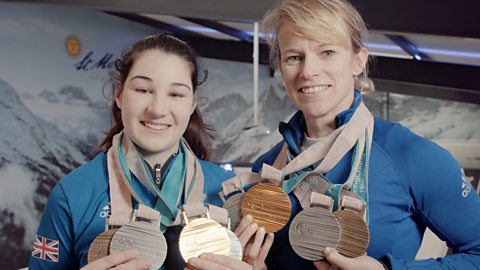
- Menna was Great Britain's most decorated athlete at the 2018 Winter Paralympics in Pyeongchang
- Menna was born visually impaired - she is completely blind in her right eye and has only 5% vision in her left eye
- She learnt to ski on a family holiday by following her dad's movements as he skied in front of her
- She was scouted by the GB team and was paired with her sighted guide Jen.

What to expect if you want to be a Paralympic athlete
Becoming a professional athlete takes a lot of commitment and hard work. You should:
- train – professional athletes train every day of the week and you should be working with a coach or training group a minimum of five days a week
- know your sport – the Paralympic Games use a process called ‘Classification’ to assess athletes’ impairments (such as Menna’s impaired vision). This process makes each sport fair for all
- compete – for many sports you will need experience of competing in national and international competitions before you enter the Paralympic Games. The Paralympic website has guidance for all winter and summer sports and what experience you should have before entering.
It’s also important to remember that professional athletes’ careers are limited with most retiring in their late 20s/early 30s. Menna is working towards a career in the media and it’s a good idea to have a think about what you would like to do when you retire from competing.
- Paralympic athlete average salary: Variable
- Paralympic athlete typical working hours: Variable
What qualifications do you need to be a Paralympic athlete?
You could get into this role via a university course, an apprenticeship or a sports development programme.
Sources: National Careers Service, ParalympicsGB, International Paralympic Committee
This information is a guide and is constantly changing. Please check the National Careers Service website for the latest information and all the qualifications needed.
For careers advice in all parts of the UK visit: National Careers Service (England), nidirect (Northern Ireland), My World of Work (Scotland) and Careers Wales (Wales).
Want to know more?
The Parasport website is a great place to start if you're interested in getting involved in disability sport.
Find out more
The Bitesize Careers Podcast
Katie Thistleton, inspiring young guests and career experts chat all things careers.
Tips and advice
Help with interviews, writing a CV and other skills for work.
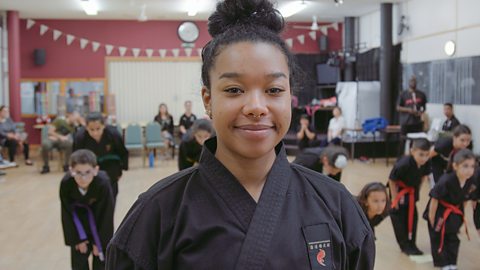
Shola: trainee karate instructor. video
Shola uses her knowledge of the body in her role as a trainee karate instructor.
3 students studying T-levels share their experiences
We spoke to three students who are in their final year of their T-level, to find out what it’s really like to study one at college.
Rachel: dancer and choreographer. video
Rachel uses her knowledge of the body to teach people how to dance.