Welcome to The Regenerators.
Introduction
It can be fascinating to find out about the history of your local area. With a bit of detective work you can discover more about the people who have lived there in the past.
Some things you discover might be very different to your life, but some things might be very similar.
When you’re next out and about have a look for historic buildings around you.
You could ask some of your older family and friends to talk about how they remember the area.
Like people, places also have their own lives and experiences.
How has my local area changed?
Join Katherine and Elliott as they explore the history of the harbourside in Bristol.
(EXCITING MUSIC)
Katherine: Hello, I am Katherine.
Elliot: And I am Elliot. We are Change Champs.
Katherine: We have come to the Bristol Harbourside to meet Lucy, who is a teacher.
Elliot: Lucy is going to teach us all about how this area has changed over time.
Lucy: Hello, children. Hey, it's so nice to meet you. So here we are at the M Shed. In the past, these docks were full of ships coming in from all over the world, bringing their cargo. Do you know why this place is called the M Shed?
Katherine: No.
Elliot: No.
Lucy: No? Each building that was here would have had a letter from A to Z so that the ships knew where to drop their cargo. And this building was named the letter…
Katherine: M.
Elliot: M.
Lucy: Well done, the M Shed. And it used to store grains, and later beer, and even bacon. Should we go in and have a look?
Elliot: Yeah.
Katherine: Yeah.
Lucy: Off we go.
Katherine: Lucy told us ships have been coming here for more than 300 years.
Elliot: Things do seem very different. So we want Lucy to teach us about what has changed.
Lucy: This picture was taken nearly 60 years ago. Can you guess what their ship was delivering?
Katherine: Vegetables. Chocolate and gum.
Elliot: Ice cream.
Lucy: Unfortunately not. It was actually delivering paper all the way from Scandinavia right here to the M Shed. Hm, what looks different to you in this photo compared to what it is like now?
Elliot: The M Shed looks smaller. It's dirtier. There's less boats.
Lucy: You're right. The biggest contrast is that now the Harbourside is used for people to come and have fun as well as to work. So over here, you'd find the coal yards, which are now restaurants and cafes. And this church right here is now flats where people live. And this old roadworks is now a street where people walk. Shall we go and get a better look?
Wow!
Katherine: This view is so beautiful, and it helps us see where things used to be.
Lucy: Can you see the people everywhere? Back when this was a working dock, it was busy and full of ships coming in and out, loading and unloading cargo, and all the buildings around the harbour would be to do with the ships. They'd be storing produce and people would be working there. That building over that is a bank, but it was the A Shed. And over there, can you see all the flats and houses? And they've been built up and up and up.
Elliot: Lucy wants to show us one last thing.
Lucy: Do you know what these are?
Katherine: Solar panels.
Lucy: Exactly. These panels turn energy from the sun into electricity. In the past, people didn't realise how important it was to use energy that was natural and would not run out. Bit by bit, the Harbourside is changing, and hopefully for the better. Should we go look around the Harbourside some more?
Katherine: Yeah.
Elliot: Yeah.
Lucy: Come on then.
Katherine: We are so grateful to Lucy as she's taught us how different this place used to be.
Elliot: And on our walk home, we will notice the flats, the old trains, the cobbled walkways and the houseboats and know that there was a time when all of this was very, very different.
Changing places
Places change in different ways and for different reasons. Some changes happen quickly and others more slowly.
The impact of history can be quite local at first; even big moments in history didn’t change everywhere all at once!
For example, the Romans didn’t reach every town when they invaded Britain in AD 43.
London was called 'Londinium' when the Romans built their city on the banks of the Thames.
Case study: St Ives
There are two towns named St Ives in England. They are both marked on this map.
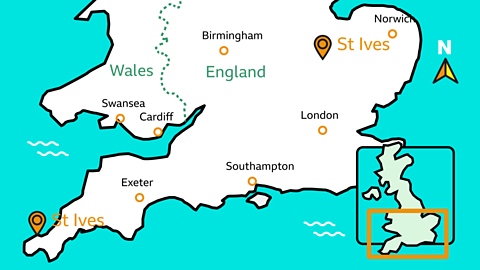
One of the towns can be found on the coast of Cornwall, which is down in the south west of England.
The other St Ives is in the county of Cambridgeshire in the east of England.
St Ives, Cornwall
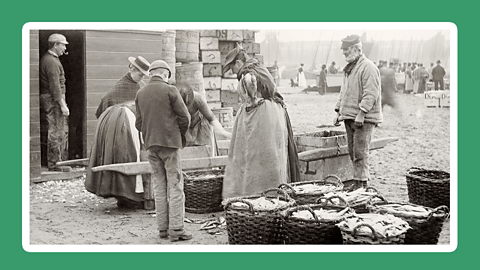
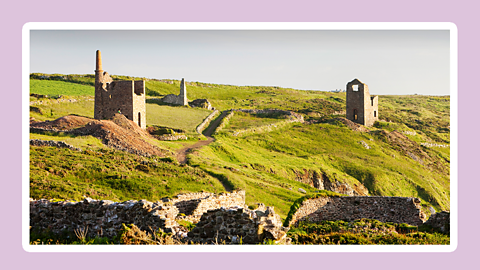
St Ives in Cornwall used to be a very busy fishing port. It was important for catching a type of fish called pilchards. These were salted and lots were sold to countries in Europe.
Tin was also mined along the Cornish coast. This attracted people for work and at one time 25% of the Cornish population worked in the mines.
During the 1800s, lots of children worked in the mines too. Boys mainly worked underground and girls worked above ground. It was very dangerous work.
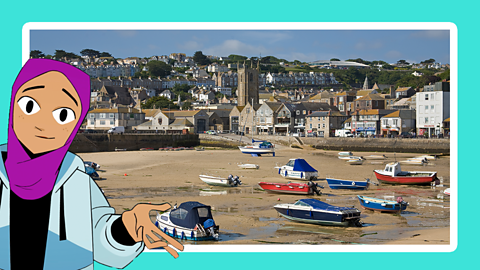
Image caption, St Ives, Cornwall
St Ives is a seaside town in Cornwall. It was a very important fishing port on the north Cornish coast and is now a popular resort for tourists.
1 of 3
When the railway arrived, St Ives grew as it became connected to other towns and cities.
Its pretty landscape and natural light attracted artists and sculptors, such as JMW Turner and Barbara Hepworth.
It is now a popular place with tourists, attracting people travelling for Cornish pasties and to visit the Tate Art Gallery.
St Ives, Cambridgeshire
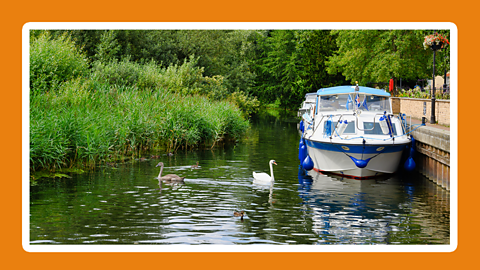
St Ives in Cambridgeshire is a market town on the River Great Ouse.
In the 5th century the first Anglo-Saxons arrived. They called the town ‘Slepe’, which means ‘muddy’. They built a quay for trade along the river and the town became a busy port.
In 1425 the famous town bridge was built across the river and a year later a chapel was built in the middle.
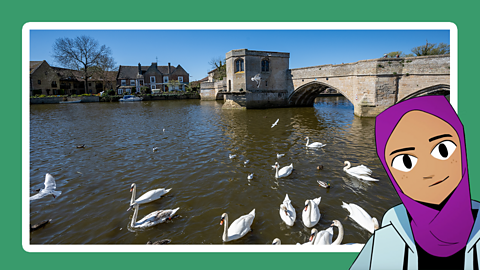
Image caption, River Great Ouse
This is the famous St Ives Bridge. It was built almost 600 years ago. It is one of only a few bridges to incorporate a chapel.
1 of 3
During the English Civil War, Oliver Cromwell kept his army in the town.
The town grew even more when the railway station opened in 1847. The town market became very important for farmers selling cattle.
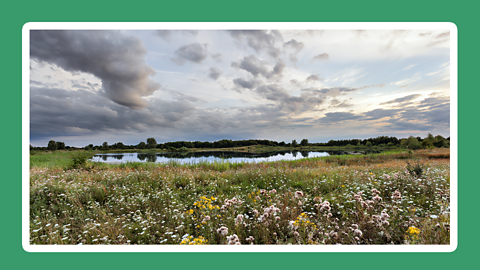
St Ives in Cambridgeshire has seen a lot of change. The river isn’t used for trade anymore, but people still enjoy sailing past the beautiful scenery and visiting the historic buidings.
Your local history
Both St Ives have seen changes throughout history and they will continue to change in the future.
The place where you live will do the same. People will do different jobs and populations will change as people move in or out. Tourists might become more interested in visiting, or find others places to go.
Buildings will change too. Some will be replaced with new buildings, but some might be protected so they can’t be removed.
Today’s historical remains exist because of decisions made by other people, sometimes hundreds of years ago.
Keep an eye out in your local area for the history all around you.

Lesson complete!
Well done Regenerator, you've completed this lesson. Now let's see what you can remember.
There's more to learn
Explore more lessons and content from around the BBC.
How have our railways changed?
GREEN CLASSROOM
How can we look after our environment?
GREEN CLASSROOM

Year 3 - 6 and P4 - P7
GREEN CLASSROOM

More from The Regenerators
BBC BITESIZE