Welcome to The Regenerators.
Introduction
Spreading a message is all about the language you use and the delivery.
There are lots of techniques you can use to become a better speaker… and a better listener!
This is crucial for talking about important things like climate change.
With a bit of practise, you can learn to communicate your points and express your feelings to other people.
Talking to others about climate change
Do you find it hard to talk about climate change? It is a big and emotional topic and it's sometimes hard to explain how you feel about it.
Climate vlogger Dr. Adam Levy knows all about this, and he's made a helpful video to get you started.
Adam: Hi, I'm Adam Levy. I'm a climate scientist and I spend a lot of my time talking about climate change on my YouTube channel Climate Adam. This is my step-by-step to making catchy climate change videos.
First things first, I think of the title. It should be something snappy and clear like 'Too late to stop climate change?' That way the audience knows what I'll be talking about and it helps me focus on what I need to write.
Then it comes to doing the writing. I think carefully about what the important info is and avoiding random waffle. So instead of saying, We need to reverse the trend of rising carbon dioxide emissions which has been taking place since the middle of the nineteenth century at least, blah blah blah.
I simply say, Emissions are rising when they need to be falling. I also make sure I use simple, powerful words like 'urgent' and 'threat' and, of course, I check what I'm saying is accurate. The reality is, every bit of warming matters.
Of course, then it's time to record. I speak straight into the camera so the audience feels like I'm talking directly to them and I deliver each line lots of times to get it just right. You see, 'emphasis' can really change the meaning of a sentence.
Often I go through a script and highlight the words that need to be stressed. The best time to act was twenty years ago but the second best time to act is right now. Then it comes to editing it all together and it takes lots of goes to get this just right.
It's always useful to have input from a friend or family member and I still get friends to give me feedback all the time. So, are we already too late to stop climate change? So that's how I communicate climate change.
I hope that following these steps will help you get your climate message across too. So, give it a try!
How to get your message across
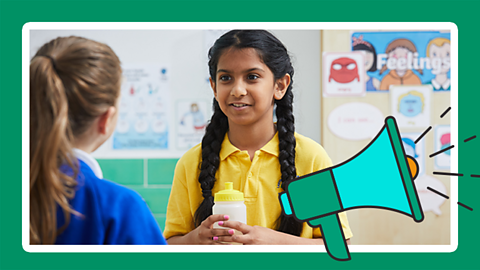
Everyone can learn how to be a better speaker and presenter.
These tips can help you to improve.
1. Think about what you want to say
Understand the topic you want to speak about. Everyone has their own experiences so it can help to talk about things that are important to you.
2. Speak clearly
Keep sentences simple and focused on your subject. This will help to get your point across.
3. Powerful words and sentence starters
The language you use is important and should be chosen carefully. For example, many people feel strong emotions when they hear words like 'danger' and 'crisis'.
You could also use these sentence starters to connect your presentation together:
"The point being made is…"
"In this image, you may notice…"
"This is because…"
4. Speak to the audience and add emphasis
Try to keep eye contact with the person you're speaking to. This makes them feel more involved.
Practise changing your voice to emphasise important parts of your speech.
5. It's okay to make mistakes
Not everyone is comfortable with giving speeches. It's okay to make mistakes.
Use your passion for the subject to keep going and build your confidence.
Asking friends and family to give you feedback is a great way to improve.
How to be a good listener
It is important to learn how to be a good listener and participant in conversations.
These tips can help you to improve.
1. Pay attention
It is polite to pay attention when someone is talking to you, especially when it's something they feel emotional about.
Try to keep eye contact and not become distracted. (If you find this difficult, you could explain that to the other person.)
2. Ask questions
This is a chance for you to learn from the other person by asking questions.
Conversations go both ways. Your questions may help the speaker to better understand the points they are making.
When asking questions, try not to change the topic.
3. Arguments and opinions
It's okay to disagree with other people and to have your own opinions.
Try to explain clearly how your view on a topic is different from theirs, and why you feel that way.
4. Tone of voice
It's important not to raise your voice or to shout over the speaker.
Try to be fair and respond the way you'd like people to do to you.
Climate change information
It's important to make sure your information is correct, especially when talking about a topic like climate change.
Watch documentaries, read books and do your research.
Just because something is on the internet, it doesn’t make it true. If an article quotes a piece of research, try to find the original study to see when it was done (the more recent the better) and the sample size if relevant (the bigger the better).
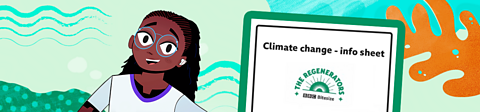
Here is some helpful information about climate change. You can download or print this sheet to look at before or during your speech.
Information sheet. document
GREEN CLASSROOM
Make a speech in pairs or small groups
Using everything you've learnt in this lesson, make your own speech or presentation about climate change.
You can try this activity on your own. But if possible, work in pairs or in a small group. It means you can get feedback on your speech… and the others can practise their listening skills.
You might even want to record your speech!
Checklist. document
GREEN CLASSROOM

We have designed a check list for you to print. Tick off each of the items as you practise how to talk to others about climate change.
Lesson complete!
Well done Regenerator, you've completed this lesson. Now let's see what you can remember.
There's more to learn
Explore more lessons and content from around the BBC.
What is climate change?
GREEN CLASSROOM

How does climate change affect living things?
GREEN CLASSROOM

Year 3 - 6 and P4 - P7
GREEN CLASSROOM
More from The Regenerators
BBC BITESIZE