When studying history, there’s so much to absorb that acronyms, songs or poems can be a welcome help to remember names, dates and places. But there may be unexpected history lessons in the rhymes we learn from a very early age.
Hidden away in the familiar lyrics of nursery rhymes, are tales of historical woe, battle and daily life.
It's difficult to say for sure what the true meaning of some of these songs is as we don't even know exactly when they were written or by who - but the stories and legends behind these rhymes paint an interesting picture of parts of British history.
Whether they’re real or not, these theories offer us a chance to learn more about key moments in time.
So let’s dive into some childhood favourites, and take a peak at what might be lurking between the lines.
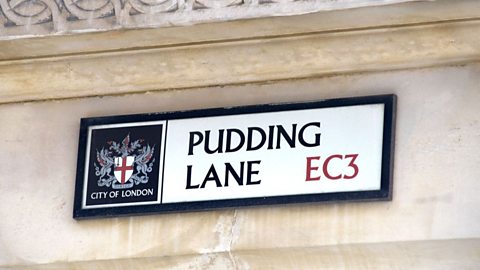 Image source, Peter Dazeley
London's Burning
London's burning, London's burning.
Fetch the engines, fetch the engines.
Fire fire, fire fire!
Pour on water, pour on water.
2 September marks the anniversary of the beginning of the Great Fire of London, in 1666. Starting in a bakery on Pudding Lane, the fire rapidly spread from building to building, destroying 13,000 homes over the next four days.
This calamitous event is thought to have been immortalised in the nursery rhyme London’s Burning.
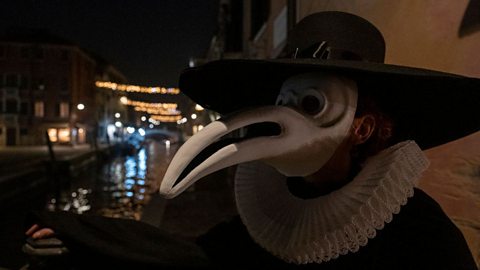 Image source, Stefano Mazzola
Ring-a-ring-o'-roses
Ring-a-ring o' roses,
A pocket full of posies,
A-tishoo! A-tishoo!
We all fall down.
It’s still up for debate, but some people believe that Ring-a-ring-o’-roses is actually about the Great Plague of 1665, just a year before the Great Fire of London.
They think that the ‘roses’ aren’t actually flowers, but instead refer to the red skin rash that some plague sufferers experienced.
At the time of the plague in 1665, it was still believed that disease could spread through unpleasant odours, a belief known as miasma theory.
To ward against bad air, plague doctors wore distinctive beaked masks, stuffed with sweet smelling herbs and flowers. Other individuals might burn such flowers in their home or carry them around, which is what ‘pocket full of posies’ may refer to.
‘Atishoo’ could be a reference to sneezing as a symptom, whilst ‘we all fall down’ might be a euphemism for death.
On the other hand, Ring-a-ring-o’-roses might just be a simple rhyme. The jury’s still out on this one.
Image source, Stefano Mazzola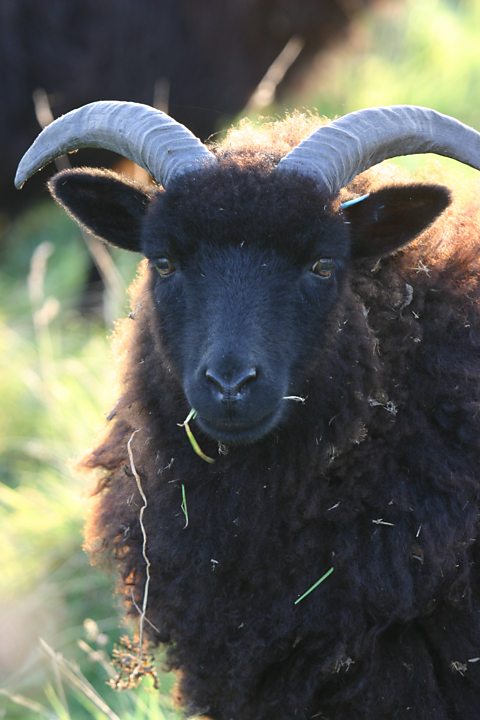 Image source, BBC
Baa Baa Black Sheep
Baa, baa, black sheep
Have you any wool?
Yes, sir, yes, sir
Three bags full
One for the master
And one for the dame
One for the little boy
Who lives down the lane
According to journalist Clemency Burton-Hill, this one appears to be a bit more straightforward. Baa Baa Black Sheep is thought to be about the medieval wool trade, specifically in 13th-Century England.
In 1272, King Edward I had just returned from fighting in the Crusades, a war that was proving costly. To fund it all and pay off his debts, he would introduce new taxes on wool.
Wool was one of the country’s most valuable exports and so offered Edward a great chance to make some money.
White wool was more highly prized than dark wool, because it could be more easily dyed for use in clothing. Sadly, Baa Baa Black Sheep’s wool would not have been considered as valuable.
Under Edward’s new tax rules, any profit made on a sack of wool was to be divided into three. One third went to the king, another went to the Church and the final third went to the farmer.
In the nursery rhyme, the master is thought to be the king, and the dame is the Church.
In the lyrics above, there is a somewhat happy ending, as the little boy down the lane still gets a third of the profits.
However, this was not always so.
Before the late 16th Century, the lyrics painted a more sinister story: ‘And none for the little boy who cries down the lane.’
In this original telling, the young shepherd boy received nothing for his work, with the profits from the wool having been divided between the king, the Church and the farmer.
Image source, BBC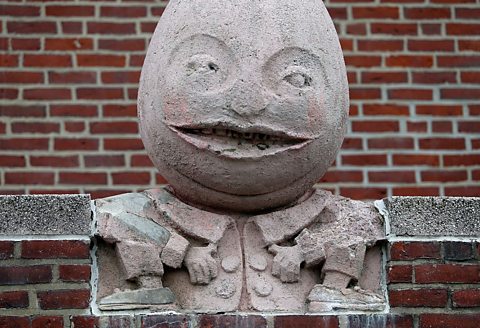 Image source, Boston Globe
Humpty Dumpty
Humpty Dumpty sat on a wall
Humpty Dumpty had a great fall
All the king's horses and all the king's men
Couldn't put Humpty together again
It will not surprise you to learn, that Humpty Dumpty was not in fact, a giant egg.
You can thank Lewis Carroll for that particular image, as he was the first to describe him as such, in Through the Looking Glass and What Alice Found There, published in 1871.
Humpty Dumpty may actually have been a very large cannon.
Author Linda Alchin (and the QI Elves, among others) speculates that during the English Civil War, the Royalist troops at Colchester were able to defend themselves for several weeks against the Parliamentary forces because they had a particularly powerful cannon.
Nicknamed Humpty Dumpty, it had a commanding position on one of the walls.
Unfortunately, when the wall below it was destroyed by enemy fire, the cannon plummeted to the ground.
Needless to say, all the king’s horses and all the king’s men, couldn’t put Humpty together again.
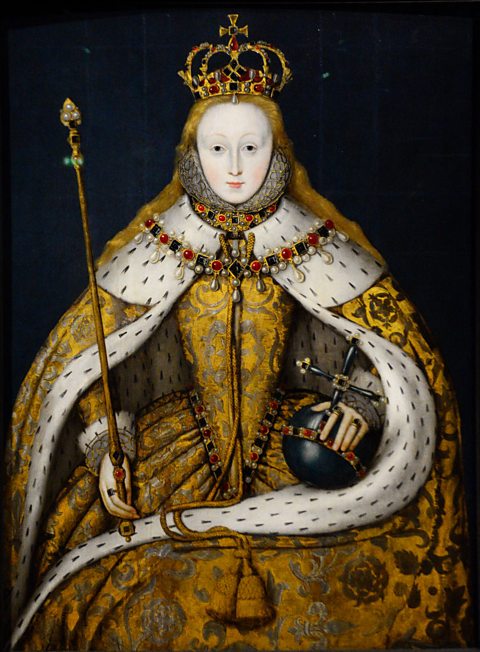 Image source, Robert Alexander
Goosey Goosey Gander
Goosey goosey gander,
Whither shall I wander?
Upstairs and downstairs
And in my lady’s chamber.
There I met an old man
Who wouldn’t say his prayers,
So I took him by his left leg
And threw him down the stair
While no one can be certain of the identity of the mysterious man who meets an unfortunate end in this rhyme, the best guess seems to be a priest.
In the 16th Century, England was in religious turmoil. Through the reigns of the Tudor monarchs Henry VIII, Edward VI, Mary I and Elizabeth, both Protestants and Catholics suffered from religious persecution.
During the reign of Queen Elizabeth I, many noble families declared themselves as being of the Protestant faith. Not all were telling the truth.
Some were able to smuggle Catholic priests into their stately homes, in order to celebrate Mass in their private chapels. When under threat of being discovered, they would hide in specially created spaces called priest holes.
Dedicated search parties were created to try and track down and capture these priests.
In their podcast Something Rhymes With Purple, lexicographer Susie Dent and author Gyles Brandreth discuss how Goosey Goosey Gander appears to tell the story of such a search party, from the viewpoint of a so-called priest-hunter.
The priest hunter searches the house upstairs and downstairs, until they find an old man in the lady’s room. When asked to swear his allegiance to the Queen and the Protestant faith, he ‘wouldn’t say his prayers’.
As punishment, the priest is thrown down the stairs.
While we will never know just how accurate these interpretations are, the intriguing lyrics of nursery rhymes are sure to keep us speculating.
Image source, Robert AlexanderFive words that have changed their meaning
Why we used to call serious people 'silly' - and other language curiosities.

Why Venice still celebrates the end of a quarantine
The Festa del Redentore marks the end of a plague epidemic 433 years ago.

Three times literature threw some serious sass
The shade was real years before social media