Do you ever wonder what people will say about the coronavirus pandemic in 443 years’ time?
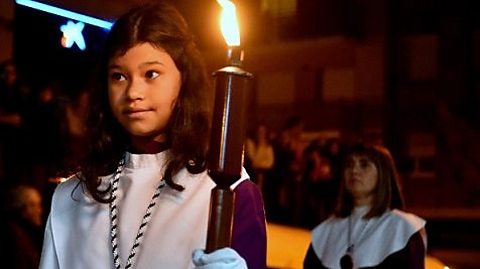
In Venice, a particular plague epidemic, which took place between 1575 and 1577, is still talked about. In fact, the city holds a festival every year to commemorate the end of this awful event.
As well as a colourful festival, this period in history also gave us some words and methods that may now sound familiar. For example, just as we have experienced, Venetians could spend weeks in quarantine. It was all part of a plan to control the spread of the plague.
So what was it like for them?
We got some answers from Dr Jane Stevens-Crawshaw, a Renaissance Italian historian at Oxford Brookes University.
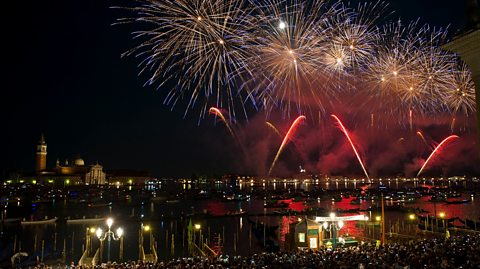 Image source, Marco Secchi
Stopping the plague in its tracks
As an important trading centre, Venice was always particularly vulnerable to plague during the 15th, 16th and 17th Centuries. Each arriving ship posed a risk of infection and plague epidemics became increasingly common.
In despair, the Venetian government took radical action. In 1423 it set up the world’s first permanent quarantine hospital on an island within the lagoon, known as the Lazzaretto Vecchio.
Dr Stevens-Crawshaw highlights that “it was open for business all of the time, whether plague was in the city of Venice or not.”
A second island, Lazaretto Nuovo, was used to house those who had come into contact with someone with plague symptoms, or those who were recovering after a stay at the Lazzaretto Vecchio.
While other European cities also had dedicated plague hospitals, only Venice had one in permanent operation. In England, the Tudors simply built cheap wooden hospitals that could be burnt down once the epidemic had passed.
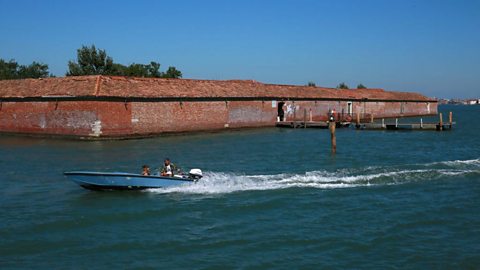 Image source, Amy T. Zielinski
Not everybody was treated equally
Most of the time, the islands were used solely for people entering the city, such as merchants, who were under suspicion of infection.
Some people were taken onto the islands, while others were allowed to quarantine on board their ships to reduce overcrowding.
That all changed when Venice went through plague epidemics. Venetians suspected of having plague were brought to the islands in large numbers.
However, not everyone in society was treated equally. Wealthier families could request permission to leave the city and head to their large, airy and well-supplied countryside homes, and were often given permission to carry out their quarantine at home.
Image source, Amy T. ZielinskiA very long process
The word ‘quarantine’ is derived from the Italian phrase ‘quaranta giorni’, meaning 40 days.
Venice was a Catholic city, and 40 days has a special significance in the Bible as a period of purification. Think of the 40 days of Jesus’ temptation in the desert, now marked by Lent.
Not everyone would spend a full 40 days in quarantine though.
People released from Lazzaretto Vecchio could then spend up to 40 more days on Lazzaretto Nuovo, followed by another week or so at home.
According to Dr Stevens-Crawshaw, the intention of having a dedicated plague hospital was to provide the highest quality care possible.
Doctors tried to supply patients with “bedding, clean clothes, good quality food, good quality wine”. Wine was often a safer option to water.
As well as using herbal remedies, doctors focused on their patients’ food, sleep and temperature. They believed that any emotional distress would cause the disease to worsen and so aimed to keep patients as calm as possible.
For that reason, patients were quarantined in groups, rather than being isolated on their own.
Visitors were also allowed onto the island to talk to patients through windows and gateways.
Dr Stevens-Crawshaw says: “It was a balancing act between stopping the spread of infection and thinking about people’s emotional wellbeing.
“They’re thinking about the impact of emotions on the body.”
But, much like today, not everybody was happy to go into quarantine or pay taxes for a permanent hospital.
Some Venetians questioned whether the permanent island hospitals provided value for money and doctors were unsure about keeping infected people together.
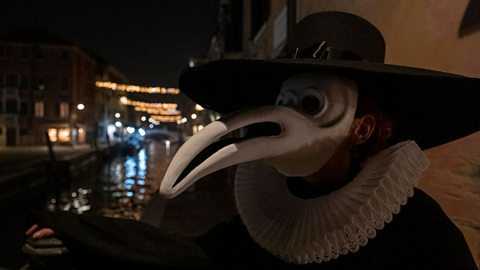 Image source, Stefano Mazzola/Awakening
PPE, 16th Century style
The famous beaked plague doctor mask wasn’t widely used until the 17th Century, but Venetians were already thinking about protective clothing during the 1575-7 epidemic.
During this period, people believed that plague was spread through bad air, in unpleasant smells and sticky particles. This is known as miasma theory.
“The idea of having something under your nose, a bit like our masks today, was to try and stop those infectious particles getting into your body,” explains Dr Stevens- Crawshaw.
Wax aprons and gloves were also though to provide protection, with their smooth surface supposedly able to repel infectious particles.
Image source, Stefano Mazzola/Awakening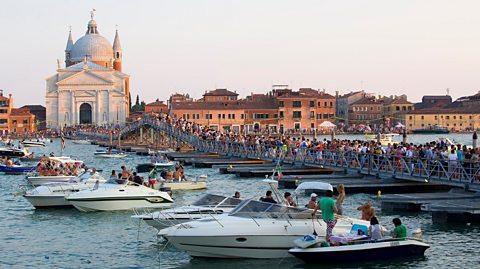 Image source, Marco Secchi
Fireworks and walking on water
The plague finally ended in 1577. According to health office records, 46,721 people died during that epidemic, or between a quarter and a third of all Venetians.
So it’s no surprise its end is still marked today. Each year, on the third Sunday of July, thousands of people gather along Venice’s famous canals to take part in the Festa del Redentore.
Translating to ‘Feast of the Redeemer’, it is named after a specific Venetian Catholic church, known as Il Redentore.
The Venetian government had pledged to build the church in 1576, when they prayed to Christ the Redeemer for mercy from the plague.
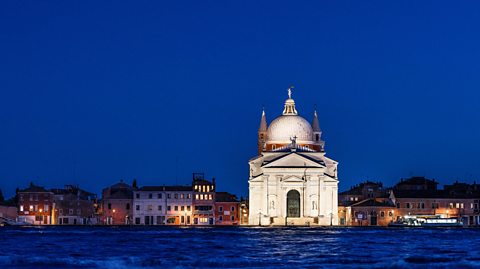 Image source, John Greim
There was a religious ceremony to lay the foundation stone of the new church on Giudecca, one of Venice’s many islands. In order to reach the island, the Patriarch of Venice (the highest-ranking bishop) crossed a bridge made of boats. This was symbolic of Christ walking on water.
It is this ceremony that is now repeated every year at the Festa del Redentore. Thousands of people will pass over a floating bridge of boats to visit the church and attend mass.
The night before the ceremony, the canals and pavements of Saint Mark’s basin are packed full of people in specially decorated boats, all watching a spectacular firework display, and remembering some of Venice’s darkest days - and their end.
Cheese-rolling and wife-carrying: Four unusual European festivals
Need summer plans? Here are four weird and wonderful festivals from around Europe to inspire you.

Coronavirus: Your questions answered
We've asked an expert to answer your questions about the pandemic.

Bank holidays: Where do they come from?
Agriculture, religion and national identity have all played a role in creating holidays.