What is space?
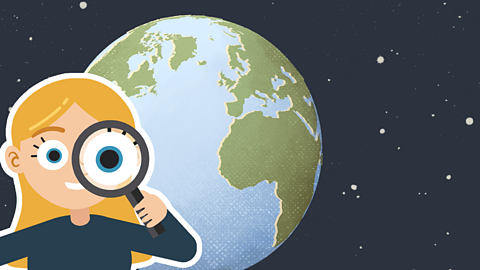
Space is very big! There are stars, planets and moons in space.
We live on planet Earth and the closest star to Earth is the Sun.
When you look up at the night sky, you can see stars and sometimes planets shining in the sky.
Some planets can be seen without a telescope, but others are so far away that you need a strong telescope to see them.
Watch – A journey through space
Travel through billions of kilometres of space, all the way from cold icy Neptune to the burning heat of the Sun.
Explore the wonders of our Solar System.
Sometimes, I look out at the stars and I wonder, “what's really out there?”
Hey! Follow me.
Oh ! Whoa! It's getting pretty hot now
First stop, the Sun. Our very own star. It's so bright and so big that you could fit a million Earths inside it.
Look over there. That's Jupiter. Can you see that giant red spot? That's a storm. That's just like a hurricane. That storm is bigger than our whole planet, and it's been raging for hundreds of years.
We can't just hang here. Lots more to see.
Saturn's rings are so pretty. From far away, they look solid, but they're not. They're made of billions of bits of ice and rock. Some are tiny, like grains of sand. And some are as big as a house.
Hmm. Where should we go now? Let's travel even further.
This is Neptune. It's the windiest planet, and it's so far away.
A year here lasts for 165 Earth years. I reckon it's time to head home.
Oh, look, there's the Moon. I've heard that because there's no wind up there, the footprints left by the astronauts in 1969 are still there. Perfectly saved.
There's so much out there to see. What will you discover?
Science
Scientists have discovered lots of interesting information about space.
People have even travelled to space to learn more about it.
Have a look at the information and activities below to learn more.
What do we know about space?
Space is full of amazing facts! Our planet, Earth, is one of eight planets in the Solar System.
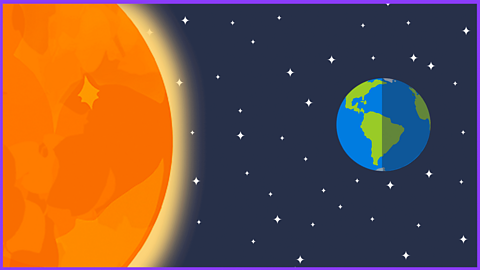
The Sun sits at the centre of the Solar System. All the planets travel around it in paths called orbits.
Have a look at this slideshow to learn more.
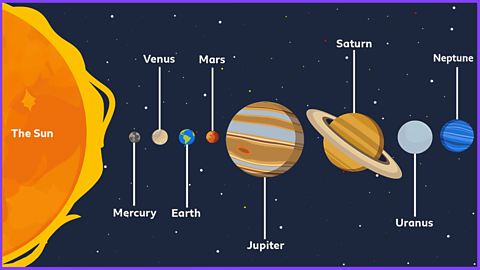
Image caption, What is the Solar System?
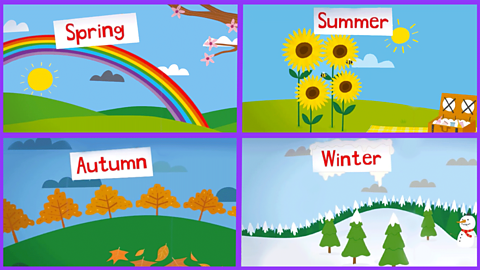
The Solar System is the name used to describe the eight planets that orbit the Sun. The planets in our Solar System are Mercury, Venus, Earth, Mars, Jupiter, Saturn, Uranus and Neptune.
1 of 3
Watch – What is the Solar System?
Join Maddie and her helpers in this video to learn more about the Solar System.
MADDIE MOATE: The Universe is vast.
CHILD: Vast means really, really big!
MADDIE: There are a lot of stars in our Universe. And the Sun is a star that gives out heat and light. The Sun is at the centre of the Solar System. The Solar System is the name we use to describe the eight planets, and their moons, that circle, or orbit, around the Sun.
CHILD: Our planet, Earth, is in the Solar System.
CHILD: Yeah, but the closest planet to the Sun is -
CHILD: Mercury!
MADDIE: Mercury is a rocky planet, with large round ditches that we call craters. Mercury takes about 88 days to travel around the Sun. When it’s closest to the Sun it gets very hot. Hot enough to fry an egg or even burn it! But when it rotates away from the Sun, it gets really, really cold.
CHILD: This planet is Venus.
MADDIE: Venus is the second closest planet to the Sun. It is very hot. The hottest planet in the whole Solar System.
CHILD: If it’s further away from the Sun, why is it hotter than Mercury?
MADDIE: That’s because Venus is surrounded by a thick layer of gasses that keep the Sun’s heat in - like a greenhouse. Venus is the second brightest object we can see in the night sky after the Moon.
CHILD: It takes Venus 225 days to orbit the Sun.
MADDIE: Earth, where we live, is the third planet from the Sun. The Earth has water to drink and air to breathe. It’s the only planet in our Solar System known to have the right conditions to support life - like plants and animals.
CHILD: And don’t forget the people!
MADDIE: It takes Earth about 365 days to orbit the sun. That’s one year. Mars is the fourth planet from the Sun. People sometimes think Mars is hot because of its red colour but it’s usually very cold. The red comes from a rusty metal called iron in the ground.
CHILD: Vehicles like this model rover are used to explore Mars!
MADDIE: That’s right! Scientists have been studying whether Mars could support life in the future, or if it did in the past.
CHILD: So how old is our solar system?
MADDIE: That’s a great question! Let’s ask an expert.
DR BECKY: Hi, I’m Dr Becky and I am a space expert. Now, the Solar System and all the planets in it were formed at the same time, from the same stuff. So, If we can measure how old planet Earth is, then we know how old the Solar System is. And we measure how old Earth is by looking at the stuff it’s made from - rocks. Because we can read rocks kind of like a big clock and some rocks change with time. So, if you look at how much they’ve changed, we know how much time has passed. And when we do that we work out that the Earth, the Sun and everything in the Solar System is 4.6 billion years old!
MADDIE: Jupiter is the fifth planet from the Sun and the biggest. It’s known as a gas giant because it’s mostly made up of swirling gases and liquid. Jupiter has very stormy weather, making its colours constantly change. Jupiter has a storm that’s been raging for over 200 hundred years.
CHILD: The storm is called ‘The Great Red Spot’.
MADDIE: Saturn is the sixth planet from the Sun and known for its great big rings that go around its middle. They look like hula hoops. The rings are made of ice and rock and move around Saturn.
CHILD: Saturn takes a little over 29 Earth years to orbit the Sun.
CHILD: Saturn has 146 moons!
CHILD: And those are just the ones we’ve discovered so far!
MADDIE: Uranus is the seventh planet from the Sun. Cold and windy, this icy planet has a rocky centre. Water and gasses, including a gas called methane, make up its surface. It takes Uranus 84 Earth years to orbit the Sun.
CHILD: What’s next?
MADDIE: The eighth planet from the Sun is Neptune. It’s another icy planet, like Uranus.
[To the children] Oh, that looks like fun! Can you remember the right order of the planets?
Our Solar System is huge and it’s just one of nearly 4000 star systems in our galaxy, the Milky Way. So there is still so much more to discover out there in space!
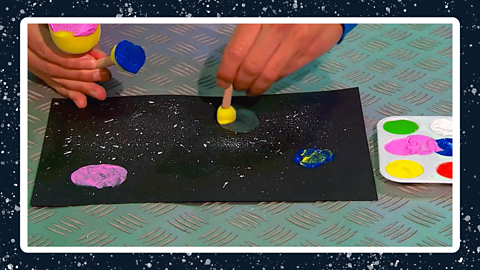
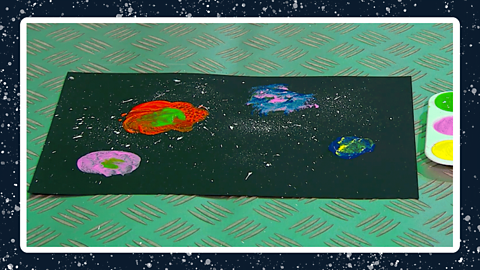
Activity - Create your own space picture
Take a look at this slideshow and have a go at creating your own space picture.
You will need:
- Black paper or card
- Different coloured paints
- A paintbrush
- Different sized sponges
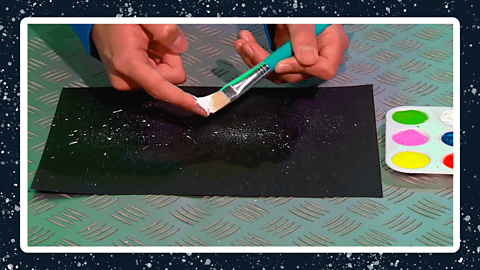
Image caption, Step 1
To make the stars, dip a dry paintbrush into some white paint and using your finger to flick the paintbrush, so that the paint goes all over the black card.
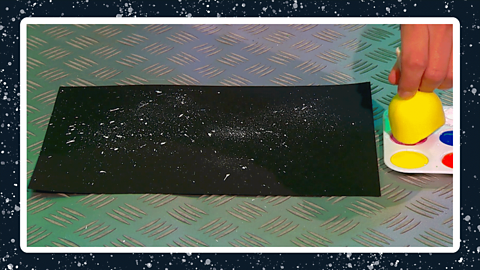
1 of 4
Discover more on KS1 Science
Have a look at these articles to learn more about the seasons, science and planets.
What is day and night?
KS1 Science
What are the seasons?
KS1 Science
Why do scientists ask questions?
KS1 Science
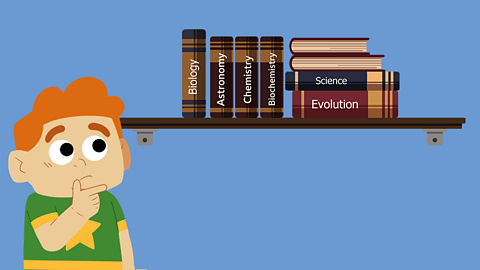
History

In 1969, Neil Armstrong became the first person ever to walk on the Moon.
This was a very important moment in history.
Have a look at the information, videos and activities below to learn more about Neil Armstrong and the Moon landing.
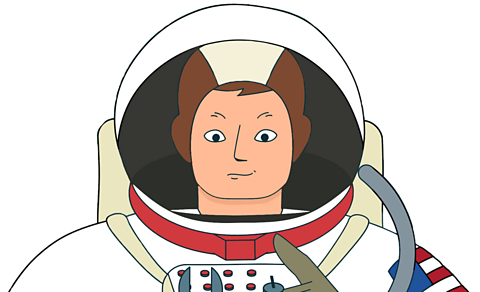
Who was Neil Armstrong?
Neil Armstrong was an American fighter pilot, who later became an astronaut.
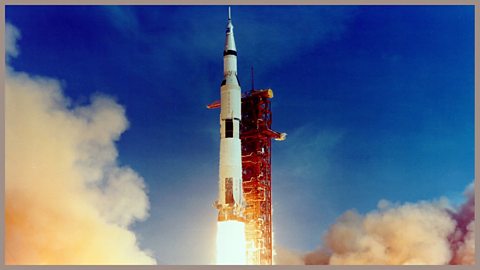
In July 1969, he and two other astronauts flew to the Moon on the Apollo 11 mission.
Neil Armstrong was the first person to step onto the Moon. He said:
“That’s one small step for man, one giant leap for mankind.”
Play the Exciting Explorers game and learn more about Neil Armstrong
Watch – The first astronaut on the Moon
Watch this video and learn more about the Moon landing that changed history.
Hey there. I’m Neil Armstrong.
These are my buddies Buzz Aldrin and Michael Collins.
We’re descending at 17,500 miles per hour, temperatures of 3000 degrees surround this tiny metal capsule and to my rear is the terrifying vacuum of space.
So, why are we up here?
Well, there are two real powerful countries on Earth doing all they can to look better than the other.
The Soviet Union put the first person into space, so President Kennedy of the United States of America set a challenge.
We will go to the Moon! Not because it is easy but because it is hard.
A trip to the Moon means flying, and boy was I good at flying.
So the US government asked if I wanted to become an astronaut.
After seven years the guys on NASA’s Apollo mission were ready to shoot me to the Moon.
The force of take off was intense.
But when we made it out into space we became weightless.
Now there was nothing holding us back.
After four days travelling, we were close.
Michael stayed in orbit while Buzz and I approached the Moon in our lander, ‘Eagle’.
Our computer was leading us into a crater full of rocks.
I quickly took control.
With just 30 seconds until we ran out of fuel, I found a smooth landing site… touch down.
That’s one small step for man. One giant leap for mankind.
It suddenly struck me that that tiny pea, pretty and blue, was the Earth.
Boy, is it worth taking care of.
This is mission control, we have you on our screen.
Welcome home Apollo 11. Hope you brought us a present.
Err… We got Moon rocks!
Discover more on KS1 History
Have a look at these articles to learn more about Neil Armstrong and other important people in history.
Who was Neil Armstrong?
KS1 History
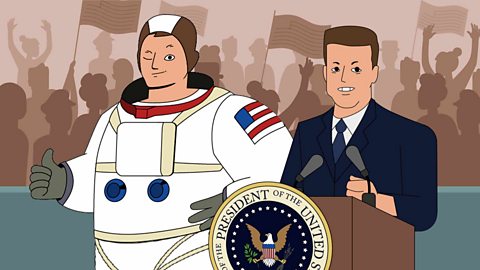
Who was Caroline Haslett?
KS1 History
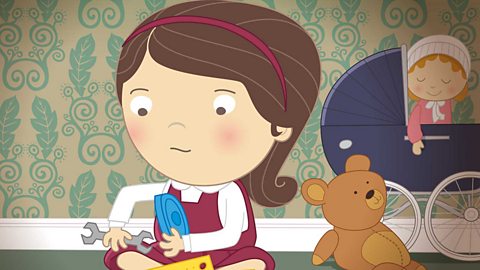
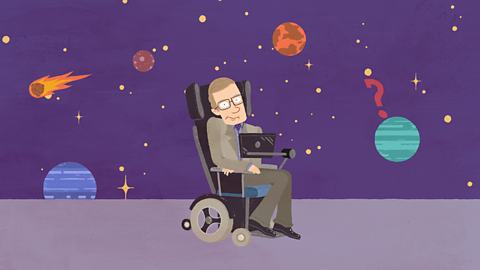
Who was Professor Stephen Hawking?
KS1 History
English

Space is a great subject to read or write about.
Stories can be about planets, rockets or even scary aliens.
Have a look at the information and activities below to learn more.
Audio story - Rocket dreams
Listen to this audio story about Lola and her magic rocket!
‘3…2…1…’ said Mum, reading aloud from Lola’s favourite storybook.
‘Blast off!’ shouted Lola.
‘Shhh! Inside voice!’ whispered Mum. ‘It’s bedtime.’
It was Lola’s favourite part of the story, even though she knew it all by heart. She squeezed her toy astronaut, Azzi, in excitement.
Dorothy in the story had just finished making her own homemade rocket out of aluminium foil and toilet paper rolls and was testing it out. What Dorothy didn’t yet know was that the homemade rocket was real and she would blast off into space!
‘Turn the page, Mummy!’
‘That’s enough for tonight,’ said Mum. ‘We’ll finish tomorrow.’
Mum tucked Lola into her blanket covered in rockets and kissed her on the forehead. ‘Good night, my little space explorer.’
Mum turned off the light. The night sky of glow-in-the-dark moons, stars and planets on Lola’s ceiling blinked down at her. Lola closed her eyes and drifted off to sleep. She imagined floating among them. Like Dorothy in the story, Lola wanted to be an astronaut when she grew up.
Next thing, something silvery was shimmering in the corner of her bedroom. Lola blinked and rubbed her eyes. It was Dorothy’s rocket! In her room! She moved closer. Next to the rocket was a spacesuit, with L…O…L…A - Lola! - in big letters on the pocket. Lola gasped!
Lola put on the spacesuit and it fit perfectly. She pressed a button and the rocket hatch opened up. She climbed inside and strapped herself in for safety. Then she pulled down her helmet over her head. Finally, she pressed the big, red LAUNCH button and…3…2…1 she blasted off!
Lola zipped around her bedroom, dipping around her bed and toy basket and then looping around her play mat. She waved to Azzi who was still in bed. Then she controlled the rocket upwards, straight towards her ceiling of glow-in-the-dark stars, moons and planets. As she zoomed upwards, the ceiling kept going and going and going…
Soon, everything around her was inky blackness filled with milky white stars. Lola gasped. She was in outer space!
She looked back and saw Earth, a tiny ball of blue and white swirls. Lola steered the nose of her rocket towards Earth and sped through the galaxy back towards home. As she got closer, she saw a ball covered in craters floating to Earth. The Moon! She had an idea. Lola steered the rocket for a Moon landing and bumped down with a thud.
She opened the hatch and took a big floating step on to the surface. ‘Wow!’ she shouted into space. She was the first child astronaut ever to set foot on the Moon!
Someone shouted back. ‘Loooo-laaaaaaaaaaa.’ Her name echoed through outer space.
Lola woke up with a jolt. She was still under her blanket. She looked up. Her ceiling was no longer glowing because it was morning. She blinked. There was no rocket in sight. She musthave been dreaming.
Mum was sitting on her bed. ‘Finally, Lola! You took such a long time to wake up today. It’s as if you were on another planet!’
Lola just smiled in response.
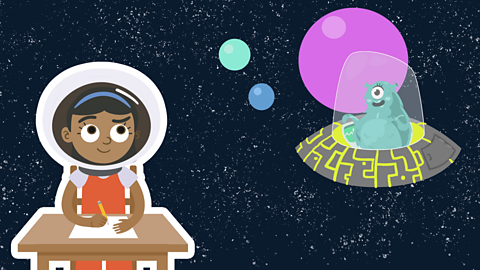
Activity - Write a space story
Why not have a go at writing your own space story?
You could write about:
a distant planet
a hero astronaut
a funny alien
What adventures will your characters go on?
Discover more on KS1 English
Learn how to make your writing even more exciting with these articles.
Describing characters
KS1 English
Creative writing vocabulary
KS1 English
What are adjectives?
KS1 English
Play - Bitesize games
Explore space and the seasons with these fun KS1 games.
Galaxy Pugs. game
KS1 Science game
Space Shoppers Money Funfair. game
KS1 Maths game
Seymour Science: Smashing Seasons. game
KS1 Science game
More resources from the BBC
You can find many more amazing resources from around the BBC.
Follow the links below for more ideas on space.
School Radio - Space songs
Bitesize for Teachers
Stargazing
CBeebies
How do we explore space?
Bitesize for Teachers
Where next?
Horrible Histories: Raid and Trade game! game
Play Horrible Histories: Raid and Trade KS2 History