Welcome to The Regenerators.
Introduction
When it comes to creative writing, the hardest bit is often getting started.
You can make things easier by writing about something you’re already interested in or passionate about, such as nature or climate change.
Every story has a setting, characters and a purpose. Coming up with ideas for all of these can be tricky, but there are different writing techniques you can try out.
Delphine's powerful poem
In 2021, eight-year-old Delphine won Blue Peter’s Our Planet Now competition with her powerful poem.
This was brought to life in a film created by Aardman Animations, with music from the BBC National Orchestra of Wales.
The animation had its premiere at COP26, the United Nations Climate Change Conference, where it was shown to world leaders.
Delphine used her passion for the natural world to inspire her creative writing. You can do the same!
I love the world I live in, and the animals and plants I share it with. I want other people to love nature as much as I do, to inspire them to look after it. It doesn't matter how young you are - you can still shout loudly and make a difference.
Delphine
Planning your story
Before you start writing, think about what it is that you want to say.
Making a plan can be very helpful. It’ll help you decide on your characters and setting, as well making sure your story has a beginning, middle and end.
As part of your plan, you should do some research.
You might read stories on a similar theme. Or, you could write something based on your own experiences.
From your research, you might have a better idea of where you want to set your story and who the characters are.
Setting
The setting of a story is simply where and when it is set.
Is your story set now or at some time in the past? Is it set in the UK, another country or maybe even in space?
These are all questions you can ask to help decide your setting, and work out how to describe it to your audience.
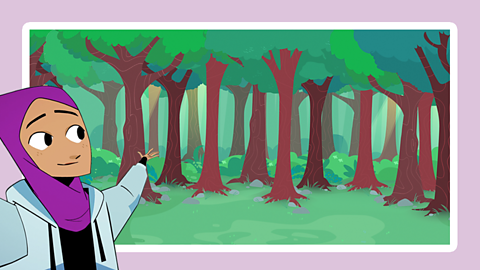
Watch the animation of Delphine’s poem again. How many different settings can you spot?
There’s the home that Delphine shares with her grandmother, the polluted environment outside and the colourful world that Delphine dreams of.
Think about the language Delphine uses to describe these different settings. In her dream, the animals are described as ‘candyfloss’ and ‘glowing’, but when she wakes up, it is to the ‘cold grey light of day’. Delphine has used contrast to show how different these two places are.
If you’re struggling to think of a setting for your story, why not start simple and describe the world around you? Go outside, see what you can spot, and you might just be inspired.
Characters
One of the best ways to invent a character is to ask loads of questions. The more questions you ask about your characters, the better you’ll get to know them.
In Delphine’s poem, there are both human and animal characters. Even though the poem is quite short, we still get to know a bit about the main character, Delphine.
We learn that she’s curious about the world around her, has a good imagination and is angry about the extinction of animals.
Think about one of your own characters, and try answering these five questions about them:
- How old is your character?
- Do they have a job or any hobbies?
- How do they speak?
- What do they like to wear?
- How do they feel about what’s happening in your story?
Writing for a purpose
When you’re writing a story, always think about why you’re doing it and who the audience is.
Writing can have lots of different purposes. It can be used to entertain, to describe, to explain, to evaluate, to inform and more.
How you write your story will depend on what its purpose is. If you want to entertain your audience, you might add some jokes. If you want to inform or argue, you might include statistics.
Delphine’s poem is an example of persuasive writing. We can tell this because she has used emotive language and made her writing both passionate and personal.
How is persuasive language effective? Watch this Teacher Talk to learn more.
Hello, I'm Mr Smith and today we're going to look at different purposes for writing.
Why do we write? We write for different reasons or for different… purposes. When we write, we want to have a specific impact on our reader.
Let's think about different reasons or purposes for writing. How many can you think of? Let's take a look.
We write to entertain, to instruct, to explain, to report, to inform, to persuade, and to recount. There are so many reasons to write. Let's have a closer look at some.
If we write to entertain, what impact do we want to have on our reader? Of course, we want to entertain them. We want them to enjoy our writing by feeling something—whether that be joy, sadness or even fear.
So what type of writing usually entertains readers?
You've probably come across loads of entertaining writing before. Maybe it was a storybook that made you smile, a play that made you giggle or a poem that made you chuckle.
Entertaining writing can come in the form of…narratives, stories, play scripts and poetry. So, we can see that the purpose is to entertain, but the form the writing takes can be different.
Let's look at persuasive writing.
What are we trying to do when we persuade? We are trying to convince somebody to do something, or to think of something, or to buy something. When we write to persuade, what form does our writing take? I bet you can write a cracking persuasive letter. But we could also write persuasive adverts and speeches. I think we're getting the hang of this.
Now let's think about writing to recount.
What is the purpose of a recount? In a recount we are retelling something. So, that can be in a story, a diary entry, a letter, and even the recount of an event like a school trip. Sometimes the same form of writing can be used for different purposes.
Let's take letter writing for example. Have a think about why you might write a letter.
There are so many reasons to write a letter. Here are some: To persuade, to recount an event, to explain something, to report on something, to instruct, to entertain—yes, letters can be part of the narrative— to complain.
When we read a piece of writing, the purpose for writing should be obvious to the reader.
Let's have a look at this grid and see if we can sort the titles of writing into different purposes. Pause the video to draw the grid, and have a go at putting these titles into the correct column:
How to make a fruit kebab?
Should children wear school uniforms?
All about Antarctica.
The adventures of Detective Delrusso.
Ready to see if you got it right? Let's take a look.
How did you do?
Well done. The titles of writing usually help us to understand the reason for writing. Have a go at adding some more examples into each column and see how many you can come up with.
For more help, challenges and games on this subject, visit BBC Bitesize.
Writing your own story
Now it's your turn. Write a short story or poem of your own. You could use the environment, nature or climate change as your inspiration. Good luck!
Write your own story
GREEN CLASSROOM

There's more to learn
Explore more lessons and content from around the BBC.
How to look for wildlife in your local space
GREEN CLASSROOM
Blue Peter
CBBC

Year 3 - 6 and P4 - P7
GREEN CLASSROOM
More from The Regenerators
BBC BITESIZE