Key points
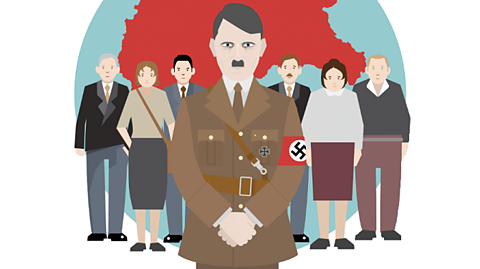
Hitler was appointed The leader in the Reichstag, appointed by the German President. of Germany in January 1933.
He quickly started to introduce Hostility or prejudice towards Jewish people.laws, rules and regulations, which took away the rights of Jewish people who lived in Germany.
These laws became more severe during the 1930s.
Timeline - antisemitic persecution in Germany
‘Aryanism’ and discrimination
Hitler and the An abbreviation for the National Socialist German Workers’ Party (NSDAP) and its members. The term was originally thought up by political opponents of the party. The Nazi Party's main ideas were based on racism, including antisemitism, and hostility towards democracy and other political systems, such as communism and socialism. believed in a so-called master An idea developed in the 1800s, believed by Hitler and the Nazis, that people from northern and western Europe were racially 'superior' to other groups. There is no scientific basis for this idea.. Some people used this term to refer to supposedly Being better or of a higher quality. people of white European origin, though there is no scientific basis for this idea.
Building on theories of An idea originating in the late 1800s. It was based on the false belief that society’s problems, such as alcoholism or poverty, could be eliminated by selective reproduction. In the context of Nazi rule, this was manifested in the prevention of so-called ‘undesirable’ groups of people from having children. There is no scientific basis for this idea., the Nazis strongly promoted the false idea that German people were part of this ‘Aryan race’, and that German society was under threat from so-called ‘inferior’ ‘non-Aryans’, such as Jewish people, An ethnic group originating in South Asia who migrated to Europe from the Middle Ages onwards. and The group of Roma people who lived in central and eastern Europe.. This resulted in the targeted Treating people poorly based on their political beliefs, race, religion or sexuality. of minority groups.
Gay men were also targeted as a consequence of the Nazis’ belief in an ‘Aryan race’. The Nazis believed that they were not contributing to its creation by supposedly not having children, though this wasn’t the only reason that gay men suffered persecution.
Antisemitic laws
On 1 April 1933, the Nazis ordered a A refusal to buy goods or services from a person or organisation as a form of punishment or protest. of all Jewish shops and businesses. The boycott lasted for one day. Many German citizens ignored the ban and continued to use Jewish-owned businesses as usual.
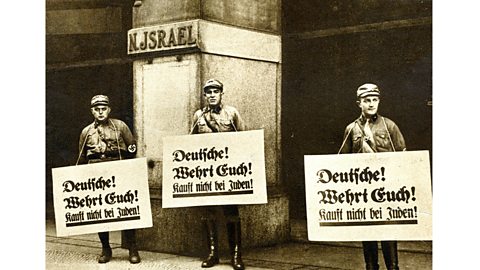
Also in April 1933, Jewish people were banned from working for the The part of a government that looks after the day-to-day running of different government departments.. Jewish judges were dismissed and Jews were banned from taking exams that would enable them to become lawyers.
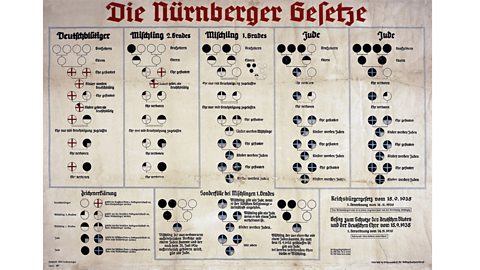
In 1935, the Nuremberg Laws were passed. The aim of these laws was to take away the rights of Jewish people to be citizens of Germany. This did not mean they had to leave the country, but it took away their right to help or support from the government, which led to the withdrawal of state education and healthcare.
It classified people who were Jewish, or of Jewish heritage, into different groups: Jews or ‘mischlinge’ (mixed) heritage. For example, a child with three or four Jewish grandparents was Jewish, whereas someone with one or two Jewish grandparents was classed as a ‘mischling’. Once these laws had been passed, marriage between Jews and non-Jews was forbidden. Those classified as ‘mischlinge’ were also not allowed to marry a non-Jewish person.
Further legislation followed the Nuremberg Laws:
1936
October: Jewish teachers are banned from working in state schools.
1938
July: Jewish doctors are banned from treating non-Jewish patients.
August: All Jewish men are forced to change their first name to Israel and all women to Sara.
October: All Jewish owned property must be given away to non-Jews.
October: All Jewish passports must be stamped with the letter ‘J’.
What was the impact of the Nuremberg Laws?
The impact of these laws on Jewish people was huge. Jewish people were unable to access key government services and had many of their rights as citizens taken away.
Edith Bulbring was a doctor at a hospital in Berlin. She was part-Jewish, and therefore regarded as a ‘mischling’. One day, after Dr Bulbring had been taking care of a young boy, she received a phone message at her hospital, advising her that there was ‘no longer any use for her services’, as she was of ‘part-Jewish origin’.
Propaganda

Joseph Goebbels was the Nazi minister responsible for Putting forward biased information to persuade people to believe a particular point of view.. It was his job to produce posters, broadcasts and news stories that would persuade the German people to support the Nazis unconditionally, and that action against Jews and ‘mischlinge’ in Germany was justified. Goebbels believed that propaganda should be subtle. He thought that, if posters and messages were too blatantly antisemitic, people would be sympathetic towards Jews rather than believe the propaganda.
The Nazis made cheap radios, known as the ‘People’s Receiver’. This meant that more people could listen to propaganda messages from the Nazi party.
Loudspeakers were used in public places to broadcast pro-Nazi messages that were supportive of the new antisemitic laws.
The 1936 Olympic Games
In 1936, Berlin hosted the Olympic Games. This was used by Goebbels and the Nazis as an opportunity to show off Germany’s economic recovery. Antisemitic propaganda was removed so that it wouldn’t be seen by foreign journalists.
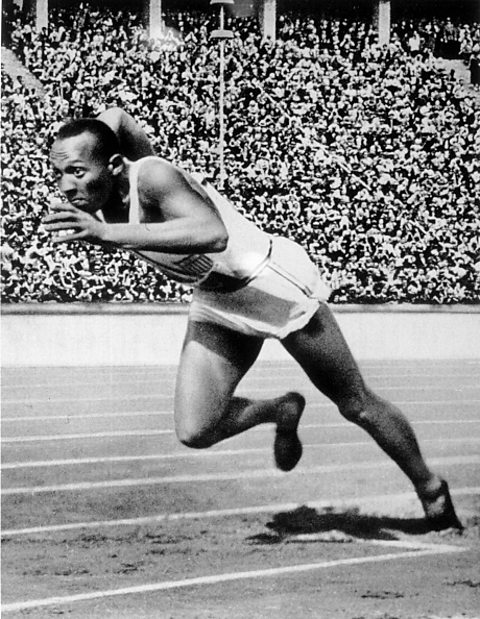
The Nazi belief in a superior ‘Aryan race’ was undermined when the star athlete of the games was a Black American called Jesse Owens, who won four gold medals.
Who was Jesse Owens?
Jesse Owens was a Black American athlete who was part of the United States Olympic team at the 1936 Olympic games.
Owens was the standout performer at the games, winning four gold medals in the 100 metres, 200 metres, 4 x 100 metre relay (setting a world record time) and long jump.
Owens’ success undermined Hitler’s attempts to use the Berlin games to promote the success of Germany and ‘Aryan’ athletes. Although Germany topped the medal table, Owens’ medal haul was the most impressive individual performance.
‘Kristallnacht’
On 7 November 1938 a German-born Jewish man, Herschel Grynszpan, entered the German embassy in Paris and murdered the ambassador, Ernst vom Rath. Grynszpan had moved to France in 1936. His sister wrote to him on 3 November about the Treating people differently on the basis of a particular characteristic, such as race, religion or sex. they had faced in Germany. This is believed to have prompted Grynszpan to go to the embassy.
The murder of vom Rath was used as an excuse for the Nazi government to order a surge of attacks against Jewish synagogues, businesses and shops in Germany on 9 and 10 November 1938. This was known as ‘Kristallnacht’, the ‘Night of the Broken Glass’, or the November A violent riot or attack that is started with the intention of killing, harming or expelling a particular ethnic or religious group..
The attacks caused huge damage and destruction to Jewish communities in Germany, Austria and the An area of Czechoslovakia that bordered Germany, where 3 million German speaking people lived. The Nazis claimed these people were being discriminated against by the Czechoslovakian government to justify their claim on the territory. Germany took over the Sudetenland in 1938.:
7,500 shops and businesses were damaged or destroyed.
30,000 Jewish men were sent to A place where large numbers of Jewish people, and members of other minority groups persecuted by the Nazis, were held captive during World War Two. .
It is estimated that approximately 100 Jews were killed.
‘Kristallnacht’ is seen as a turning point by many historians, as the persecution of Jews changed from being based on discriminatory laws to violent attacks on a large scale.
Following ‘Kristallnacht’, further discriminatory laws were introduced in November 1938. Jews were banned from owning businesses and all Jewish children were barred from attending school.
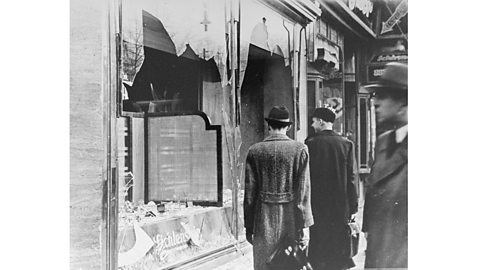
What was it like to live through ‘Kristallnacht’?
The text below contains offensive language
Ruth Winkelmann was ten when ‘Kristallnacht’ took place. She lived in Berlin. In 2018, she spoke to the BBC about what she saw on 10 November 1938:
"On our way [to school], we saw broken shop windows and shards of glass lying in the streets. And then we saw a shop where someone had painted the word ‘Jew’, and smeared on a star of David… [At school] we heard what had been going on in Berlin during the night - that Jewish shops had been smashed up and people brutally killed. Shop windows had been broken everywhere, and the words ‘Jew’ or ‘Jewish pig’ written in many places… In retrospect, I became a grown-up on that day. The pogrom night took away my childhood."
The SS and concentration camps
The first concentration camp was opened in Germany at Dachau in 1933. Concentration camps were initially used to hold political opponents of the Nazi party.
From 1937 onwards there was a rapid expansion in the use of concentration camps. There were four camps in 1937. By 1944, there were hundreds of camps across Nazi-occupied Europe.
The camps were organised and manned by the The Schutzstaffel, an organisation led by Heinrich Himmler that was originally set up to be Hitler’s personal bodyguard service. Its members later set up concentration camps, and were specifically given the responsibility for murdering Jewish people., who were led by Heinrich Himmler. Conditions in the camps were appalling. Prisoners were forced to do hard labour.
The mass use of concentration camps for Jews began after ‘Kristallnacht’.
Test your knowledge and inference skills
Question 1
How did non-Jewish people react when the Nazis introduced the one-day boycott of Jewish shops and businesses in April 1933?
Many people ignored the boycott and did not support it, continuing to use Jewish shops.
The boycott only lasted for a day. From this, you could infer that it was damaging the economy and that people largely ignored it.
It is important to remember that the boycott was the start of further action that was brought in to persecute German Jews, including the ban on Jews working in the civil service.
Question 2
Why were the Nuremberg Laws introduced in 1935?
The Nuremberg Laws were a set of antisemitic laws that were designed to take citizenship away from German Jews. This meant that Jewish people lost many rights, including to government help. These laws also placed limits on the freedoms of Jewish people.
The Nuremberg Laws also classified who was Jewish and who was a ‘mischling’, which meant that they were of ‘mixed’ heritage.
Marriage was banned between Jews and non-Jews, as well as between ‘mischlinge’ and non-Jewish people.
Question 3
Fritz Rodeck was a Jewish man who lived in Vienna during ‘Kristallnacht’. Read his testimony below and then answer the questions:
‘There were more than twenty large synagogues in Vienna, not to mention the far more numerous smaller ones. The destruction was the work of a few hours… In the case of each of these synagogue burnings, the fire brigade was called in, but not to put out the fire… [they] were there merely to prevent the fire from spreading to neighbouring buildings.’
What did the Nazis do in Vienna?
What impact would this have had on Jewish people?
20 large synagogues in Vienna were destroyed. Jews would have been upset and angry about the destruction of their places of worship.
The fire brigade arrived yet did not do anything to save the synagogues. They only protected the surrounding buildings.
Destroying synagogues was a way of stopping Jews from being able to follow their religious customs and beliefs.
The Holocaust Educational Trust gave advice and guidance during the production of this guide.
Play the History Detectives game! game
Analyse and evaluate evidence to uncover some of history’s burning questions in this game.
More on World War Two and the Holocaust
Find out more by working through a topic
- count9 of 10
- count10 of 10
- count1 of 10
- count2 of 10