What is a recount?

A recount is a way of telling others what has happened to you. A diary entry is a type of recount.
Here are some key features to remember when writing a recount:
- Write your recount in the first person because it happened to you!
I used the stars to navigate across the desert.
- Use the past tense because it has already happened.
It took a long time!
Have a clear structure. Use paragraphs to separate different events and ideas.
Within each paragraph include observations (what you saw), thoughts and feelings.
I was so relieved to see the next city; my throat was dry, and I needed water.
Diaries (recounts) are written in the order in which they happened - chronological order.
Use time conjunctions like primarily, next, then and finally to show this.Use description to add detail so the reader can build an image in their head.
The sand dunes were as tall as mountains.
- Use emotive language so the reader understands your point of view.
I put blood, sweat and tears into my journey; I have no regrets!
Watch: Features of a recount
How to write a recount with author Michael Rosen.
[MICHAEL ROSEN SINGING]
"Little Mary, Mary Anne
Was really quite fantastic
She wasn't like her friends
'Cos she was made of elastic
She'd roll herself up…"
MICHAEL: I'm Michael Rosen and I'm an author. To be able to write fiction, there are a few tricks which help to make your writing more exciting for the reader and easier to follow.
One type of writing is recount. When you write a recount, you reconstruct a past experience and tell the reader what happened. It's always written in the past tense, as if you're remembering what took place.
Recounts are written from one viewpoint – usually the author – so this means that anybody can write a recount because you have the freedom to write about your own personal thoughts.
A recount can retell a real-life experience of something that actually happened – for example, telling a story about the last time you went on holiday, or we can put ourselves into somebody else's shoes and imagine what might have happened. For example, a day in the life of a pop star.
One of the easiest ways to start thinking about a recount story is to draw a diagram to help you to plan your writing. For example, draw a map and imagine a place you could have visited. Or write a timeline of events in an imaginary day.
Your recount story should be written in chronological order, which means sequencing the events in the order they happened. Recounts also need to be structured so that they include a beginning, a middle and an end.
During your recount story, you must use emotive words to set the scene. If you wrote, "I went to the park and it rained", that's telling the reader what you did. But by using more emotive language, it makes a more exciting read and helps your reader visualise the story.
For example, "I woke early, when the sun had just risen and as I walked to the park, the rain started to drizzle like… a summary waterfall."
During your recount story, try to focus on a few key events to give your writing structure. Try to think of three things that happened that you'd like to describe.
To link your recount together, try to use time connectives, like "firstly", "secondly", "finally", "afterwards" and "meanwhile", "eventually", "minutes later", "before I knew it", "without warning", "as quick as a flash".
Here's my example: "Finally, when the rain eventually stopped, I was able to enjoy the park and find my next adventure."
Always try to end with a closing statement. Reflect on what happened and what might happen next.
When you've written down your first draft, read it through and see if you like it. Are there parts that you would change? Or could you think of a better name for someone?
I like to read my writing out loud, so that I can hear what my readers might hear.
"I wrote some letters to many different people, friends, relations, workpeople. Some of them answered me, that was good. What they said was interesting. Some of the letters…"
When you write your second draft, keep the sections that you like and then add in new sentences that you like more.
As an author, I'm constantly editing my writing so that it's the best I can make it.
Watch: Why were diaries important?

Remember, a diary is a type of recount. Diaries can be useful as a way to document thoughts and experiences to look back on. They have also been useful for historians to understand what people's lives were like during olden times.
Watch this video about diaries and why they were so important during World War I.
D is for Diary.
CHILD 1: This is a diary that was kept by a sergeant in 1915.
CHILD 2: We can learn more about World War I from diaries.
CHILD 3: It's good to keep diaries because people in the future can find out what happened in that time.
KATHLEEN JANE MORGAN: Kathleen Jane Morgan, 22 years old. It's just a school exercise book. It only cost a penny to buy, but it's the most precious thing that I possess. My husband, Captain Wilfred John Morgan of the Royal Welsh Fusiliers, wrote in this book every single day. Sometimes he was too tired to scribble more than a couple of words, but every day he wrote something.Someone spilt coffee on this page. And look, here, it's been trodden on by muddy boots. And here the corner of the front cover has been nibbled. A rat, I think. I often read this page. The last page.
Friday, 6th July 1916, Mametz Wood, The Somme.
Then, he writes:
It's 8.30 at night, still light and very warm.
Earlier I talked to my men about the big push tomorrow. Told them that when we went over the top, they were to stick together and follow their sergeants. Told them not to run, but to keep walking steadily until they reached German lines. Said we weren't expecting much trouble from the enemy because our guns had been shelling their lines for three days and they'd probably all run away by now.
Then I wished them all luck and told them to try and get some sleep. "It's going to be all right, men," I said. "We're going to be fine."
There isn't any more.
They found this book on his body the next day.
When they told me they were going to send it to me, I was frightened that I might find blood on it, or a bullet hole or something, but there's nothing, just a coffee stain and muddy footprint. And a missing corner where a rat had its breakfast.
Activity 1
Check your understanding using this diamond nine activity.
Can you order the key features of a diary?
Put the most effective features at the top and the least effective features at the bottom.
- First person.
- Past tense.
- Paragraphs.
- Observations, thoughts and feelings.
- Date and introduction for each entry.
- Chronological order.
- Detail and description.
- Emotive language.
- Time conjunctions.
There's an example below to help you.
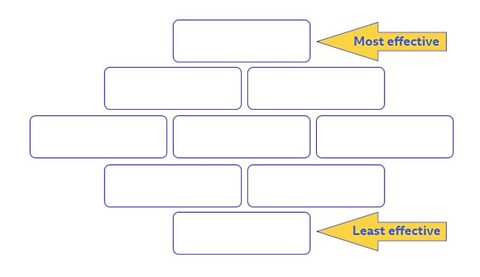
Remember: You can move the features around - don’t be afraid to change your ideas.
Top tip!
Sketch out the diagram to save yourself time!
Activity 2

Read the following article from Bitesize History about Emmeline Pankhurst.
Imagine what Emmeline would have written in her diary on these three key dates:
- 1903 (when she set up the WSPU)
- 1914 (when the First World War began)
- 1918 (when the First World War ended)
Use the information from the article to support you in writing a few sentences for each key date. You could recount the event and then add emotion.
Remember to write in the first person and use the past tense!
Activity 3
Watch this video about explorer Ibn Battuta and his journey to Mecca.
The life of Ibn Battuta.
OLLIE: Who shall we look up today?
FATIMA: My grandmother told me about this amazing explorer, Ibn Battuta. He was a Moroccan explorer from way, way back; the 1300s, I think. Can we look him up?
OLLIE: Sounds great. Holo-Lab, let’s meet Ibn Battuta.
HOLO-LAB: Searching. Searching… Explorer found. Ibn Battuta.
FATIMA: Wow! Before Henry VIII. Before Guru Nanak.
IBN BATTUTA: As-salamu alaykum!
OLLIE & FATIMA: Alaykumu s-salām.
FATIMA: Tell us about the places you’ve explored.
IBN BATTUTA: My journey started when I wanted to undertake the Hajj, a pilgrimage to the holy city of Mecca, to visit the Kaaba, the house of God. I left when I was twenty-one, in June 1325.
OLLIE : Was it far?
IBN BATTUTA: It was nearly 3,000 miles as the crow flies, from my home in Tangiers in Morocco, but I had to travel by land. I made a point of never travelling on the same road twice. And because I wanted to explore, I stopped at many wonderful places.
FATIMA: Where did you stop?
IBN BATTUTA: I travelled 2,200 miles to Alexandria which took 34 weeks, when I saw the lighthouse of Alexandria, before heading to Cairo where I saw the Great Pyramid of Giza. Two of the seven wonders of the ancient world. It was hard to get to Mecca. The first time I tried, I was beaten back by bandits so I spent Ramadan in Damascus, before heading south 810 miles to Medina and then finally, Mecca.
FATIMA: Did you walk all that way? How did you know which way to go?
IBN BATTUTA: I travelled using camels and I had the stars to guide me.
OLLIE: Why did you use camels?
IBN BATTUTA: Life in the desert is hard. There is little to eat or drink. Horses are no use there, but because camels have lived so long in the desert, they have adapted to travel far without water and to store fat in their hump to feed on. You can ride them or use them to carry things.
FATIMA: How do stars guide you?
IBN BATTUTA: We didn’t have satellite navigation like you do, to tell us which way to go. However, by observing the sun, moon and the planets, you can fix your position and work out in which direction you’re going.
FATIMA: What was the holy city of Mecca like?
IBN BATTUTA: It’s a special place for Muslims. I was so taken with it that I returned many times and spent many months there.
OLLIE: What did you do after you went to Mecca?
IBN BATTUTA: Normally after being away so long, you would go home but I didn’t go back to Morocco for 24 years. My Rihla, or Journey, lasted for 29 years, covering 75,000 miles. That’s further than three times around the Earth. I visited 44 countries, from Tangiers in the west, and travelled as far east as Quanzhou in China where I saw the Great Wall. And from Bolghar in modern day Russia to Kilwa in Tanzania. I witnessed the spread of Islam across the globe.
As I travelled through places like India and Mali in Africa, I met many important people like princes and princesses, queens, kings and emperors.
FATIMA: Wow!
OLLIE: What was it like when you returned home?
IBN BATTUTA: I had lived many lifetimes on my travels. The place I came back to in 1355 was not the same as the one I left. Imagine being away from your friends and family for 29 years. But I had with me a wife, and began a new life. I wrote the story of my travels and later in life, became a Judge.
FATIMA: Thank you for sharing your journey with us, Ibn Battuta.
OLLIE: Goodbye.
IBN BATTUTA: Ila-likaa.
Watch the video again. This time, write down the key events of Battuta’s journey and how he may have been feeling.
Imagine that you are Ibn Battuta. Write a diary entry for part of the incredible journey.
You might write one entry to describe a single day OR several entries to describe a few days of his adventure.
Remember to include some of the key features of a diary.

Top tip!
In your concluding paragraph, you could:
- Pose a question to the reader
For example:
How would you feel if you had no water and were stranded in a vast desert?
- Look forward to the future
For example:
As I look towards the coming days and weeks, I’d love to make it to Mecca soon!
Play our fun English game Crystal Explorers! game
Use grammar, punctuation and spelling skills to explore jungles, caves and tombs on your mission.

More on Non-fiction
Find out more by working through a topic
- count17 of 18
- count18 of 18
- count1 of 18

- count2 of 18