What’s in a name? A lot more than you might think.
The study of place names is known as toponymy, and it can tell us a lot about who held power in an area and the amount of influence they had over the local language.
Before the Norman invasion of 1066, Britain was invaded over and over again, and each time the new settlers left their mark. Under Roman rule, York had been known as ‘Eboracum’. With the Anglo-Saxons it became ‘Eoforwic’ before being changed by the Vikings to ‘Jorvik’.
Journey with us into the past as we uncover the history hidden in plain sight in place names.
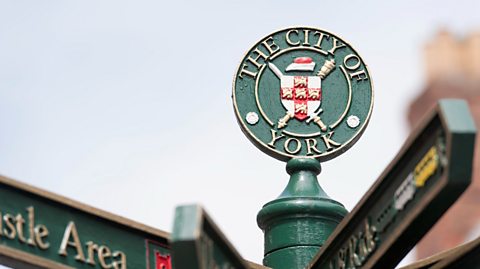 Image source, georgeclerk
The Celts
During the Iron Age, from around 800BC until the Roman invasion of AD43, Britain was inhabited by various different Celtic tribes. Their languages can be split into two broad groups, known as Goidelic/Gaelic and Brittonic/Brythonic. The former would evolve into Irish, Scots and Manx, whilst the latter would become Welsh and Cornish.
Some of England’s most famous rivers are thought to be Celtic in origin, including the Avon (which meant river in Brittonic), Derwent, Severn, Tees, Trent and Tyne. The Welsh word for the mouth of a river, ‘aber’, was used as a prefix for settlement names e.g. Aberystwyth, Abergavenny and Abergele.
Continuing with the geographic inspiration, the Brittonic ‘pen’ translates as hill or headland and can be found in Penarth, Penrith, Penzance, Pendleton and more.
The Romans
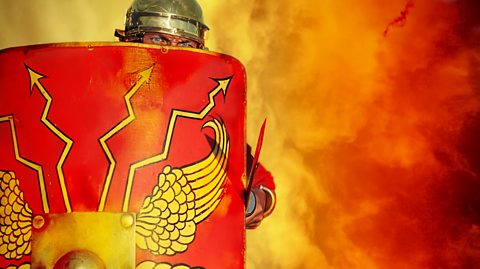
In AD43, the Roman Emperor Claudius successfully invaded Britain with around 40,000 soldiers. The Roman army would remain in Britain for the next 300 years, and certainly left a military imprint when it came to place names.
In Latin, the term for a fortified military encampment was ‘castrum’. This word would later evolve into the suffixes ‘-chester’, ‘-cester’ and ‘-caster’, all of which can be found in the names of towns and cities with links to the Roman military:
- Colchester
- Lancaster
- Leicester
In Wales, ‘caer’ was used to signify a fortified settlement, giving us Caernarfon, Caerleon and Caerwent.
 Image source, Christopher Hope-Fitch
The Anglo-Saxons
Following the withdrawal of the Roman army in AD410, the Anglo-Saxons became the dominant force in Britain. These Germanic and Scandinavian tribes were not a single united people, but rather warring groups who settled in different parts of Britain and formed their own kingdoms.
However, their contribution to British place names was significant. Obvious examples include the name of England itself (Land of the Angles), as well as the county of East Anglia, which was the territory of the East Angles.
Two common Anglo-Saxon suffixes that have stood the test of time are ‘-ham’ and ‘-tun’ (now -ton), which indicate a village or settlement.
Sometimes, the Anglo-Saxons would name a settlement after an important local figure. The suffix ‘-ingas’ (since shortened to -ing(s)) would be used to declare that somewhere belonged to a particular family and its followers. For instance, Hastings was named for a man called Hæsta.
The same idea would also occur with ‘-ham’ and '-ton’. Birmingham was named for a man called Beorma, whilst Wolverhampton was named for a noble lady called Wulfrun.
It wasn’t just people who would get a shout-out though. The Anglo-Saxons would sometimes highlight an animal in their naming choices. Swine is another name for a pig, and so Swinton translates to pig farm or settlement. Similarly, Oxford got its name from a shallow point in a river (a ford) where it was safer for ox to cross.
Within some Anglo-Saxon place names, there are hints to what you might expect to find in the local landscape. The word ‘mutha’ was used to describe the mouth of a large river, or estuary, and so can be found in the name of coastal settlements like Plymouth, Exmouth and Yarmouth.
Other Anglo-Saxon place names suggest religious links. A community of clergy, a monastery, was known as a ‘mynster’, which led to the naming of places like Westminster, Kidderminster and Leominster.
Image source, Christopher Hope-FitchThe Vikings
The majority of place names of Viking origin can be found in the north and east of England, in the region known as the Danelaw, the west and north of Scotland and the Isle of Man.
An outlying farm was known in Danish as a ‘thorp’, to which an extra ‘e’ has since been added to give us names like Scunthorpe and Countesthorpe. A farmhouse or village was identified with the suffix ‘-by’, as seen in Selby, Grimsby and Wetherby.
As with the Anglo-Saxons, Viking place names were often linked to the local geography. A clearing in a woodland, or a meadow, was known as ‘-thveit’ which has since become ‘thwaite’, e.g. Slaithwaite.
The harbour town of Stornoway in Scotland’s Western Isles, translates from Old Norse to ‘Steering Bay’, perhaps highlighting how carefully boats had to manoeuvre. The island of Scalpay literally means ‘boat-shaped island’ while the island of Jura is ‘deer island’.
Most of the surviving Viking place-names in Ireland and Wales are found along the coast or as islands. Whilst the Welsh name for Anglesey (Ynys Môn) pre-dates the Viking period, the Viking’s named it Ongulsey after an unknown individual called Ongull.
The large sea loch Strangford Lough and the nearby village of Strangford, in County Down, Northern Ireland, take their name from the Old Norse for 'strong fjord', thanks to the strong tidal currents at the inlet's narrow entrance. The Battle of Strangford Lough was fought in AD877 between two rival Viking groups.
Rather than completely change some pre-existing place names, the Vikings sometimes simply changed the pronunciation to suit their speech. Sounds like ‘sh’ and ‘ch’ became ‘sk’ and ‘k’. For example, Shipton became Skipton.
 Image source, Alan Novelli
The Normans
1066 famously saw William the Conqueror defeat King Harold at the Battle of Hastings, and claim the English crown.
Norman knights who had supported King William I in his invasion were rewarded with land and property. In some cases, these areas took on the surnames of the family who controlled them. For instance, Redmarley d’Abitot was held by the d’Abitot family, while the Copeland Islands off the coast of Northern Ireland are thought to have been controlled by the de Coupland family.
Similar to the Vikings, the Normans also amended the spelling and pronunciation of existing place names. The ‘s’ was dropped from the start of ‘Snottingham’ to give us Nottingham, a change that today’s residents are probably relieved about.
This article was published in August 2022.
Five words that have changed their meaning
Why we used to call serious people 'silly' - and other language curiosities.

Five things we get wrong about the Roman conquest of Britain
We look at five things you may not know about the Roman invasion of Britain.
The stories behind some of the UK's street names
Why is it a Royal Mile - and why aren't the Welsh Streets in Wales?