By Francesca Laws, Schools Programmes Manager, National Portrait Gallery, London and Richard Ansett, Photographer
Making a portrait on a phone or camera is a creative and empowering way for your child to take their first steps into photography and art.
Depending on their age and photographic ability, your child can create their own portraits independently or with your support.
Portrait photographer Richard Ansett’s early experiments with the camera helped him explore his relationship to the world as an adopted young person and he believes passionately in the power of the camera as a way to explore otherwise hidden and difficult feelings. Here he offers some tips for creating an amazing portrait at home with a phone or camera, and shares some of his own photographs.

1. Photographer and sitter
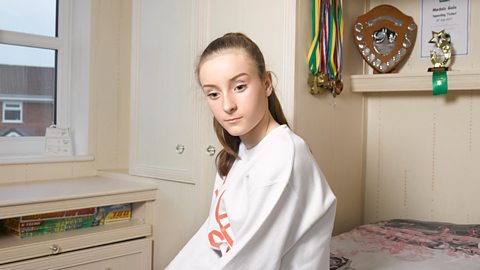 Image source, RICHARD ANSETT
The portrait is a story as much about you as the person you are photographing.
It is important to start by asking your sitter or sitters if they will let you take their picture. Once you have permission, you can work together to get a portrait that says something special.
Make your sitter or sitters feel important!
- They might be shy, so be patient and try not to get upset with them. You could try making some photos of them hiding to help them get used to you and the camera and the attention.
- When making portraits with people, ask simple questions to help them think about their feelings and photograph those moments.
- Stay focussed on them and make sure they know you care about what they think and feel.
- Go with what your sitter is feeling even if it is not what you want sometimes.
- Try not to be too bossy, but be assertive when you want them to do something. Try to work in silence sometimes and see how your subject responds and take pictures of that.
- Check that your sitter is comfortable with you photographing them when they are not aware - perhaps in a moment of thought. Always share these with them afterwards to check they are comfortable with them.
2. Generating ideas
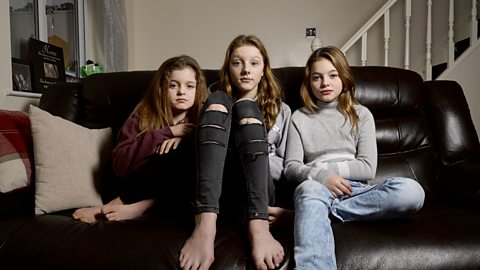 Image source, RICHARD ANSETT
How can you help the viewer understand your life in an image?
- Think about the emotions you have shared as a family at home recently.
- Write down thoughts, draw a mind map, or talk these through with each other.
- Try not to feel limited by what you think other people might think.
- Trust your idea and find a way to do it, no matter how crazy it might feel.
What is most important is telling a story about you and your sitter/s.
- Try and stay open to what a great portrait might be. The best picture might not be what you are expecting!
3. Expressing ideas
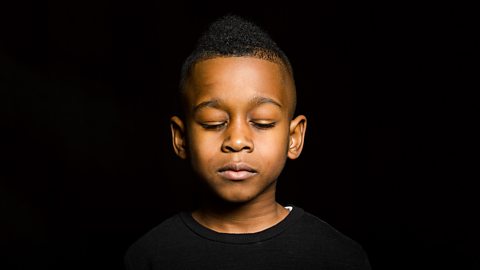 Image source, RICHARD ANSETT
Sometimes we can find it hard to express our feelings directly and the camera can help us! It can give us a reason to explore sides of ourselves we might find difficult to share normally.
- There is no such thing as a bad idea!
- Don’t be afraid to try out different ways to express yourself.
- It can feel scary to show a vulnerable or secret side of ourselves to others, but the camera is a great way to communicate to other people what your life is like.
- Try anything and if you aren't happy with it, you can delete it and try something else. Experiment!
4. Take lots of pictures
 Image source, RICHARD ANSETT
We have many expressions that communicate different emotions and the camera will capture all of them. When you have lots of images, go through them and choose a few that represent what you want to say.
- Try not to just choose the prettiest or the nicest.
- Think about which picture most represents your feelings and the theme.
5. Lighting and props
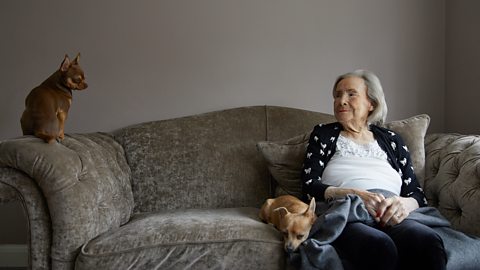 Image source, RICHARD ANSETT
The way the light looks in a portrait is a very important part of conveying the emotion you want other people to feel.
- Experiment with the light in your home. Ask permission if you want to move a lamp to create the feel you want.
- Work within your means and experiment with what is to hand.
- Think about which items are important to you such as toys, pictures, household objects or possessions. Play around with how to include these in your photograph and how you will pose.
- Create a studio by using a sheet as a backdrop and make homemade props!
6. Reviewing your pictures

- Don’t delete your portraits too quickly. If you aren’t happy with them, ask why. Try to leave them for a little while and come back to them, and see how you feel - otherwise you might delete a picture you later regret, or that other people think helps to understand you.
- When you have taken lots of different pictures sit down, go through your pictures with your sitter and listen to how they feel about them.
- Select the images that you think best communicate your feelings too and talk together about the images you’ve made.
More from BBC Bitesize Parents' Toolkit…
Parents' Toolkit
Fun activities, real-life stories, wellbeing support and loads of helpful advice - we're here for you and your child.



Rob Biddulph's five tips to help you confidently draw with your kids
Rob Biddulph, author and official illustrator for World Book Day, has some great tips and tricks to share to help you draw with your kids.
Christine McGuinness - How my autism can help me to help my kids
Christine McGuinness talks about the positives and challenges she's faced through her life as a mum since diagnosis.

Filmmaking at home - how your child can learn the basics
How parents can help their little ones get started with filming and editing their own films at home.