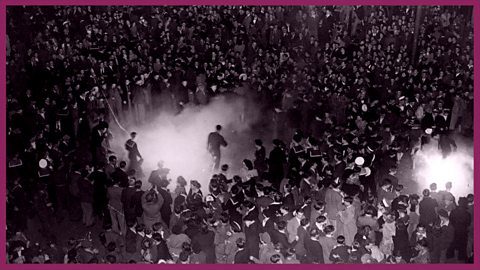
Victory in Europe Day, or VE Day, didn't signify the end of World War Two, but marked the end of the fighting against Nazi Germany in Europe.
Meanwhile, major changes to how people would live their lives - in the United Kingdom and the rest of the world - were yet to be revealed.
So what happened next after 3pm on 8 May 1945, when UK Prime Minister Winston Churchill made an announcement on the radio that the war in Europe had ended, after Germany's surrender the day before? BBC Bitesize looks at how the world would never be the same again after that day of celebration.
The atomic bomb and its impact on the world
Although the fighting in Europe was over in May 1945, the Allies - which included the UK, USA and USSR (the former Soviet Union) - were still fighting against Japan in east Asia.
The Allies told Japan to surrender, giving it a deadline of 26 July 1945 - but it passed without them doing so. The US then dropped two atomic bombs on the country, with the city of Hiroshima targeted on 6 August and the city of Nagasaki being hit three days later. Around 214,000 people were killed in the blasts and Japan was forced to admit defeat.
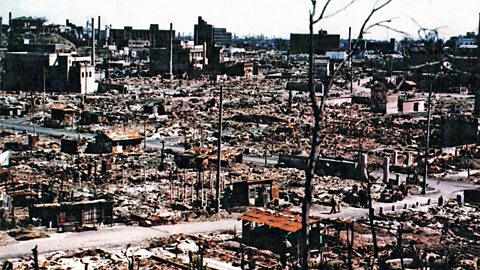
US president Harry S. Truman broke the news of its surrender at a press conference at the White House at 7pm on 14 August. At midnight, Britain's new prime minister Clement Attlee confirmed the news, saying: "The last of our enemies is laid low." He then announced two days of national holiday to celebrate Victory in Japan Day, or VJ Day - on 15 and 16 August.
Some historians have suggested the atomic bombs might also have been intended as a warning to the USSR regarding the strength of the American military. The USA and USSR had been able to join together in an uneasy alliance against Nazi Germany during World War Two. However, once the war was won, this alliance began to fall apart and the ideological differences between the two countries developed into a "Cold War" - a state of extreme mutual hostility which provoked many crises in the coming decades, including the building of the Berlin Wall in 1961.
The beginnings of the Cold War
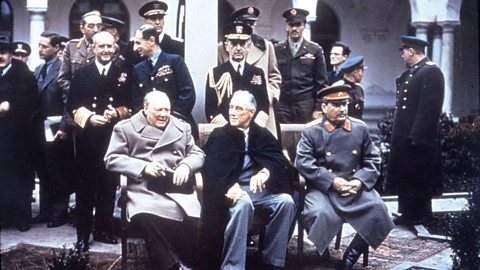
At the Yalta Conference - held between 4 February and 11 February 1945 in the Crimea region of the USSR - it was decided Germany would be split into four zones at the end of World War Two, with the Soviet Union, UK, USA and France controlling one each.
Berlin, which was to be in the Soviet zone, would also be divided into four sections - France would control the north-western zone, the UK the western zone, and the USA the south-western area, with the whole of the eastern part of Berlin allocated to the Soviet Union.
Tensions between the victorious powers soon led to the start of the Cold War, which affected the entire world - but especially Berlin. In August 1961, the Soviet Union began building a wall around West Berlin. It remained in place until 1989, becoming a symbol of the division between East and West.
Austria, which had been incorporated into Germany by Adolf Hitler in March 1938, was liberated by Soviet troops in April 1945. The USSR then allowed a new Austrian government to form and appointed a new mayor of Vienna, before, in July 1945, the Allied powers agreed that an Allied Commission for Austria with representatives from the USA, UK, France and the Soviet Union would control the country.
Vienna was divided into five occupation zones - one zone for each of the Allied powers and one international zone in the city centre. Austria remained officially under four-power occupation until 1955. Then a treaty signed by the USA, UK, France and the Soviet Union established an independent but neutral Austria. The four powers withdrew their troops, and Austria joined the United Nations.
The founding of the welfare state and the NHS in the UK
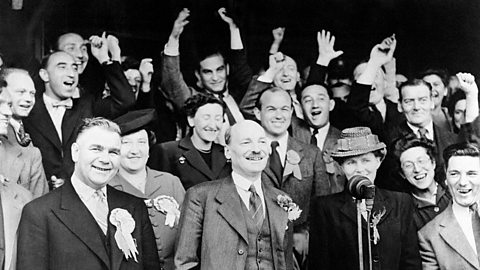
The UK went to the polls on 5 July 1945, just eight weeks and two days after Winston Churchill, the Conservative leader of the country's wartime coalition government, announced Victory in Europe Day.
Clement Attlee's Labour Party defeated Churchill in a landslide victory. Attlee's government went on to create the country's welfare state and National Health Service, and it was Mr Attlee who was in 10 Downing Street when VJ Day was announced on 15 August.
The seeds for the great post-war changes in the UK were sown from 1941, when Liberal politician William Beveridge set to work finding out what kind of Britain people wanted to see when peace was secured. His report, published in December 1942, was entitled Social Insurance and Allied Services, and it recommended a comprehensive welfare state and National Health Service.
There was widespread support in the country for the report's findings - and, when it became clear that the war would soon be over, people expected to be able to enjoy the fruits of victory after living through a terrifying and traumatic six years. Attlee also nationalised one fifth of the economy - including the coal industry, electricity utilities and the railways - and overall, his government significantly reshaped British society between 1945 and 1950. After an election in 1950 led to a smaller majority and disagreements within the government, Attlee called a snap election in 1951 resulting in defeat and the return to power of Winston Churchill.
The United Nations charter
Between April and June 1945, as the war drew to a close, representatives from 50 countries met at the San Francisco Opera House to draw up the Charter of the United Nations. The UN's aim was to maintain international peace and security and to achieve cooperation among nations on economic, social and humanitarian problems. Its forerunner was the League of Nations; an organisation established under similar circumstances following World War One.
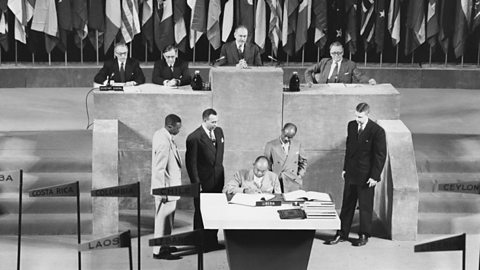
Although it was signed by the representatives of the 50 countries involved on 26 June, the terms of the charter were not ratified until 24 October - the date celebrated as United Nations Day. Poland was allowed to join in October 1945, making a total of 51 members, though the organisation has grown considerably since then.
As of 2025, there are 193 member states. The UN Security Council, which has primary responsibility for international peace and security, has 15 members - five of whom have permanent seats: the UK, USA, China, France and Russia (who took the former Soviet Union’s seat in 1991).
This article was published in May 2025
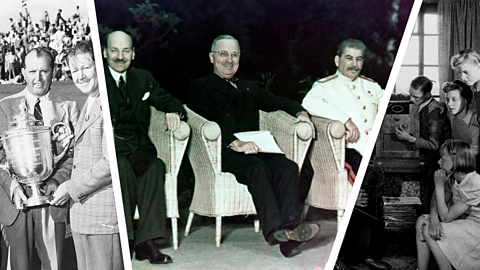
What did the world look like when the UK last had a July general election?
World politics, entertainment and sport: find out more about what was going on when the UK had its last July election in 1945.
Countdown to Hiroshima
BBC Teach
History KS2: VJ Day
BBC Teach