

About the Mara
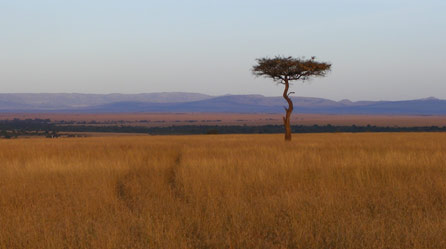
A view over the Mara Reserve
The Masai Mara National Reserve is in south-west Kenya on the border of Tanzania. It lies within the enormous Great Rift Valley, a 5,500km long fault line that runs from the Red Sea through Kenya and Tanzania and into Mozambique. The Mara sits at an average altitude of 1500m.
Over the Tanzanian border lies the Serengeti and the two plains serve as the migration route for millions of plains animals. It's this influx of prey animals that makes the area so good for the big cats.
The reserve was established here in 1974 and covers around 1,500km² of plains grassland and woodland. Clumps of flat topped acacia trees dot the landscape giving small patches of shade. The Mara river cuts through the reserve giving it its name.
Over a million wildebeest, 200,000 zebra and 350,000 Thomson gazelles form some of the huge plains herds.
Great Migration
The great migration is one of the largest mass movements of land animals on the planet. It is a quest without end for about two million ungulates as they continually follow the rains for fresh grass to graze and water to drink.

It's hard to picture just how many animals are involved in the migration: over a million wildebeest, 200,000 zebra and 350,000 Thomson gazelles form some of these huge plains animal herds. It's only through this continual journeying in search of new pastures that the wildebeest and other grazers are able to build up such large populations.
The migration has no beginning or end but is a continuous, clockwise, 3,000km round trip through the Serengeti ecosystem. The great herds spend December to March on the short grass plains of the Serengeti, the mass migration moves north and west when the grass is exhausted and the rains leave. After a dangerous crossing of the River Mara, the next few months are spent on the lush plains. The return to the south Serengeti plains follows the rains – and the cycle begins again.
In this section

On the Website
Big Cat Raw: the final episode
Cam Highlight: John Aitchison's Web Safari
More on the Web
The Mara Triangle Online
Read the Mara Triangle blog – written by anti-poaching wardens working in the area
Masai Mara National Reserve
More about different parts of the Mara reserve
BBC Radio 4: Serengeti March
Listen again to a soundscape of one of the greatest migration stories of them all

