
Hands-on challenge: String around the Earth

How long's a piece of string?

Imagine a piece of string wrapped around the Earth's equator - that's about 40,000km. How much MORE string would you need for it to sit 15cm above the ground, all the way around?
A) 1 metre, B) 1 kilometre or C) 1,000 kilometres
String fact not theory
Answer A is right!
(In fact 1 metre extra would lift the string by 15.9cm.)
Sense of proportion
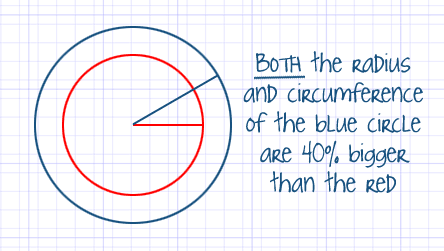
The important thing here is to get a sense of proportion. The circumference of a circle is directly proportional to the radius. Double the radius, double the circumference. Half the circumference, half the radius. Increase the circumference by 40%, increase the radius by 40% and so on.
The magic ingredient
In the case of our 'string around the Earth' puzzle, the radius is being increased by 15cm, so we need to know that as a fraction of the original radius.
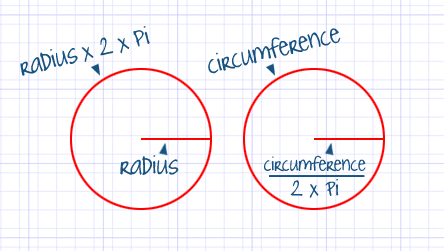
So what is the radius to start with? Well, that's where pi (pronounced 'pie') comes in. Pi is a constant - it's about 3.14. The circumference of any circle is the radius multiplied by two multiplied by pi, so we can work it backwards to get the radius from the circumference - just divide by two and then divide by pi.
Do the maths
40,000 divided by 2 is 20,000. Divide again by pi to get the Earth's radius - 6,370km. 15cm (that's how far off the ground we're lifting the string, remember) out of 6,370km is close to one part in forty million. The string was forty million metres long to start with, so we need just an extra 1 metre.
The really odd thing, though, is that this doesn't actually depend at all on the size of the Earth - an extra metre of string will lift it 15cm off the surface of the Moon, or Jupiter, or a ping-pong ball. How can that possibly be?
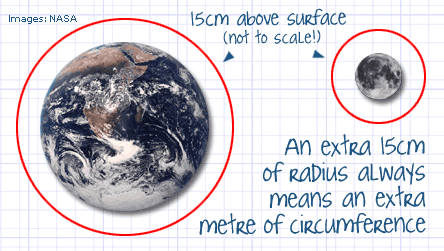
Well, right at the beginning I said that the radius and circumference of a circle were always in proportion and that if you change one you change the other by the same amount.
An extra 15cm above the moon is a much larger proportional change in the radius (about one part in eleven million rather than one part in forty million) and the same change applies to the circumference... which is much smaller to start with. So we take a larger proportion of a smaller thing, the effects cancel out and we still need just an extra metre of string.
Dr Ian Johnston (known as Dr Megaphone to Bang roadshow visitors) is a Lecturer in Engineering with the Open University.
Up close and quizzical
Stand close to a vertical bathroom mirror and move back. Do you see:
- 1. more of yourself
- 2. less of yourself
- 3. the same?

Science speak
- Sir Isaac Newton, physicist, mathematician, alchemist, philosopher (1643-1727)
BBC iD
BBC iDBBC navigation
BBC links

BBC © 2014The BBC is not responsible for the content of external sites. Read more.
This page is best viewed in an up-to-date web browser with style sheets (CSS) enabled. While you will be able to view the content of this page in your current browser, you will not be able to get the full visual experience. Please consider upgrading your browser software or enabling style sheets (CSS) if you are able to do so.

