Hands-on brainteaser: mirror reflections

Up close and quizzical

Dallas asked: "If you stand close to a vertical bathroom mirror and then move back, what do you see?"
A) More of yourself, B) Less of yourself, C) The same
Face the facts
Answer 3 is correct. You see the same no matter how far back you go.
This may seem counter-intuitive. We've all checked our reflection before going out, and it seems natural that to see our whole body (and snazzy outfit) we simply have to step back from the mirror.
So what's going on?
Law of reflection
The important thing to know about mirrors is that a ray of light shining on a mirror at an angle will reflect off the mirror at the same angle - rather like a snooker ball bounces off a cushion.
In physics we say that the angle of incidence equals the angle of reflection. This is known as the law of reflection.
Standing in front of a mirror, some of the light bouncing off you hits the mirror and then bounces into your eyes.
That can be a bit hard to think about, so let's reverse the process: follow the light backwards from your eyes on to the mirror and then back on to you. This is what we call a line of sight.
Bathrooms and belly buttons
Imagine looking in the bathroom mirror and seeing yourself as far down as your belly button. Below your belly button is the bottom of the mirror and then just bathroom wall.
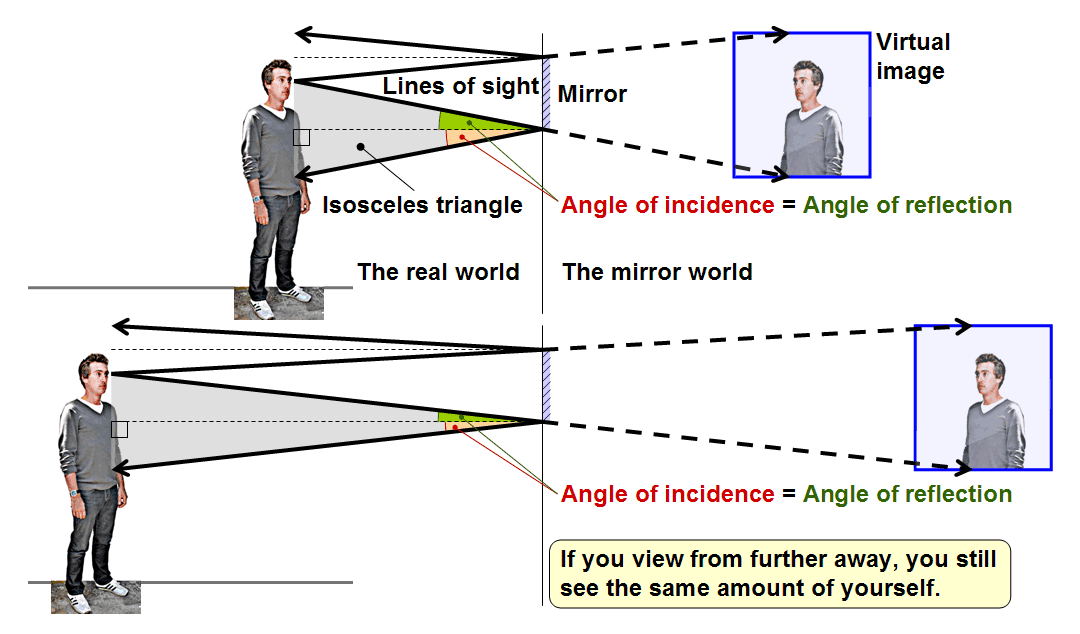
The line of sight goes from your eye to the bottom of the mirror, and then back on to your belly button.
You know from the law of reflection that when the line of sight reflects off the mirror, the angle of incidence equals the angle of reflection.
Another way of thinking of that is that the ray makes the two equal sides of an isosceles triangle, with your body as the third side.
Lines of sight
Even through a telescope
You can see from your belly button upwards because the bottom of the mirror (the tip of the triangle) happens to be at a height exactly half way between your eye and your belly button.
That holds true as long as you don't move up or down - however far away you are from the mirror.
Even if you look at the mirror through a telescope, you still won't be able to see what is below your belly button!
The key to Dallas' question is that the mirror must be vertical. Things are different if the mirror is tilted up or down. You might want to work out what happens there - you have all the physics you need.
Answered by Daniel Ridley-Ellis, Civil Engineer, Edinburgh Napier University, Edinburgh Beltane Beacon.
Rocking the boat

Imagine a boat floating in a lake, and a heavy object such as an anchor (but without a chain) is dropped off the side. What happens to the water level of the lake?
- A. Rises
- B. Falls
- C. Stays the same

Science speak
- Stephen Hawking, theoretical physicist (1942-present)
BBC iD
BBC iDBBC navigation
BBC links

BBC © 2014The BBC is not responsible for the content of external sites. Read more.
This page is best viewed in an up-to-date web browser with style sheets (CSS) enabled. While you will be able to view the content of this page in your current browser, you will not be able to get the full visual experience. Please consider upgrading your browser software or enabling style sheets (CSS) if you are able to do so.