
Hands-on challenge: spaghetti snap

Spaghetti snap challenge

Jem's challenge to Liz: "If you bend dry spaghetti until it snaps, how many pieces does it break into?"
A) Always two, B) Always more than two
Always a bit in the middle
It's almost impossible to break a strand of dry, uncooked spaghetti into just two pieces by bending it from each end.
The effect is thanks to the physical properties of the pasta - you can bend it a lot before it ultimately snaps. So when it does snap, there's a lot of stress within the spaghetti as it springs back to straight.
Snap shots
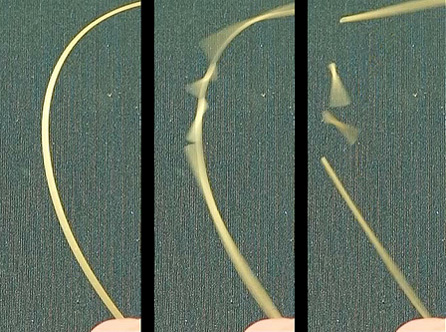
Frames from high speed video of bending pasta strands, courtesy Daniel Ridley-Ellis.
Even if it seems the strand snapped cleanly, look closely and you'll see the broken ends don't match. A tiny piece has flown off.
So what's going on?
Brittle and flexible
Uncooked spaghetti is a brittle material. You can tell by examining broken bits: they are just as straight as the original strand. There is no permanent change of shape.
A spaghetti strand is brittle, but it's also flexible - in fact you can bend it quite a lot before it breaks. If you bend it a little and let go, it will happily straighten again. This is 'elastic strain'; deformation that goes away when the load does. There is a limit to the amount of elastic strain a material can take. At this limit brittle materials fracture.
Bending the spaghetti strand increases the elastic strain until, at a weak point somewhere along the strand, it exceeds the limit. SNAP!
Immediately, the spaghetti pieces are released from the bending you were applying. They want to become straight again and have a lot of elastic strain to get rid of. Waves of stress run through the strand incredibly quickly and prompt further fractures.
Improbable Research
The fractures can happen because of various forces: bending, shearing (cross-sections sliding against each other), tension (pulling) and torsion (twisting). Researchers have used high speed photography to try to establish which are significant in the case of snapped spaghetti, by examining the directions in which the pasta shards fly off.
Two French physicists caught the public eye in 2006 when the Annals of Improbable Research awarded them an Ig Nobel Prize.
Basile Audoly and Sébastien Neukirch's scientific paper - Fragmentation of rods by cascading cracks, why spaghetti do not break in half - showed that as bent spaghetti returns to straight, at points along its length it curves even more than the original bend. Hence the very high likelihood of further fractures.
Answered by Daniel Ridley-Ellis, Civil Engineer, Edinburgh Napier University, and Steven Watterson, Research Fellow, University of Edinburgh, both from the Edinburgh Beltane Beacon.
Up close and quizzical

Stand close to a vertical bathroom mirror and move back. Do you see:
- 1. more of yourself
- 2. less of yourself
- 3. the same?

Science speak
- Edwin Powell Hubble, astronomer (1889-1953)
BBC iD
BBC iDBBC navigation
BBC links

BBC © 2014The BBC is not responsible for the content of external sites. Read more.
This page is best viewed in an up-to-date web browser with style sheets (CSS) enabled. While you will be able to view the content of this page in your current browser, you will not be able to get the full visual experience. Please consider upgrading your browser software or enabling style sheets (CSS) if you are able to do so.

