
Hands-on science: Squish bottle

Squish Bottle

Instant foam
What happens to something airtight when the air around it changes? Find out by making a pressure bottle and squishing some foamy materials.
Download the Squish Bottle PDF (375 Kb). Adobe Acrobat is required.
Step by step
Yan's video guide
In order to see this content you need to have both Javascript enabled and Flash installed. Visit BBC Webwise for full instructions
Dr Yan shows you how to experiment with your squish bottle safely
Checklist
| Difficulty: low | Adult help needed for a couple of steps |
| Time/effort: pretty quick | The build takes only a few minutes |
| Hazard level: take care | Sharp tools, glue and air under pressure |

SAFETY: The bottle must be for a fizzy drink, so that it is designed to hold pressure inside it.
Making a hole through the bottle cap is a job for an adult.
If you use any glue or sealant, follow its instructions.
During pumping, anyone standing over the bottle must wear eye protection: safety specs or glasses/sunglasses with plastic lenses.
Do not overpressurise the bottle. While pumping, squeeze the bottle frequently to see how firm it is. If you cannot easily squeeze it by hand, stop pumping.
You need
One plastic fizzy drink bottle, with plastic screwtop cap
A valve from a bicycle inner tube. Cycle shops will often give you old punctured ones
A pump that fits the valve. Hand pumps or foot pumps are fine
Possibly: glue, sealant, plasticine or Blu-Tac
A little washing up liquid and some water (about 100ml)
Alternative: some marshmallows
What you do
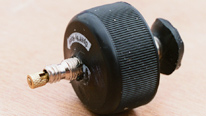
The valve screws on to pressurise the bottle
Use scissors to trim away the rubber around the inner tube valve. It needs to fit through the neck of your bottle.
Safety: Adult help required for the next step.
With a screwdriver, sharp scissor point or drill, make a hole in the bottle cap, a bit narrower than the valve stem. Push through from the cap's inside to its top.
Push the valve stem through the hole, again from the inside.
Pour a small amount of water and some washing up liquid into the bottle. The amount isn't critical.
Screw the bottle top valve on firmly and take it somewhere outside.
Safety: While pumping, people close by need eye protection. Squeeze the bottle frequently to check the pressure inside.
Connect the pump and start pumping gently and steadily. Test how firm the bottle gets, to judge when to stop. For an ordinary hand bicycle pump and a 2 litre drink bottle, 30–50 pumps is plenty.
Remove the pump and shake the bottle up to make bubbles inside.
Release the pressure in the bottle by tapping the valve. (An adult could unscrew the top instead.)
Alternative: If you shake the bottle before you pump up the bottle, you'll see the bubbles do something different.
Marshmallow method
You can try marshmallows rather than soapy water, to see the effect that pressure has on them. Dry the bottle as much as you can before putting the marshmallows in. You don't need to shake the bottle at all.
What should happen
Changing the pressure changes the volume of the bubbles. The number of bubbles doesn't change, just their size.
Increase the pressure (by pumping more air in) and the foam will shrink. Decrease the pressure (by letting high pressure air out) and the bubbles grow. With a bit of practice, you can make foam gush out of the bottle just by touching the valve.
Marshmallows are made of foamy cells with air inside so you can crush them with high pressure and they'll expand again as air rushes out of the bottle.
If it doesn't work for you
Examine the join where the valve goes through the bottle cap. If there are visible gaps or you can hear air escaping, consider using some glue, sealant, plasticine or Blu-Tac to make it more airtight.
For the most impressive bubbles, experiment with the volume of water and the amount of washing up liquid that you use.
Water Bottle Rocket
If you have made a Squish Bottle then you have almost everything you need to build and fly a Water Bottle Rocket. Watch Yan's video activity guide and have a go.
What's going on?
Growing bubbles
When you make a soap bubble you put a delicate - but airtight - wrapper around a blob of air. The number of air molecules in the bubble cannot change.
The pressure of the air inside can change though. In fact, the bubble wall is so flimsy that the pressure inside the bubble has to match the pressure outside.
Make a bubble from air that's under higher than normal pressure and - for the same volume of bubble - you trap more air molecules inside. But the bubble looks no different to one that formed at standard atmospheric pressure.
The volume and pressure of air (or any gas) are related. Unless the temperature changes, as volume goes down, pressure goes up. (Hopefully that sounds like common sense, squeeze something and it will press back more against its container.)
The reverse is true as well. If a gas expands in volume (at fixed temperature) then its pressure falls.
When you release the high pressure by tapping the valve or unscrewing the bottle cap, the bottle air pressure - outside the bubbles - goes down. The bubble air pressure has to match the change, so the bubbles expand.

Dr Yan has also been getting his head around exactly why your kettle bubbles before it boils.
Gas laws
The way in which the pressure, volume and temperature of a gas are related is described by a law of physics. The law has several names - including Boyle's law and the ideal gas law - and gets expressed in several different ways.
Here, it's useful to state it as: if no gas is added or escapes, and the temperature doesn't change, then
Pressure × Volume = a constant, fixed number
So doubling the pressure inside the squish bottle will halve the volume of the bubbles.
BBC iD
BBC iDBBC navigation
BBC links

BBC © 2014The BBC is not responsible for the content of external sites. Read more.
This page is best viewed in an up-to-date web browser with style sheets (CSS) enabled. While you will be able to view the content of this page in your current browser, you will not be able to get the full visual experience. Please consider upgrading your browser software or enabling style sheets (CSS) if you are able to do so.

