
Hands-on science: Water bottle rockets

Water Bottle Rockets

Wet Jet Go!
This stunt has lots going on: air pressure, a satisfying 'whoosh' noise, a high speed departure and a good soaking if you are standing close. It's classic science that's fun to do as a family or a team. Practise and challenge your friends!
Download the Water bottle Rockets PDF(378 Kb). Adobe Acrobat is required.
Step by step
Yan's video guide
In order to see this content you need to have both Javascript enabled and Flash installed. Visit BBC Webwise for full instructions
Dr Yan shows you how to construct and launch your water bottle rocket safely
Checklist
| Difficulty: moderate | Some adult help needed |
| Time/effort: moderate | Half an hour or so to make. Launching takes seconds |
| Hazard level: slight | Sharp tools while building. Take care at launch |

SAFETY: This rocket uses air pressure to fling a bottle at high speed 20–50 metres.
The bottle must be made entirely of plastic, it must have no sharp points and it must be for a fizzy drink, so that the plastic is designed to hold pressure inside it.
Making a hole through the cork using a drill, punch or awl is a job for an adult.
The rocket launches with little or no warning and can fly in a random direction. Never fire it towards or over anyone.
Before you start pumping, make sure the area you are firing into is empty of people, animals and breakable objects.
You need
One 2 litre plastic fizzy drink bottle
A wine cork that fits snugly in the bottle spout
A valve from a bicycle inner tube, the longer the valve the better. Cycle shops will often give away old punctured ones
A pump that fits the valve. Hand pumps or foot pumps are fine
Something that can hold the bottle, neck down, at an angle to the ground – the handle of a garden fork works well but branches, bits of wood or plant pots will all work as a launch pad
A few litres of tapwater
Alternative: see the Football pump method below
What you do
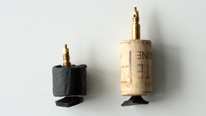
If the valve is too short, cut the cork. Wrap tape around the cork if it doesn't fit snugly in the bottle.
Check the cork will be a good tight fit in the bottle. You can wrap tape around it to make it a bit bigger.
Check the valve is long enough to poke through the cork and still let you attach the pump. You can shorten the cork by slicing it through if you need to.
Safety: Adult help required for the next step.
Make a hole through the length of the cork so that the valve can let air in. Use a drill, or a punch and a small screwdriver. The hole needs to be as small as it can be while still letting the valve go through.
Safety: Choose your launch area carefully so you there's no hazard to you or to anyone else.
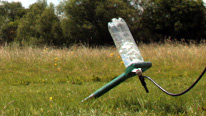
The handle of a garden fork makes a good launch holder.
Make a launchpad that holds the bottle with the neck downwards, lets you attach the pump and stand behind the bottle. One good method is to plant a spade or garden fork in the ground at a low angle and poke the bottle through its handle.
Into the bottle put roughly 500ml of water (a quarter of its capacity). Seal the bottle with the cork and valve. Open the valve and attach the pump.
Safety: Check the launch area is clear before you start pumping. Get anyone watching to stand at least 3 metres back.
Start pumping gently and steadily, keeping the bottle lined up as best you can.
Keep pumping until the cork pops and the bottle flies away.
Football pump method
Here's a simpler design using a pump that has a needle for inflating things like rugby or soccer balls. You don't need the bicycle inner tube valve and you don't need to make a hole in the cork. Instead carefully drive the pump's needle through the cork so you can add air. You will probably get even wetter using this technique.
What should happen
As you pump, you can see air bubbling into the bottle. When the pressure is too great for the cork to contain, the cork is pushed out.
The bottle flies off, leaving a trail of water behind it and probably soaking the person pumping too.
Once the bottle is empty of water, its flight starts to slow.
If it doesn't work for you
If the rocket doesn't fly at all, check two things:
Is water escaping from the bottle? Look around the cork to check if it's sealing reasonably well.
Is air getting into the bottle? Look for air bubbles in the water when you pump. If no, make sure the valve can open to let air through from the pump. It may be damaged or screwed shut.
If the rocket does fly but not very well, there are things you can adjust.
The amount of water makes a big difference. Start with the bottle one quarter full (500ml water in a 2l bottle) and adjust it up or down for best flying distance.
Check that your launchpad allows the bottle to fly cleanly away. You may need to try a few methods depending on your pump and the shape of your bottle.
Flying further
This design is a basic one to show how the principle works. Using just the friction of a cork to hold in the air and water means the pressure can't get very high. And most bottles aren't a great shape for smooth flight.
There are many other, more advanced, rocket designs. Some people compete in national competitions.
Explore the Internet for inspiration and see how you can improve your rocket. There are a few suggested links top right on this page.
Bear in mind that if you change the design, you also need to consider extra safety precautions.
What's going on?
Backwards and forwards forces
Rockets work by ejecting something out of the back and a so-called 'reaction force' then pushes the body of the rocket forward.
Here, water and air are shoved out the back. The water is heavier so that's what gives the bottle the main kick forwards.
The energy to force the water out is stored as air pressure inside the bottle. You supply the energy as you pump air into the bottle.
The air pressure inside builds up and pushes on the water. But friction holds the cork in place and that pushes back on the water, so for a while nothing moves.
Once the friction force can no longer contain the pressure, the cork is shoved out and the pressure then acts on the water to eject it from the bottle.
Compared to the bottle, the water is heavy. So pushing water out at a moderate speed backwards gives the bottle a lot of forward speed.
Sir Isaac Newton
Perhaps you have heard of Newton's laws of motion. Isaac Newton was the 17th century British scientist whose ideas about gravity and other forces transformed science. Oh, and an apple may have fallen on his head.
The water bottle rocket demonstrates two of his laws.
Every action has an equal and opposite reaction. The water moves one way and the bottle goes the opposite way.
The same amount of force can accelerate a heavy object slowly or a light object more quickly. The water is much heavier than the empty plastic bottle.
BBC iD
BBC iDBBC navigation
BBC links

BBC © 2014The BBC is not responsible for the content of external sites. Read more.
This page is best viewed in an up-to-date web browser with style sheets (CSS) enabled. While you will be able to view the content of this page in your current browser, you will not be able to get the full visual experience. Please consider upgrading your browser software or enabling style sheets (CSS) if you are able to do so.

