Photo credit: © Kyla Brettle
Sound can be used in many different ways in a radio package, so you should always be listening out for sounds you can potentially use in your piece.
Here are some examples:
1. General atmosphere
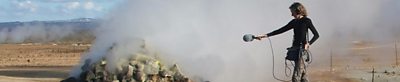
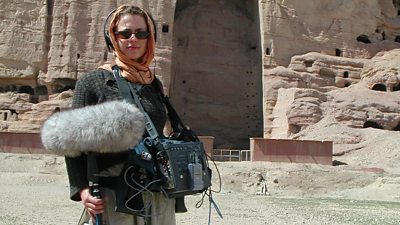
Every location has its own ambient sound.
Capturing this will give your audience the feel of where you're recording, place you at the location and help you smooth over bumpy edits in your interviews.
You should record at least one minute of ambient sound at every place you visit for your piece.
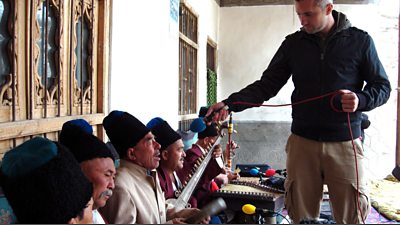
2. Specific sounds
Most locations will have specific sounds that make up the general atmosphere.
For example, at a biscuit factory there will be the general atmosphere of the factory, which you can record by standing in the centre of the factory floor.
There will also be many other specific sounds which make up that environment, e.g. the rattle as biscuits pass down a production line, the sound of biscuits being packed into boxes, conversation between factory workers, etc.
All of these different sounds will add texture to your piece and make it more interesting to listen to. Think of these sounds as the equivalent of close-up shots in TV.
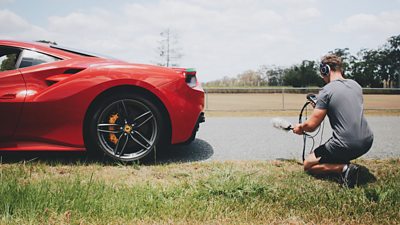
Tip: Get as close as you can to record this sound, otherwise it will sound indistinct from the general atmosphere. Well-recorded sound can be a beautiful thing.
3. Sound as shorthand
There are many sounds we hear every day which can be used to quickly suggest something in a package where scripting would take several seconds, e.g.:
- car engine being turned off, door slam = arriving somewhere by car
- railway station announcement = we're travelling from/have arrived in a train station
- satnav = we’re travelling in a car
- shop assistant asking for money = we're in a shop
But be careful, as sometimes these sounds can become clichéd if overused.
4. Sound as punctuation
If you want to change locations, then suddenly introducing a strong sound can indicate that we have moved on in the story, rather like a full stop and a capital letter at the same time.
It could be music e.g. the sound of a brass band at a country fair, the sound of the air brakes of a bus, a dog barking, a child laughing. It should always be a strong sound.
5. Sound as a bridge
To move from one part of your story to the next and from one location to the next, you can use sound as a bridge.
A cross-fade of sound - that is, fading down one sound as you fade the next sound up - at one location to that at another can be a very effective transition.
Well-recorded sound can be a beautiful thing.
Final tip: Let sound breathe
Don’t be afraid to let good sound play on a little.
If it's well recorded, then the thinking space allowed by a few seconds of sounds can increase the impact of a clip or a piece of script.
It need only be a few seconds, but can be more effective than moving on too quickly.
Downloads
Reflection
Think about what you have just read and complete the following questions. Take some notes. If you are a member of BBC staff you can share your thoughts in the Yammer discussion group.
- What range of sound can you use to help tell your story?
- How will you bring locations to life?
