|
 |
 | | | | | | |||||||||||||||||||||||||||||||||||||||||||||||||||||||||||||||||||||||||||||||||||||||||
| | | You are in: UK: Wales | |||||||||||||||||||||||||||||||||||||||||||||||||||||||||||||||||||||||||||||||||||||||||||
|
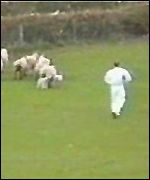
| | Tuesday, 22 October, 2002, 16:01 GMT 17:01 UK Council's �100,000 fine for sheep cull  The sheep cull caused outrage in the locality Monmouthshire County Council has been fined �100,000 for putting people at risk when a sheep cull was carried out by a marksman during the foot-and-mouth crisis. The council had admitted two charges of breaching health and safety regulations at Cardiff Crown Court in May this year. Sentencing had been delayed in order for the trial of the slaughterman, Adrian Walker, 33, to be carried out.
But earlier this month, Mr Walker was found not guilty of flouting the same safety laws the council has been fined for breaking. The incident happened at Gilwern in Abergavenny in April 2001. Mr Walker was filmed by local residents shooting at stray sheep in a field from a distance of at least 30 metres, rather than the recommended 25cm. The amateur video was screened on national television and caused outrage in the local community. Speaking at Cardiff Crown Court, prosecutor Philip Marshall said Mr Walker had been paid �25 per sheep and �10 per lamb that he shot, as well as a �35 call-out fee. He used a .22 rifle to carry out the shootings. "The field was surrounded by public roads. Not far away was a trading estate. All of those were within the range of the rifle," Mr Marshall told the court.
"Although some attempt was made by the police to block off the roads, these did not remove the risk of injury to members of the public. "Mr Walker was clearly inexperienced in using a rifle in the circumstances which he did. He had no experience of shooting unrestrained animals with a rifle. "A policy of tight containment should have been employed by the council. "The council discussed obtaining pens for containment but this was not until later." The court heard the council had "embarked on an operation of which they had no real experience at all and sought no advice". In addition to the fines, the council was also ordered to pay �8,360 in costs. 'Shooting gallery' Council officials had to rely on speaking to police and others over the phone for guidance, Mr Marshall told the court. "Residents described it as a 'shooting gallery' and said that Mr Walker fired 'willy-nilly'," he said.
But the council had accepted that the use of a rifle was a risk to health and safety, he added. Defending, David Travers said the 32 sheep in the field was a "very substantial escape of sheep". He said guidance from government levels was not as "clear, comprehensive and consistent" as it might have been. Officials from the Ministry of Agriculture, Food and Fisheries had become more "accommodating" in providing vets to put stray sheep down, the court heard. He added: "The circumstances of the offence are unusual to put it at its very lowest. It is unlikely that lessons have not been learned." Monitoring Judge John Griffith Williams QC said he was satisifed Mr Walker had not been "sufficiently experienced" to be shooting stray sheep in the open. "At the very least, the officials should have been monitoring the shooting. The evidence is that they remained out of sight. "There was only one safe way to kill sheep in that field and that was to pen them. "The county council's approach to the health and safety arising out of this aspect of the foot-and-mouth crisis fell well below what should be expected of a local authority. "The council immediately after these events introduced a practice of confined slaughter." Video The shootings were captured on video by a local resident, Leslie Smith, as Mr Walker wandered through fields near Gilwern wearing white protective clothing and shooting at 21 ewes and 11 lambs, which had strayed close to a main road. Mr Walker, of Grosmont, near Abergavenny, had held a slaughterman's licence for more than two years and - since he was 16 - a firearms certificate, which police had amended for the cull job. He stopped the shooting after distressed residents living yards from the field voiced their concerns about what was happening. During his trial earlier in October, Mr Walker had told Cardiff Crown Court he was familiar with the area from a young age and was "very proficient" at shooting. He said "safety, safety, safety" had been his main concern on the day. He also told the court he would have used sheep hurdles if any had been available on the day. | |   See also: 04 Oct 02 | Wales 03 Oct 02 | Wales 02 Oct 02 | Wales 01 Oct 02 | Wales 27 Apr 01 | Wales Internet links: The BBC is not responsible for the content of external internet sites Top Wales stories now: Links to more Wales stories are at the foot of the page. | |||||||||||||||||||||||||||||||||||||||||||||||||||||||||||||||||||||||||||||||||||||||||
| |
|  E-mail this story to a friend E-mail this story to a friend |
| |
| Links to more Wales stories |
| | | ||
 | ||||
 | | Back to top
| ||
| ---------------------------------------------------------------------------------- To BBC Sport>> | To BBC Weather>> | To BBC World Service>> ---------------------------------------------------------------------------------- © MMIII | News Sources | Privacy |