|
 |
 | | | | | | |||||||||||||||||||||||||||||||||||||||||||||||||||||||||||||||||||||||||||||||||||||||||||||||||||||||||||||||||
| | | You are in: UK: Politics | |||||||||||||||||||||||||||||||||||||||||||||||||||||||||||||||||||||||||||||||||||||||||||||||||||||||||||||||||||
|
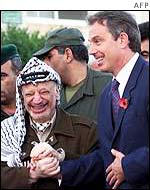
| | Wednesday, 8 January, 2003, 01:28 GMT Analysis: UK-Israeli 'prickly' ties  There have been many public rows between the two sides
On the Israeli side, it is fuelled by a suspicion that Britain plays to the Arab gallery too often. It is as if Israel cannot get over the past and Britain cannot get over the present. Smiling ambassador Ironically, the British Ambassador to Tel Aviv, Sherard Cowper-Coles, has done more for Anglo-Israeli relations than any previous envoy.
He has learned Hebrew (almost unheard of among senior British diplomats) and has been a bridge between London and Jerusalem. Though he, too, has caused the bridge to wobble once or twice by incautious remarks. Most previous ambassadors were sidelined. Even his skills could not forestall this latest row. I encountered the ambassador at a meeting of British diplomats in London, which he was leaving early to return to his post to deliver a calming letter from Tony Blair to Ariel Sharon. He was still managing to smile. "Ninety per cent of the time it is OK but 10% of the time it goes wrong very quickly," said Jerry Lewis the long time correspondent for Israel Radio in London. "Israel thinks that Britain leans on it too hard and not hard enough on the Palestinians," he added. 'Seeds of conflict' Historically, relations between Britain and Zionism began warmly.
In November 1917, Britain declared, in a letter from the foreign secretary, Arthur Balfour, that it "viewed with favour the establishment in Palestine of a national home for the Jewish people". But the letter contained within it the seeds of future conflict for it went on to say that, "nothing shall be done to prejudice the civil and religious rights of non-Jewish communities in Palestine". This proved to be an impossibility. As Jewish immigration into Palestine (then administered by Britain under a League of Nations mandate) increased in the 1920s and 1930s, the "non-Jewish communities" i.e. the Arab population already there rose in rebellion. 'Camel corps' To this day, the Palestinians regard the Balfour Declaration as the source of all their woes. But nor did it satisfy the Zionists. British rule ended in chaos and political violence. The legacy was mistrust. Israel felt that Britain had reneged on the Balfour pledge for a national home and Britain was bitter about the Jewish underground groups, some of whose actions have never been forgiven. There was also sympathy, especially in the British foreign office, for the Palestinians and a fear that British interests in the wider Arab world would be badly affected. This, too, lingers. The Israelis attribute hostility to them as a continuing theme of the foreign office Arabists whom they refer to as the "camel corps". Public spats Over the years, there have been many rows. Only recently, the Public Record Office released files from one such row in 1969 when a previous British Labour government refused to sell Chieftain tanks to Israel, led at the time by the Labour Prime Minister, Golda Meir. There was further bad feeling when the Conservative government of Edward Heath embargoed arms sales to the whole Middle East in the 1973 October War. More recently, British Conservative and Labour ministers have sparked off verbal contests while in Israel and the Palestinian territories. Conservative minister David Mellor publicly reprimanded an Israeli officer and was accused of colonial arrogance by the Israeli media (which is as quick to take offence as the British). Labour minister Robin Cook annoyed the Israelis by protesting about an Israeli settlement at Har Homa near Bethlehem and was lambasted in return. Thorny issues Currently, there are two other issues of contention, apart from the Palestinian conference. The Israelis are complaining that Britain is blocking the sale of military equipment including spare parts for ejector seats in old Phantom jet fighters. The British Government admits that there is a "case by case" decision on each order but no overall embargo. Britain does not want military equipment it provides to be used for internal repression. London is angry that old Centurion tanks (sold during the 1950s and 1960s when Israel was seen as David against the Arab Goliath) were converted into armoured infantry vehicles despite an assurance from Israel that this was not so. Another issue concerns a visit by the new Israeli Labour Party leader, Amram Mitzna. He is being received by Tony Blair at Downing Street, and this is being seen by the Israeli Prime Minister Ariel Sharon as interference in the Israeli election which is being held on 28 January. And although Tony Blair is accepted by most Israelis as a "friend of Israel", that is not a universal view. A commentary in an Israeli paper Maqor Rishon described Mr Blair as a "hostile prime minister who heads a hostile British establishment". Until there is a settlement between Israel and the Palestinians there will be more spats of the kind we are seeing today. | |
See also:  07 Jan 03 | Politics 06 Jan 03 | Politics 20 Dec 02 | Middle East 06 Jan 03 | Middle East 05 Jan 03 | Middle East Internet links: The BBC is not responsible for the content of external internet sites | |||||||||||||||||||||||||||||||||||||||||||||||||||||||||||||||||||||||||||||||||||||||||||||||||||||||||||||||||
 | |
|  E-mail this story to a friend E-mail this story to a friend |
| |
|
| | | ||
 | ||||
 | | Back to top
| ||
| ---------------------------------------------------------------------------------- To BBC Sport>> | To BBC Weather>> | To BBC World Service>> ---------------------------------------------------------------------------------- © MMIII | News Sources | Privacy |






 It is as if Israel cannot get over the past and Britain cannot get over the present