Plans have been laid to grant gay and lesbian partners many of the same rights as married couples. UK Government proposals for legally recognised civil partnerships have received backing from MPs of all parties. BBC News Online outlines a chronological timeline on the issue.
August 1954: The Home Secretary appoints a committee under Sir John Wolfenden "to consider... the law and practice relating to homosexual offences and the treatment of persons convicted of such offences by the courts". September 1957: Publication of the Wolfenden Report on Homosexual Offences and Prostitution, recommending that homosexual behaviour in private between consenting adults, (ie, over 21) should be decriminalised but that curbs on prostitution should be tightened. October 1957: The Archbishop of Canterbury, Dr Fisher, supports the Wolfenden Report: "There is a sacred realm of privacy... into which the law, generally speaking, must not intrude. This is a principle of the utmost importance for the preservation of human freedom, self-respect, and responsibility". The recommendations are also supported by the British Medical Association, the Howard League for Penal Reform, and the National Association of Probation Officers.
Media liberalisation
December 1953: In the House of Commons, Desmond Donnelly (Labour) and Sir Robert Boothby (Conservative) call on the government to set up a Royal Commission to investigate the law relating to homosexual offences. November 1958: The Lord Chamberlain's ban on plays with homosexual themes is lifted, allowing representation in theatre and cinema.July 1967: Sexual Offences Act received Royal Assent, partially decriminalising sex between men - two men over 21 'in private', (ie, no-one else in the same house), neither of them in the Armed Forces or the Merchant Navy. This applied only to England and Wales. 1969: Formation of the Scottish Minorities Group (SMG) to campaign for the decriminalisation of gay sex in Scotland. October 1970: First meeting of London Gay Liberation Front (GLF) at the London School of Economics.
January 1972: National Council for Civil Liberties (NCCL) begins survey on police harassment of gays. March 1972: GLF occupy London's Time Out office, demanding publication of gay advertisements.
Gay couples' register
1979/80: As a result of campaigning by the SMG, the Criminal Justice Act brings Scots law on gay sex into line with English law, decriminalising sex between two men in private. May 1988: The Local Government Act, containing Section 28, becomes law. May 1990: Formation of OutRage! following several murder of gay men.
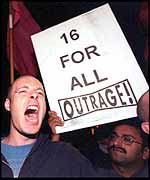 The age of sexual consent was lowered in 2000 |
February 1994: Age of consent for sex between two men is reduced from 21 to 18. An amendment to reduce it to 16 (to bring it into line with heterosexual sex) is defeated in the Commons.June 1998: The Commons votes to equalise the age of consent for sex between two men at 16 but this is defeated in the Lords. February 2000: Commons Speaker Michael Martin invoked the rarely used Parliament Acts to force the measure through. 2001: London Mayor Ken Livingstone made good his election promise to set up Britain's first register for gay couples as a step towards equality under the law for same sex couples, even though the register does not confer legal marriage rights upon them.November 2002: Controversial adoption legislation to give unmarried and gay couples the right to adopt a child completes its passage through Parliament. 



 Equality debate


 E-mail this story to a friend






 TALKING POINT
 85.67%
  14.33%