|
 |
 | | | | | | ||||||||||||||||||||||||||||||||||||||||||||||||||||||||||||||||||||||||||||||||||||||||||||||||||||||||||||||
| | | You are in: UK: Politics | ||||||||||||||||||||||||||||||||||||||||||||||||||||||||||||||||||||||||||||||||||||||||||||||||||||||||||||||||
|
| | Tuesday, 3 December, 2002, 18:17 GMT Blair links Saddam to global terror 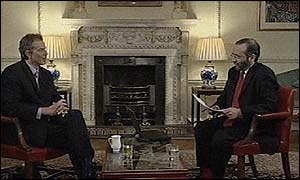 Mr Blair answered BBC News Online users' e-mails A direct link between global terrorists and "unstable" countries like Iraq will develop unless dictators such as Saddam Hussein are tackled, UK Prime Minister Tony Blair has warned. Mr Blair said weapons of mass destruction could find their way into the hands of terrorists with "truly awful" results if the threat from Iraq and other such countries was not dealt with.
Mr Blair was answering questions from BBC News Online users and BBC World Service listeners in a special interactive edition of the phone-in programme Talking Point. The interview in Downing Street was part of the 70th anniversary celebrations of World Service radio.
Mr Blair said: "I have got absolutely no doubt at all that the issue of weapons of mass destruction in the hands of unstable, dangerous rogue states - if that issue is not dealt with, then at some point we will find those weapons in the hands of international terrorists. "And then the destruction will be truly awful." "We have to deal with both threats," he went on.
He added: "They are linked because they have the capability of crossing national boundaries. "They are linked because they are both issues to do with fanatical or extreme political positions that can wreak enormous havoc and danger on the world." He said he believed Iraq was still developing weapons of mass destruction - and warned: "If Saddam refuses to co-operate in any way at all then he must be disarmed by force." He accepted it was difficult for people to get the "full measure" of the threat because "it has not come to our notice through some terrible event". But he added: "It has the potential to become a terrible event." Multi-lateral action He said it was right to take a multilateral approach to Iraq - but he warned that UN route had to be a way of tackling the situation, "not avoiding dealing with it". "We are not going to have unilateral action. If there is a breach by Saddam (of UN resolutions) then the world recognises that action will have to follow." Vowing to act with international law, he said the UN route must not be allowed to "fester". Mr Blair said torture and human rights abuses in Iraq were "unique in scale and intensity".
Mr Blair was asked whether the UK would push as hard for United Nations resolutions to be applied to Israel as it does in relation to Iraq. The prime minister insisted such resolutions should be implemented as well as those dealing with Iraq and the Palestinian territories. Solution But he stressed that Israel was facing "barbaric" acts of terrorism with no peace process in place under which action could be taken on UN resolutions. It was "dangerous" to equate resolutions on Israel with the "very specific" resolutions on Iraq. And he said outstanding UN resolutions affecting other parts of the world were no reason to ignore Iraq. He said the only way of solving the Middle East crisis was a two state solution - Israel existing alongside a viable Palestinian state. And he said terrorism played into the hands of extremists: "The only way of making progress is not to let the extremists win." The debate was widened by one caller who asked why more action was not taken against North Korea. Mr Blair said North Korea did pose a threat to the world, but that a different process - offering the country "the chance to change" - was in place. Asked about Zimbabwe, he said the UK would do what it could to influence the government of President Robert Mugabe. Focus He said it was a "deeply frustrating" situation - and that there were limits to what the UK could do. But he said the UK was helping Zimbabwe by "dramatically" increasing aid to tackle its food crisis. Pressed to do more for Africa - and accused of focusing too heavily on Iraq - Mr Blair said: "I give as much focus to the issue of Africa as I do to virtually any other foreign policy issue in government. "What I find frustrating is that people say 'you deal with this or you deal with that,' but I say you deal with both." Exciting Mr Blair had hopeful words for a questioner from Croatia asking about the country's hopes of joining the European Union. He said it was exciting for such countries to have the prospect of joining the EU should they meet the necessary requirements. Asked about his most memorable moment as prime minister, he said it was the signing of the Good Friday Agreement in Northern Ireland. Paying tribute to the World Service, Mr Blair said it played "an absolutely crucial role" in the world. A week of special programmes are being planned to show how the service has developed - both technically and creatively - over the last 70 years. | | See also:  03 Dec 02 | In Depth 21 Nov 02 | Politics 02 Sep 02 | Africa 03 Dec 02 | Middle East 02 Dec 02 | Talking Point 04 Sep 02 | Politics Internet links: The BBC is not responsible for the content of external internet sites | ||||||||||||||||||||||||||||||||||||||||||||||||||||||||||||||||||||||||||||||||||||||||||||||||||||||||||||||
| |
|  E-mail this story to a friend E-mail this story to a friend |
| |
|
| | | ||
 | ||||
 | | Back to top
| ||
| ---------------------------------------------------------------------------------- To BBC Sport>> | To BBC Weather>> | To BBC World Service>> ---------------------------------------------------------------------------------- © MMIII | News Sources | Privacy |