|
 |
 | | | | | | ||||||||||||||||||||||||||||||||||||||||||||||||||||||||||||||||||||||||||||||||||||||||||||||||||||||||||||||
| | | You are in: UK: N Ireland | ||||||||||||||||||||||||||||||||||||||||||||||||||||||||||||||||||||||||||||||||||||||||||||||||||||||||||||||||
|
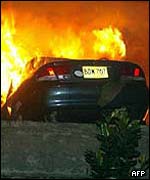
| | Sunday, 9 February, 2003, 15:41 GMT Eyewitness: The Bogota bombing  The fire took two hours to bring under control
The tango, with its sinuous suggestiveness is really an Argentinian invention. But there are plenty of Colombian locals among the ex-pats in Bogota's Cafe Buenos Aires - eating, chatting and practising their Friday night moves. And we are there too at nine o'clock in the evening, finishing our meal, when word comes that there has been an explosion on the north side of the city, about five miles away.
Already the radio is reporting that there are fatalities. My colleague, BBC Newsline reporter Chris Capper, looks at me, and we both look at our local fixer, Irishman Mark Duffy, and then catch the eye of our friend and colleague Roderigo, a cameraman for local television station RCN. Moments later, we are clambering into Roderigo's car, moving child seats and toys into the boot as he hurtles along the road that runs north along the edge of the city, its twinkling lights a couple of hundred feet below us from our route along the foothills of the Eastern Andes. We find a scene all too familiar for those who know the history of Northern Ireland over the last 35 years. Death toll For us, a BBC identity card is enough to get us under the tapes past the first police guard, and we weave in and out of ambulances, police and militia vans, Red Cross vehicles and trucks from the local gas company, until we are within 30 yards of the rescuers.
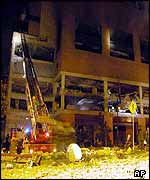
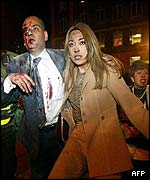
The sky is bright with the flashing lights of all of them. The exclusive club, Le Nogal - playground of the rich and influential - is on fire. There are three floors of car park clearly visible with debris piled onto each one, and sometimes, slipping down to the street below. The explosion has almost collapsed the building. Word filters through the waiting journalists that the death toll has now risen to nine, but each of us knows it will climb much higher. Over 100 injured have been taken away already. A female employee of the club tells me there are people trapped in its restaurant. Her friends and colleagues are among them. She estimates there might have been 900 people in the building when the bomb went off two hours ago. It is 2200 local time. Colonial building Every few minutes a whistle is blown, the barriers are pulled aside and another ambulance speeds off to hospital. Mark introduces us to Stephen Ferry, a photographer for the agency Look At. He has heard the security men saying there has been a car bomb which has in turn caused a gas leak.
Anxious commanders are clearly considering the possibility of a further device. Stephen points out the exclusive area we are in. Opposite the explosion is a yellow Spanish colonial building. Under the pall of smoke hangs the Spanish flag and we realise it is the embassy building itself. The British embassy is a block away, so are the Italians. The US Ambassador's residence is a few hundred metres away. 'A bigger crisis' All around Le Nogal are tall apartment blocks, an anxious onlooker on the balcony of each one. Below them there is a sudden flurry of activity as Colombia's president Alvaro Uribe arrives to see the damage for himself, his entourage ducking under the police tapes and hurrying under the ladders of the fire trucks. Just a day earlier, he lost his social security minister, Juan Luiz Londono, when his aircraft went missing in the west of Colombia. Now he has a bigger crisis to deal with. He leaves shortly afterwards, obviously shocked by what he has seen and heard - flanked by television crews and security men. A few moments later, we are crouching beside a police vehicle listening to the radio. The president comes on to appeal for international journalists like us to stop "going soft on terrorists" like the left wing FARC rebels which control so many of the rural areas of this huge country. It is clear he fears that with the bombing they have once again taken the fight to the capital city. He offers a reward for information worth about 500m pesos - �200,000. Defence witnesses There is still no word on who left the bomb. Most people seem to suspect the FARC. Some of the local journalists hear we have been in Bogota to cover the trial of three suspected IRA men, accused of training FARC soldiers. A few hours ago, both of us were in court hearing a prosecution witness claim that three foreigners had been lecturing about mortars, car bombs and remote detonation devices.
Again and again we are asked if it is true, and each time we answer that we are all waiting to see what happens at the trial when it resumes next month for the defence witnesses to be heard. By morning, the death toll has risen significantly and President Uribe is closeted in the presidential palace with his security council, before preparing for a broadcast to the nation. Colombia's brutal internal war has lasted longer, and cost many ten of thousands of lives more, than the Northern Ireland's Troubles. But even as strangers in this dangerous but remarkable country, perhaps we understand a little of its pain. | |
See also:  07 Feb 03 | N Ireland 08 Feb 03 | Americas 19 Jan 03 | Americas Internet links: The BBC is not responsible for the content of external internet sites Top N Ireland stories now: Links to more N Ireland stories are at the foot of the page. | ||||||||||||||||||||||||||||||||||||||||||||||||||||||||||||||||||||||||||||||||||||||||||||||||||||||||||||||
 | |
|  E-mail this story to a friend E-mail this story to a friend |
| |
| Links to more N Ireland stories |
| | | ||
 | ||||
 | | Back to top
| ||
| ---------------------------------------------------------------------------------- To BBC Sport>> | To BBC Weather>> | To BBC World Service>> ---------------------------------------------------------------------------------- © MMIII | News Sources | Privacy |






 Under the pall of smoke hangs the Spanish flag and we realise it is the embassy building itself