
|
 |
 | | | | | | |||||||||||||||||||||||||||||||||||||||||||||||||||||||||||||||||||||||||||||||||||||||||||||||||||||||
| | | You are in: UK: Education | |||||||||||||||||||||||||||||||||||||||||||||||||||||||||||||||||||||||||||||||||||||||||||||||||||||||||
|
| | Wednesday, 4 December, 2002, 09:24 GMT '�40,000 needed for uni' claim 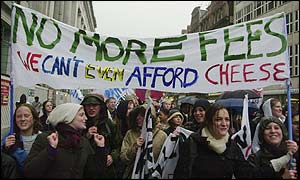 Thousands of students marched through London The cost of a university education could spiral to �40,000 according to student leaders. As they marched through the London rain, they warned a rise in top-up fees would mean poorer youngsters would miss out on university. They say the increases - typically dubbed "top-up" fees - would deter people from poorer families.
The National Union of Students (NUS) stoked up its war of words with the government by releasing an estimate of what it thinks it would cost to send a student to university in seven years' time if top-ups were allowed. The union says families with a child now aged 11 would have to pay nearly �40,000 for their university education. It based the figure on the idea that students would have to pay �4,500 a year in tuition fees - which many universities say is the full cost of a course - then added on an estimated figure for the cost of living. NUS National President, Mandy Telford, said: "Top-up fees will quite simply cripple our higher education system. "With fees at this level it is quite clear that many people will not be able to afford university in the future. "While the top-up fee debate continues we must not forget that the cost of being a student already prohibits many people from going to university." All-night bar work London student Maureen O' Donnell says higher fees would have stopped her going to university because her family is not well-off. "I wouldn't be here if they had been brought in and if they do come in then my siblings won't be able to go." Maureen, who is studying at University College London, lives with her parents but works 20 hours a week to support herself. In her second year, she has a �6,000 debt. "I work Friday night, Saturday night and Sunday night in a pub, sometimes until four or five in the morning," she said. "It's a myth that students spend all their time drinking. I don't. I'm working in a bar." Third-year biology student Suzanne Cooley says she probably would not have made it to university if the tuition fees were in the region of �4,000 a year. Graduate tax The other idea being considered as a way of funding higher education is a graduate tax, as in Scotland. Suzanne says that would not be fair either: "Let's not forget that if you earn more as a graduate, you are already going to be paying more tax.
Manchester student Ruth Richards says her family is already struggling to support their children's education. "If tuition fees were brought in, my family would disown me," she said. "I am one of four children and my father is a vicar, so money is a big deal. "It would be crippling to some families." At the moment, less than half of students pay full tuition fees, currently pegged at �1,100. Fees for poorer students are met by the government. The government is committed to increasing the range of people going to university, from the present level of 40% of young people to 50%, by 2010. The universities argue this expansion will increase their funding gap. They say they need another �10bn. | |
Internet links:  The BBC is not responsible for the content of external internet sites Top Education stories now: Links to more Education stories are at the foot of the page. | |||||||||||||||||||||||||||||||||||||||||||||||||||||||||||||||||||||||||||||||||||||||||||||||||||||||
| |
|  E-mail this story to a friend E-mail this story to a friend |
| |
| Links to more Education stories |
| | | ||
 | ||||
 | | Back to top
| ||
| ---------------------------------------------------------------------------------- To BBC Sport>> | To BBC Weather>> | To BBC World Service>> ---------------------------------------------------------------------------------- © MMIII | News Sources | Privacy |






 FORUM
FORUM Top-up fees


