
|
 |
 | | | | | | ||||||||||||||||||||||||||||||||||||||||||||||||||||||||||||||||||||||||||||||||||||||||||
| | | You are in: UK: Education | ||||||||||||||||||||||||||||||||||||||||||||||||||||||||||||||||||||||||||||||||||||||||||||
|
| | Tuesday, 26 November, 2002, 13:26 GMT Pupils still struggle with reading 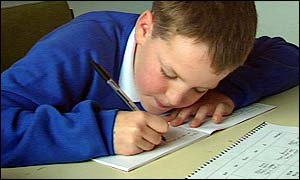 National test results have hit a plateau School inspectors say the government should embark on "a critical review" of its strategy for teaching children in England to read and write.
The inspectorate, Ofsted, points out that test results have not improved for two years - and fell short of government targets for 2002. It says the maths strategy does not need the same kind of overhaul - but is not being taught well enough. The chief inspector, David Bell, said there was " a stubborn core of weak leadership and management" in primary schools. Deprivation In its report on the first four years of the literacy strategy, Ofsted says it has had "a significant impact" on standards in English and on the quality of teaching. But it says this was not enough for the government to meet its target that 80% of 11 year olds should reach the level expected for their age in this year's tests. Only 75% did so, a figure which has not changed for two years. "It is undoubtedly harder for some schools than for others to change teaching and raise standards, but even in areas of social deprivation and staffing difficulties, just under half of the schools have made good progress," the inspectorate says. Weaknesses in teaching After "a very uncertain start", there has been "a marked shift" in teachers' attitudes towards the place of phonics - letter sounds - in teaching reading and spelling. But this is patchy. And "long-standing" weaknesses persist in the teaching of guided reading - helping small groups of children to the point where they can read and write on their own. Among more recently emerging problems: despite the millions pumped into giving schools computers and internet links, they have had difficulty using these to access guidance and support. And "teacher recruitment difficulties and high levels of teacher turnover have adversely affected the impact of the strategy in some schools." Achievements In reviewing the first three years of the numeracy strategy, Ofsted says steps that have been taken to tackle weaknesses in teaching "have not been effective enough". It says ministers and officials should see to it that teachers and school leaders are better trained and make better use of the teaching materials that are provided. The chief inspector of schools, David Bell, said the two strategies continued to have "a positive impact". "These achievements are a credit to the schools, teachers, teaching assistants and others who have made them work. "But I am concerned that there is still a stubborn core of weak leadership and management where head teachers do not do enough to make a difference to the standards in their schools." 'Blame culture' Trevor Millum of the National Association for the Teaching of English said this "Woodhead-speak" was the sort of thing that might have been expected of the former, more abrasive chief inspector. "It's a blame culture," he said. Mr Millum said teachers had come round to appreciating the literacy stratgey's framework for teaching.
"But where it has worked best is where they have departed from the prescription and made it their own, and interpreted it to suit their schools. "If it is possible to achieve these increasingly demanding targets it's more likely to be done by teachers freeing themselves and feeling more confident - rather than feeling they have got to follow strict guidelines. "It may be that rather than weak leadership in some schools, it may be less confident leadership that isn't fully able to do that." 'No complacency' The School Standards Minister, David Miliband, said: "We are not taking our eye off the ball. "The Ofsted reports are helpful in identifying which aspects of teaching and leadership we must tackle if we are to make further improvements and we will continue to review and refresh the strategies to ensure that they are meeting the needs of all pupils."
"I think a 90% approval rate would be something that most professions would be pretty pleased with. "But there's absolutely no room for complacency - if there are 2,000 schools that need further attention, that action must be taken as a matter of urgency." Mr Hart rejected Ofsted's call for an overhaul of the literacy strategy. "Quite honestly, I think we need more and more fundamental reviews of literacy and numeracy like we need a hole in the head." | | See also:  26 Sep 02 | Education 04 Dec 01 | Education 29 Oct 01 | Education 08 Feb 02 | Education 14 Dec 99 | Education 25 May 99 | Education Internet links: The BBC is not responsible for the content of external internet sites Top Education stories now: Links to more Education stories are at the foot of the page. | ||||||||||||||||||||||||||||||||||||||||||||||||||||||||||||||||||||||||||||||||||||||||||
| |
|  E-mail this story to a friend E-mail this story to a friend |
| |
| Links to more Education stories |
| | | ||
 | ||||
 | | Back to top
| ||
| ---------------------------------------------------------------------------------- To BBC Sport>> | To BBC Weather>> | To BBC World Service>> ---------------------------------------------------------------------------------- © MMIII | News Sources | Privacy |





