|
 |
 | | | | | | |||||||||||||||||||||||||||||||||||||||||||||||||||||||||||||||||||||||||||||||||||||
| | | You are in: UK: Education | |||||||||||||||||||||||||||||||||||||||||||||||||||||||||||||||||||||||||||||||||||||||
|
| | Monday, 11 November, 2002, 15:30 GMT Inspectors focus on failing schools 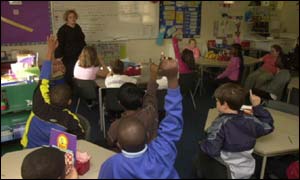 The aim to help all school raise standards Struggling schools are to receive greater support from inspectors in an attempt to stop them failing altogether. The schools watchdog in England, Ofsted, has decided to increase the number of visits to primary and secondary schools judged to have "serious weaknesses" to try to stop them falling into the category needing "special measures" - drastic action to prevent closure.
The chief inspector, David Bell, said the new approach was part of Ofsted's attempts to help school raise standards. Until now, inspectors revisited only a small number of schools with serious weaknesses up to 18 months after their initial inspection. Now all schools judged to have weaknesses will be checked within eight months to prevent them sliding into the special measures group. 'Spur to improvement' At the end of July 2002, there were 272 schools in special measures (1.1% of the total) - down from a 515 peak in 1998. Currently 491 schools are judged to have serious weaknesses, down from a high of 885 in 2000. Speaking before a conference to mark the 10th birthday of Ofsted, Mr Bell said, while many schools were often in shock when they received a bad inspection, the judgement often acted as a spur to real improvement. "Often, you find people have gone right back to basics in everything, right down to how do you structure lessons and get children around the school in an orderly fashion," he said. The Department for Education said Ofsted's reinforced measures would help to tackle failure at an earlier stage. "Ofsted has previously monitored schools with serious weaknesses, but we welcome the greater focus they are now giving to the problem," a spokeswoman said. "This is in line with new legal powers that allow ministers more scope to intervene, where necessary, in cases of school failure." Greater freedom Speaking at the conference the Education Secretary, Charles Clarke, repeated the government's intention to give successful schools greater "earned autonomy" to experiment. Proposals on how this should work are expected before the end of the year. But Mr Clarke said: "I am clear that wherever we start, we should aim for as many schools as possible to qualify over time. "As standards continue to rise, there is no reason why all of our schools shouldn't eventually qualify." His Conservative shadow, Damian Green, accused him of keeping the power to pick and choose which freedoms would go to which schools. "This means more power is being centralised - the very mistake the government keeps making," he said. One decade on Ofsted was set up in 1992 under John Major's government and is accountable to Parliament, not government ministers. At its helm for six years was the controversial figure, Chris Woodhead. Mr Woodhead gained a reputation for being tough on schools and teachers that were not making the grade. Loved by parents and loathed by teachers, Mr Woodhead once declared 15,000 members of the teaching profession were incompetent and should be sacked. His successor, Mike Tomlinson, adopted a more "softly, softly" approach, stressing that Ofsted inspections were not about hounding teachers, but helping them to improve standards. Before handing over to Mr Bell in April, Mr Tomlinson brought in a new inspection regime which will see shorter and less burdensome inspections of successful schools. Mr Bell said surveys suggested head teachers were now "broadly positive" about the effect of an Ofsted report on their school. | | See also:  02 May 01 | Education 05 Apr 02 | Education 07 Jul 02 | Education 24 Jan 02 | Education 30 May 00 | Unions 2000 03 May 02 | Mike Baker Internet links: The BBC is not responsible for the content of external internet sites Top Education stories now: Links to more Education stories are at the foot of the page. | |||||||||||||||||||||||||||||||||||||||||||||||||||||||||||||||||||||||||||||||||||||
| |
|  E-mail this story to a friend E-mail this story to a friend |
| |
| Links to more Education stories |
| | | ||
 | ||||
 | | Back to top
| ||
| ---------------------------------------------------------------------------------- To BBC Sport>> | To BBC Weather>> | To BBC World Service>> ---------------------------------------------------------------------------------- © MMIII | News Sources | Privacy |