
|
 |
 | | | | | | |||||||||||||||||||||||||||||||||||||||||||||||||||||||||||||||||||||||||||||||||||||||||||||||||||||||||||||
| | | You are in: UK | |||||||||||||||||||||||||||||||||||||||||||||||||||||||||||||||||||||||||||||||||||||||||||||||||||||||||||||||
|
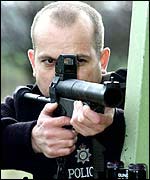
| | Wednesday, 15 January, 2003, 18:44 GMT Concern over rising police deaths  6,000 police officers in the UK trained to use weapons
The stabbing of a police officer in Manchester will be a further cause of concern for many within the service. While terrorist incidents may still be relatively unusual, the risks faced by policemen and women seem to be on the increase. Over the past 30 years, 70 officers have been killed in the line of duty. But 14 of those deaths occurred last year, and already this year there have been two fatalities. In Northern Ireland at least 302 officers have been killed since 1969 as a direct result of the Troubles. It raises once again the issue of whether Britain's police officers should be routinely armed, and what kind of protective clothing they should wear. Traditionally unarmed The bobby on the beat has traditionally been unarmed, although individual police forces have armed response units, specially trained in the use of firearms, and able to respond quickly to serious incidents. Home Office figures for 1999-2000 show that 6,200 police officers in England and Wales were authorised to carry firearms. During the same period, guns were issued for 10,917 police operations. In seven incidents, guns were fired by officers, resulting in three deaths.
In recent years, however, the terrorist threat has seen a more visible armed presence, particularly in London. Officers openly carrying guns patrol Heathrow Airport, and firearms units have stood guard outside the Old Bailey during major trials. Chief constables across the country have to assess the threat faced by their officers, and respond to local circumstances. In some areas, it has resulted in armed patrols on the streets. Reluctance to carry weapons But there has been a reluctance among many police officers to see the carrying of guns on duty becoming more widespread. The Police Federation represents 129,000 officers up to the rank of chief inspector. In 1995, it polled its members on the issue. Asked whether they wanted to see the police routinely armed, 79 per cent were firmly against. But 83 per cent said there should be an increase in the number of police officers trained in the use of firearms, so they could provide armed back-up when required. Police opinion has not been tested recently, but there has been concern about the risks now faced by police officers, not least because of the increase in the number of criminals carrying guns.
The Police Federation points to research which shows that while there has been a fall in the number of assaults and injuries suffered by officers, the number of serious injuries is going up. "We do not want our country to go the same way as America, nor do we wish police officers routinely armed," said federation chairman Jan Berry. "But if gun crime continues its rapid rise, we will have to think seriously about the best options to protect us all. That could include the adoption of more non-lethal weapons, such as a gun that disables an attacker with an electric shock. And many officers now wear knife-proof vests when on patrol. Protective clothing The Police Federation says it will not speculate about what happened during the incident in Manchester, and the inquiry will determine what lessons can be learned. But there is already a campaign to raise awareness within police ranks about the value of protective vests, with officers on the beat being invited to join the debate about safety. The threat from knives has existed ever since the police service was founded. The first recorded was Constable John Cooper, stabbed to death in London in 1703. It was the fatal stabbing of another London police officer, in 1985, that led to the development of body armour. A variety of protective clothing is now available. In the United States, it has been estimated that the lives of 2,500 police officers have been saved by body armour. Cliff Dixon, the deputy chief constable of Bedfordshire, wants to see more British police officers wearing protective clothing. "Not just when a risk assessment dictates it, but when they are out on general patrol and are unexpectedly involved in a potentially violent confrontation, or a difficult domestic or a vehicle pursuit," he says. "Not just on a Friday or Saturday night, but on a Wednesday morning when there is perceived to be little risk on an ordinary shift." The message to police officers is to be prepared for the unexpected. | |
Top UK stories now:  Links to more UK stories are at the foot of the page. | |||||||||||||||||||||||||||||||||||||||||||||||||||||||||||||||||||||||||||||||||||||||||||||||||||||||||||||
 | |
|  E-mail this story to a friend E-mail this story to a friend |
| |
| Links to more UK stories |
| | | ||
 | ||||
 | | Back to top
| ||
| ---------------------------------------------------------------------------------- To BBC Sport>> | To BBC Weather>> | To BBC World Service>> ---------------------------------------------------------------------------------- © MMIII | News Sources | Privacy |






 We do not want our country to go the same way as America, nor do we wish police officers routinely armed


