|
 |
 | | | | | | |||||||||||||||||||||||||||||||||||||||||||||||||||||||||||||||||||||||||||||||||||||||||||||||||
| | | You are in: UK | |||||||||||||||||||||||||||||||||||||||||||||||||||||||||||||||||||||||||||||||||||||||||||||||||||
|
| | Thursday, 18 July, 2002, 14:22 GMT 15:22 UK Build castles in the sky 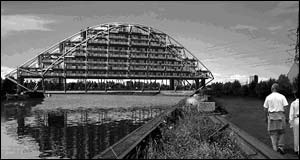 Would you live in the air?
 Building on abandoned commercial or industrial sites - so-called brownfield sites - has long been suggested as an alternative to encroaching on greenbelt land, but what if industry hasn't yet finished with a space ideal for residential use?
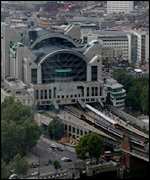
Seeking the "air rights" to build over an existing structure or transport link is something property developers have already become adept at in London's key business districts. Railway stations at Liverpool Street (near the City) and Charing Cross (close to Whitehall) both boast office complexes suspended over their busy tracks. Low-rise sprawl While the expense of constructing a "transfer deck" - the bridge on which the new buildings can be placed - have seen air rights only sought by those planning lucrative office developments, the housing crisis has prompted interest from residential architects. "It's something people are waking up to," says James Pickard of Cartwright Pickard Architects. While England has comparatively little spare land, Mr Pickard says that low-rise cities such as London have a far lower population density than other European cities - which tend to have four and five-storey apartment blocks.
Texaco is even planning to build homes and offices above three of its 1,500 UK petrol stations. This may benefit key workers (lower-paid public sector employees such as nurses and teachers) and others priced out of the urban housing market. On a solely economic level, land prices in London can contribute up to an eye-watering 80% of the cost of building a home. Even with the cost of the "transfer deck", air rights homes could still be cheaper than comparably located conventional ones. Building up The perceived stigma of living over a railway line or shopping centre, might also serve to keep prices or rents within the means of key workers rather than see the floating homes sold off as luxury pieds-a-terre. Even if there was a boom in air rights luxury homes, developers would be obliged to include a percentage of affordable housing in their plans.
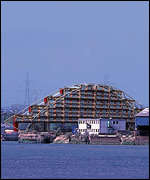
"Modern technology can take out the vibration and noise of living near a road or railway. If you live in a Victorian house by a railway, you know about it, but we can design that out now," says Mr Pickard. Noise should be a problem in Mr Pickard's latest project for the Peabody Trust, a 92 home, 10-storey bridge over the River Lea in east London. Weight watching The key to the development is the use of prefabricated housing modules, half the weight of conventional houses and ideal for placing on a transfer deck spanning the river. Inhabited bridges are not new to London. Indeed, the original London Bridge dating from 1176 was lined with homes, shops and even a chapel.
Those eager to move in may have to be patient though. At present the plan remains, sorry... up in the air. Would you live above a petrol station or railway track if it meant a city flat was affordable? Let us have your views, using the form below. Living over a river might be nice, but you cannot expect anyone to live above a busy railway line. I don't believe they can remove all the noise and vibrations, and what happens in the event of a rail disaster? Not only is there a risk of structural collapse, but rescue attempts would be seriously hampered by the building above. Lenders are the reason London is a sprawl. Getting mortgages above even the fifth floor is a challenge. Low paid workers have to overcome this issue first. Then we can look at air-rights. Using prefabricated modules is an excellent idea. These can be constructed off-site, which means the quality control standards are far higher. I can't understand why this hasn't taken off more. Perhaps it's the "prefab" term, which dates back to the post-war when such dwellings were built on spare land. I would live in a high rise flat. Building vertically also helps preserve the environment, it means less countryside is turned into housing estates. Anything is better than having to live in a tiny studio flat that costs �140,000. The London property market needs drastic action. As a graduate who earns nearly twice the average wage, I still can't afford a mortgage on a one-bed flat. I like the idea of living in the sky with good views. These sorts of innovative ideas are essential for sustainable housing. I'd live in one. I'm not sure about living above a petrol station, but living above a shopping centre wouldn't be too bad, possibly could even be considered an advantage with easy access to shops. The rest of Europe has a sense of society in architecture; here everyone wants a bit of garden and a piece of cheap farmhouse vernacular tat in the countryside. Apartments can be both functional and beautiful. Perhaps someone who lives in the Barbican centre could extol its virtues. You can live close to work, avoid the traffic and have a better quality of life. This idea of air rights isn't new, in fact one of the proposals for a new bridge over the Thames for the millennium was called "the living bridge", it was a suspension bridge with a residential tower on one end. Clearly the only way to sort out the problems of housing we have is to increase the density and this means building up. Unleaded Fuel contains compounds such as benzene, toulene and xylene which have been proved to cause cancer. Burnt diesel emits a similarly unpleasant cocktail of chemicals. Forget the fire risks, the constant smell and noise both locations would be subjected to (I doubt even the world's most able engineers could damp out the vibration caused by 15,000 tonnes of passing goods train) I would rather live elsewhere� Sounds to me like the buildings detailed in your story have some of the ingredients of becoming the slums of the latter half of this century. I think the possible use of air rights in ridiculously low-rise cities like London is an excellent idea. With pressure rising for more affordable housing (which will eventually reach the Green Belt) a solution has to be found. And soon. | | See also:  18 Jul 02 | Politics Top UK stories now: Links to more UK stories are at the foot of the page. | |||||||||||||||||||||||||||||||||||||||||||||||||||||||||||||||||||||||||||||||||||||||||||||||||
| |
|  E-mail this story to a friend E-mail this story to a friend |
| |
| Links to more UK stories |
| | | ||
 | ||||
 | | Back to top
| ||
| ---------------------------------------------------------------------------------- To BBC Sport>> | To BBC Weather>> | To BBC World Service>> ---------------------------------------------------------------------------------- © MMIII | News Sources | Privacy |