|
 |
 | | | | | | ||||||||||||||||||||||||||||||||||||||||||||||||||||||||||||||||||||||||||||||||||||||||||||||||
| | | You are in: UK | ||||||||||||||||||||||||||||||||||||||||||||||||||||||||||||||||||||||||||||||||||||||||||||||||||
|
| | Wednesday, 19 June, 2002, 15:29 GMT 16:29 UK Pedal power in Motor City
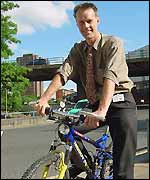
 It's a glorious day as I emerge from Birmingham New Street station, so I'm keen to crack on. I immediately head for the "travel information" office. "You can't bring that in there," warns the assistant, "it's a health and safety hazard." "There's nowhere to lock it up," I reply. "All I want is a map with cycling routes." "There are no cycling lanes in Birmingham, there are no maps." Clearly, this is going to be a challenging day out. 1000: Tourist Information Centre Here, I get a better reception. The fabled cycling map appears - for a fiver - and it strongly recommends I use the canal towpaths ("More canals than Venice!" apparently). I ask why there are no bike racks outside the office which lies on glorious Victoria Square. "Birmingham is not a cycling-friendly city," the assistant concedes with an embarrassed smile. 1030: Orientation I'm getting the feel of the city centre. Lots of dual carriageways, flyovers and underpasses. I can't see anything for concrete. This is apparently dubbed the "concrete collar", a planning disaster that cut through the city centre and strangled its expansion at the same time.
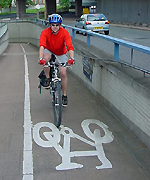
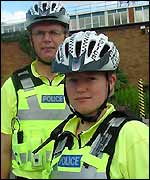
It's not all that bad. The very core of the city has an impressive one-way system which is easy for cyclists to use if they fancy taking on white van man. The National Cycle Route is marked - though it doesn't tell me where it is going. I even find a dedicated cyclists' crossing at Centenary Square. These are few and far between in the UK. Every time I try to get out of the city, I hit the collar. 1100: To Birmingham University This is a pleasant 15-minute, traffic-free ride along the Worcester and Birmingham Canal, although I have to hoik the bike up a flight of steps at the end. At the university, I meet Bubug, the cycling campaign group. Organiser Richard Pannell tells me cyclist numbers at the university are increasing, partly due to pressure to reduce the number of cars on the campus. He tells me that Bristol Road, one of the major routes south of the city, is a campaign priority because of its numerous lanes of fast moving vehicles and easy access to the city. 1300: Bournville Lane police station In the heart of a city built on the motor car, the West Midlands Police are successfully getting officers on bikes. I meet Sergeant Pete Newman of the Selly Oak Police Cycle Team. The team wear trendy rip-proof cycling trousers that I immediately covet, athletic tops, anti-stab vests and black and white cycling helmets.
So what's it like taking on Birmingham traffic? "You get this bubble around you that no one approaches. We tend not to use our blue flashing lights. I think we'd have the mickey taken. It's a bit Noddy car..." Joking aside, the experiment has been a success to date and is likely to expand. 1500: Back to the city I spend the next few hours criss-crossing the city, linking up suburbs with major employment centres. Later, I head for the largest new tourist attraction in town - the science museum at Millennium Point. The cycle parking at the museum is a bit disappointing because it's not sheltered. I can't quite see a family tackling inner-city Birmingham by pedal power for this day-out. 1600: To Birmingham airport Ok, not many holiday makers cycle to the airport, but I'm more interested in getting to the next-door National Exhibition Centre by bike? The woman on the NEC information line suggests I use the motorway. I explain that this is illegal. She tells me to call the tourist information office. They advise me to use the train. At the airport, a helpful man gives me a detailed back route but says I can't avoid some rather large stretches of fast road. I abandon the idea. 1700: At the city council My final visit is to the city council's cycling officer, Graham Lennard. "No more than 2% of journeys here are by bike," he tells me. "It's only ever really been the confident and the idealistic who cycle."
"It just wasn't going to be realistic to try and meet them," says Graham. "We're starting a new consultation now. I hope that in five years time we will have a new network linking work places and schools. The evidence is that it could be done." 1900 Back to London So what did I make of it? I'm not going to say that Birmingham is the worst place to cycle in Britain. It can fight that out with Newcastle and London. But I did notice one thing: I watched evening rush hour traffic for 45 minutes and spotted just nine cyclists. Your comments so far: Cardiff is pretty atrocious - lots of new "cycle lanes" which don't conform to any recognised standards and are too narrow to use safely. Lots of dedicated left-hand lanes at roundabouts which can leave cyclists stranded between two lanes of fast-moving traffic. I live nine miles from Birmingham City Centre, and would love to cycle to work if only the risk of getting killed by cars, buses and lorries were acceptable. Oh, and if my office had a shower too. South London is not too bad; although there are few dedicated cycle lanes bus lanes are common - and policed, at least where I am - and car drivers are actually reasonably considerate. Bristol isn't so bad, except that the cycle lanes seem to come and go at random, crossing back and forth to either side fo the road. The Bristol-Bath cycletrack is excellent, though. I was at university in Bristol and went everywhere by bike. It is by far the best city to cycle in. Having returned from a year spent in the Netherlands I can confidently say that all British cities are the worst to cycle in. Cambridge, as you might expect, is very cycle-friendly. There's still any number of ways in which it could be better, but when you go pretty much anywhere else in the UK you suddenly realise how good we have it here. I live in Nottingham which has excellent cyclepaths to most areas of the city, making cycling faster than the bus in many cases! However this is only let down by the lack of anywhere safe to leave your bike when you get there! Oxford is very cycle-friendly though I don't have the experience of having cycled in other cities to compare. Milton Keynes is a fantastic place to be a cyclist - there are nearly 200 miles of dedicated cycle and pedestrian routes throughout the city. Contrary to Seans experiances I find Nottingham a very poor city to cycle in. The good paths must be in specific directions. I reckon Edinburgh is one of the best cities for cycle-commuters. And I also believe I've got the best cycling route to work in Scotland which takes me past the Palace of Holyrood House and the impressive crags of Arthur's Seat, Edinburgh's mini-mountain. | | Internet links:  The BBC is not responsible for the content of external internet sites Top UK stories now: Links to more UK stories are at the foot of the page. | ||||||||||||||||||||||||||||||||||||||||||||||||||||||||||||||||||||||||||||||||||||||||||||||||
| |
|  E-mail this story to a friend E-mail this story to a friend |
| |
| Links to more UK stories |
| | | ||
 | ||||
 | | Back to top
| ||
| ---------------------------------------------------------------------------------- To BBC Sport>> | To BBC Weather>> | To BBC World Service>> ---------------------------------------------------------------------------------- © MMIII | News Sources | Privacy |