Roger Hearing:
We have David Mackie on the line from Bridgwater, England. David what do you think about this?
Roger Hearing:
I was reading up a little bit about the history of Iraq the other night and I learnt something quite interesting which was that Iraq had nationalised the oil industry in about 1972 - 1973. It then got me thinking about how that must have really upset a lot of American businesses and a lot of British businesses and the establishment and all that sort of thing.
I wonder if the antagonism towards Iraq goes back to that or whether the doctor thinks there's maybe other reasons why the West seems to be determined to get Saddam Hussein out of power no matter what?
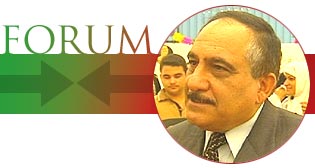
Dr Mohammed Murafa al-Adhmi:
You are right because when it was nationalised, the Americans started to practise some military exercises in the Mohave Desert in California. The American soldiers were practising fighting in the desert with others who were putting on Iraqi military clothes.
You are right, the nationalisation of oil - the Americans, the British were angry because they were controlling it because Iraq was poor at the time. They were getting the whole amount of the oil - the money as well. So when Iraq nationalised it, that's right, the Americans were angry and they are trying since that time to overthrow the national government in Iraq.
Roger Hearing:
Timmy, Australia: It is sad to see that the greed for money is an underlying factor in the attack against Iraq. If America was to conquer Iraq they would gain control of the oil fields, which would mean savings of millions of dollars. It is sad that so many people are going to lose there lives for the greed of a few.
Dr Mohammed Murafa al-Adhmi:
Yes, we have to defend our land. We have to defend our wealth. What can we do - we have no choice. We are trying now to avoid war by diplomatic and by political means that's why we accepted the re-admitting of the inspection team. That's why there were a lot of initiatives sent to Mr Blair and to the Congress and to everybody in the West.
That's why now we are getting support by others in the West - the Germans, the French and the others - who are saying no to the war.
Roger Hearing:
But they want cheap oil as well.
Dr Mohammed Murafa al-Adhmi:
Why not. We are not going to throw the oil in the sea or drink it - even for the Americans. Believe me we want to sell our oil and to get money and we would like have good relations with the United States. We would like to do so. We would like to have a dialogue with them. But they are refusing everything.
Roger Hearing:
An e-mail from Al Ghazali, Iraqi in Toronto: The US is acting like a tyrant to destroy a tyrant and to further their oil interests. War will only accelerate the cycle of violence to come.
Dr Mohammed Murafa al-Adhmi:
Yes, I think it will do so. But that's what the Americans wants not Iraq. Iraq doesn't want any war.
Roger Hearing:
But Iraq has waged war, hasn't it? It waged war against Iran.
Dr Mohammed Murafa al-Adhmi:
If you talk about Iran, we were defending our land. The 4th September 1980, they started to attack Iraq. They said they wanted to export the Islamic revolution to Iraq and they wanted to occupy Iraq and the holy cities. This is what they were saying at the time. So Iraq had to defend itself and then the counter attack came on 22nd September. Everybody knows about that. We had to fight - we didn't want that but they forced us.
After 10 days of fighting, we asked for a ceasefire but they refused. Just as we did in Kuwait, when we said we were going to withdraw after five days. And we started to withdraw by the way at the time. You can go to the documents, you can go to the data base, you can go to the newspapers and you will see that.
Roger Hearing:
We have a call from Benny Glass, Antwerp, Belgium. Benny, what do you think about this?
Benny Glass:
I'm probably very na�ve and I'm not specially pro-Iraq at all. But I heard that the US is saying they are making weapons of mass destruction and that they use them already and that is the excuse for the fear which they have.
But as far as I know, the US has made weapons of mass destruction and they use them on civilian people as well in Japan. They used them on civilian targets, women, children - not on military targets.
So I find it strange that people should come forward with excuses. If they don't want Saddam they should have done that in 1991 - they had plenty of opportunity.
Dr Mohammed Murafa al-Adhmi:
Well I can continue that comment in saying that the Israelis have weapons of mass destruction. Many other countries in the area have got weapons of mass destruction. Why don't they ask the Israelis also to destroy these weapons of mass destruction?
They are practising aggression against the Palestinians. Every day, many Palestinians are killed and put in prison but they don't talk about that. It is a double standard.
Roger Hearing:
Benny, if it were proven that Iraq did have weapons of mass destruction, would you then favour some kind of international action or not?
Benny Glass:
No because they are a sovereign state and like so many other countries who have weapons of mass destruction if they have the ability to build them, so be it.
Roger Hearing:
You don't think it's a threat to anybody?
Benny Glass:
We have so many other unstable countries with weapons of mass destruction.
Roger Hearing:
Which countries are you thinking of?
Benny Glass:
Pakistan, India. If Pakistan and India would wage a war it would be terrible for the whole of Asia. Russia has weapons - maybe I'm too much science fiction - but they can't even account for all their weapons.
Roger Hearing:
Would you object then if many other countries developed weapons of mass destruction? If there was a great proliferation of such countries.
Benny Glass:
Well no. If everybody felt they needed such weapons to feel strong, they should rather see a "shrink" because that's not the way to go. But I cannot change the world and everybody seems to think I need big weapons, I need to threaten - you don't need to threaten anyone.
Roger Hearing:
I'll come now to Dr Mohammed. What do you think about that?
Dr Mohammed Murafa al-Adhmi:
If you check the Resolution of 687 concerning Iraq - Article 14 mentions that the weapons of mass destruction should be destroyed in the Middle East and not just in Iraq. This article should be enforced - this is very important.
The second thing, I would like to mention that during the 1991 war, Iraq didn't use chemical or any weapons of mass destruction.
Roger Hearing:
Was that not in part because America threatened that if they did it might use nuclear weapons?
Dr Mohammed Murafa al-Adhmi:
No, no, no. They didn't use it and the Americans came here but they couldn't enter the country because usually they can't fight in the cities - they only stopped in the desert and then after that they withdraw.
Roger Hearing:
Let me ask you, Dr Mohammed, why did Iraq develop weapons of mass destruction? Why did it have programmes in the first place?
Dr Mohammed Murafa al-Adhmi:
At the beginning every country here in the area is developing nuclear and weapons of mass destruction - not just Iraq. Any country is doing so to protect itself. But we don't have it. We didn't use it at all. As I said from the beginning it is a pretext raised by the Americans to launch an aggression against Iraq, that's all.
Roger Hearing:
Fawad Arain, Washington: Do you think that after the US has pulled back the bow so far, we could still avoid a war?
Dr Mohammed Murafa al-Adhmi:
Well, I think so. But we have to be ready if the Americans launch an aggression against us. Even the Americans themselves - I mean the nation - the Americans are refusing this way of dealing with this question. Because you can't say to the others - you have to do so and so otherwise I will attack you. We did that when we accepted the readmitting of inspection teams.
When we had a dialogue with the United Nations and reached an agreement about the inspection teams, they are still insisting that this is no, we want to launch a war against Iraq.
Roger Hearing:
Let's come back to the referendum which has been completed in Iraq with the return of the President, Saddam Hussein as President for another 7 years.
We had an e-mail from John Cutajar, Valetta, Malta: I have come into across many intelligent and capable Iraqi people all over the world and I am sure there must be more in Iraq itself: Is it possible that since Saddam Hussein came to power there has been no other man or woman capable of running Iraq? When will he call it a day?
Dr Mohammed Murafa al-Adhmi:
President Saddam Hussein is leading the country since 1968 - before he was the vice-president and then in 1979 he became the president. So he is leading the country - he is still loving the country.
Roger Hearing:
That's about 23 years - it's a very long time for one man to be in power.
Dr Mohammed Murafa al-Adhmi:
Yes I know. This is our tradition, this is our customs as I said from the beginning. Nobody should interfere in our internal affairs.
Nobody could go to Blair and say well we don't like you and outside Britain we would like to change you. Why have you been here for so long? The system of the West is different as I said. But the foreign policy - when they are changing presidents or the prime ministers, nothing changed. The same foreign policy, the same internal policy, the same system. So is this democracy?
It's the wealthy people only who could go through the elections and be candidates and nominees to be elected as members of parliament. And in the parliament - let me as a parliamentarian say - if you go there you will see the majority in the parliament are forming the government and the minority are the opposition. Any law could be passed easily. So where is the democracy?
Roger Hearing:
An e-mail from Marcel Elkenbracht, Rotterdam, Holland: Are you afraid of Sadaam?
Dr Mohammed Murafa al-Adhmi:
No, we like him. If you talked about me personally you should also ask the others - in the streets, everywhere - nobody is afraid of him. Why?
Roger Hearing:
Because there are a number of people are in prison for opposing him aren't they?
Dr Mohammed Murafa al-Adhmi:
No, no. This is not right. I think the Iraqi government should arrange a visit for the media as well.
Roger Hearing:
To the prisons?
Dr Mohammed Murafa al-Adhmi:
To the prisons, yes because we don't have political prisoners.
Roger Hearing:
There are no political prisoners?
Dr Mohammed Murafa al-Adhmi:
No, no, not at all. We asked everybody who considered himself as an opposition to come back to Iraq. Several times there were declarations saying Iraqis who are abroad, who are staying there, could come back to Iraq.
You know the opposition are a few by the way. We don't to execute and we don't need to put people in prison. The whole nation said yes to Saddam Hussein.
Roger Hearing:
Prisoners can't vote can they?
Dr Mohammed Murafa al-Adhmi:
Prisoners for crimes - theft and so on - this is different.
Roger Hearing:
But the opposition hasn't come back and does that really surprise you because clearly they are afraid aren't they?
Dr Mohammed Murafa al-Adhmi:
Who's afraid?
Roger Hearing:
The people who won't come back to Iraq because they oppose Saddam Hussein.
Dr Mohammed Murafa al-Adhmi:
You are right, I know they are afraid. Iraqis who are outside and with that huge media - dis-information of the media - they imagine that in Iraq the situation is different than the reality of what it is. So that's why many of them they feel that they might face prison.
Roger Hearing:
Is there room for opposition in Iraq? If an opponent of Saddam Hussein came back to Iraq and wrote in a newspaper for example a letter saying, I disagree with Saddam Hussein, would that be allowed?
Dr Mohammed Murafa al-Adhmi:
If you go to the newspapers - many of the newspapers they criticise the ministries - there is much envy in the parliament itself. We discuss many issues and there is different points of view. So it is not the matter of President Saddam Hussein only. This is what the West is trying to do.
It is the situation in Iraq - this country is trying develop itself. It has a project to develop itself in a modern style. We want to exploit our oil for the benefit of the country. The Americans and their supporters are trying to put obstacles in our way.
Roger Hearing:
I come back to the point about opposition because if I were in Britain or America I could write a letter in the paper saying I thought that Prime Minister Blair or President Bush should step down. But you couldn't write that same letter in Iraq could you?
Dr Mohammed Murafa al-Adhmi:
No, no, we don't say that because everybody believes this is the cause of Iraq. Saddam Hussein is a symbol for the Iraqis in defending the country and developing the country. Nobody will say that because they are in fear but because they believe in this, they believe in their national government.
Roger Hearing:
An e-mail now from Laird Loughlin, New York, USA: How do you picture Iraq's future? Short-term and long term? How do you see your role in that future?
Dr Mohammed Murafa al-Adhmi:
It's really a very sensitive question. We believe that we have actually in Iraq, we have a project to build a country - a modern Iraq - a developed country. We have also plans for 10 years - an official plan which was planned by the ministries and other officials here and this plan is to develop the country better and better.
So the sanctions were there. We are trying to build the country to establish good relations with our neighbours - economically and politically - and that's what happened now actually. We hope to have very important and good relations with the West as well - with everybody, including the United States.
So we hope that if we go through this crisis of the threat of the Americans and we overcome it, I think we will have good relations with the whole world.
Roger Hearing:
Do you really believe that will happen?
Dr Mohammed Murafa al-Adhmi:
I hope so.
Roger Hearing:
I can see what you hope. But what do you think will happen? What is your best guess as to what will happen?
Dr Mohammed Murafa al-Adhmi:
I think they will send rockets. They will bomb some places but I think it will be very difficult for them to fight on the ground. The problem is the ground. Are they going to fight on the ground? Are the Americans ready to fight on the ground? This is the question. Every Iraqi is ready to fight - well trained, I will tell you. Every Iraqi is well trained through the party, through the government, through the army. So everybody is ready to fight and the British themselves knows that very well.
During the revolution in 1920, the Iraqis fought the British while they only had simple guns but they were fighting and the fighting lasted for a long time. And after that the British established an Iraqi government - they were forced to establish an Iraqi government instead of that high commissioner and so on.
Roger Hearing:
What about you? What's your future in Iraq?
Dr Mohammed Murafa al-Adhmi:
We have to fight - we are trying to build our future as a developed country - as a civilised country. By the way, President Saddam Hussein believes that the Iraqi civilisation - you know this is the cradle of civilisation - should be revived in a modern style.
Roger Hearing:
But what about your personal position in all of this? Dr. al-Adhmi, what are you going to be doing in the next few years?
Dr Mohammed Murafa al-Adhmi:
I've got a job as a dean of a college, as a member of parliament. So I will try to develop my college, trying to help the people, trying to serve the people, trying to solve their problems - that's what we have to do. We are working - even during the war we have to work.
Roger Hearing:
And are you convinced that you and your family will be safe during all this period? It seems like Iraq has a turbulent period ahead.
Dr Mohammed Murafa al-Adhmi:
Nobody can be sure of that. You can't be sure that the rockets will go to the places they are sent. Many, many families were killed during the war.
Roger Hearing:
That's all we've got time for. My thanks to everyone who took part in the programme and my guest also Dr. Mohammed Murafa al-Adhmi, thank you very much.




 E-mail this story to a friend



