|
 |
 | | | | | | |||||||||||||||||||||||||||||||||||||||||||||||||||||||||||||||||||||||||||||||||||||||||||||||||||||||||||||||||||||||||||||||||||||||||||||||
| | | You are in: Science/Nature | |||||||||||||||||||||||||||||||||||||||||||||||||||||||||||||||||||||||||||||||||||||||||||||||||||||||||||||||||||||||||||||||||||||||||||||||||
|
| | Wednesday, 7 August, 2002, 13:40 GMT 14:40 UK The stink is upon California 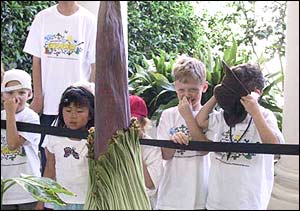 Too much for some: The smell can be unbearable There is now a rancid odour hanging over The Huntington Botanical Gardens in San Marino, California, US.
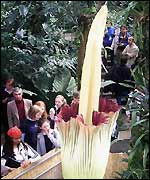
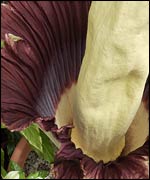
Although normally an extremely rare event under cultivation, this is the second time the Huntington's plant has flowered in three years. Indeed, 2002 is turning out to be a memorable year for this Sumatran oddity: specimens have already flowered in the past few months at the Royal Botanical Gardens, Kew, UK, and at the University of Wisconsin-Madison, also in the US. While you wait The Huntington flowering had been expected for several days and the plant finally began to unfurl its red bract - the part that looks like a petal - at 1700 hrs on Tuesday. By 2200, this had spread to a diameter of about 60 centimetres (two feet).
 Brendan Craughwell, a conservation assistant at The Huntington, told BBC News Online: "As the A. titanum opened up, the rancid fish odour it emitted could be smelled 20 feet away.
 "Several staff members and others associated with The Huntington braved the noxious fumes to stay and watch the bloom progress. We toasted it with white wine and crackers. "The process is so quick that once flowering begins, the changes can be detected while sitting and watching." Flower cluster The plant, also known as Titan Arum or the "corpse flower", is found only in Sumatra. It is not naturally self-pollinating - its male parts mature after its female parts are receptive - which makes cultivation of single plants in botanical gardens difficult to achieve.
These are found hidden inside the base of the spadix. When the spathe - the large frilly edged leafy structure surrounding the spadix - opens, the flowers are mature and give forth their famous stink. In the rainforests of Sumatra, this would attract pollinators such as carrion beetles and sweat bees. But in the case of cultivated specimens like the one at The Huntington, artificial pollination is required. Fruit and seeds "When the bloom opened the female flowers became visible at the bottom of the tall spadix in the centre," Mr Craughwell said.
"The pollen will be applied to the female flowers using a cotton swab by John Trager, curator of desert collections, and Gary Lyons, curator of the desert garden, on Wednesday." Hopefully, the plant will then bear fruit and produce seeds from which further specimens can be grown up. Big pots In May, three specimens held at Kew Gardens in London burst into flower. Huge crowds were drawn to witness their enormous bulk and experience their "fragrance" - described by many as a cross between excrement and rotting flesh. And last month, the Wisconsin flowering also proved a big draw. Since the very first blooming event under cultivation was recorded at Kew in 1889, an Amorphophallus titanum has been seen to go into flower fewer than 10 times in the UK and less than 20 in the US. So why the sudden rush of flowerings? (events were reported in Atlanta, US, and Bonn, Germany, last year as well). "It is really difficult to say," says Kathleen King, collections and science co-ordinator at Kew, where the specimens have been kept in unusually large pots for the first time. "They pretty much look after themselves; it's just when they are dormant they need to be kept dry. I like the theory that our success was down to the plants being in bigger pots but then you look at other people's containers and they are nothing like as big as ours. "So why there have been all these recent flowerings is hard to say." Main image courtesy of The Huntington Library, Art Collections and Botanical Gardens. | | See also:  02 May 02 | UK 03 Aug 99 | Science/Nature 23 Jul 99 | Science/Nature 01 Feb 00 | Science/Nature Internet links: The BBC is not responsible for the content of external internet sites Top Science/Nature stories now: Links to more Science/Nature stories are at the foot of the page. | |||||||||||||||||||||||||||||||||||||||||||||||||||||||||||||||||||||||||||||||||||||||||||||||||||||||||||||||||||||||||||||||||||||||||||||||
| |
|  E-mail this story to a friend E-mail this story to a friend |
| |
| Links to more Science/Nature stories |
| | | ||
 | ||||
 | | Back to top
| ||
| ---------------------------------------------------------------------------------- To BBC Sport>> | To BBC Weather>> | To BBC World Service>> ---------------------------------------------------------------------------------- © MMIII | News Sources | Privacy |