|
 |
 | | | | | | ||||||||||||||||||||||||||||||||||||||||||||||||||||||||||||||||||||||||||||||||||||||||||||||||||||||||||||||||||||||||||||||||||||||||||||||
| | | You are in: Science/Nature | ||||||||||||||||||||||||||||||||||||||||||||||||||||||||||||||||||||||||||||||||||||||||||||||||||||||||||||||||||||||||||||||||||||||||||||||||
|
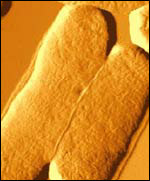
| | Wednesday, 5 June, 2002, 12:44 GMT 13:44 UK Closing in on bacteria Salmonella cell surface: Looking for chinks in the armour
Researchers at the Institute of Food Research (IFR), Norwich, UK, have been using an Atomic Force Microscope (AFM) to map the surfaces of individual cells. The AFM - a powerful tool that can see beyond that possible with the most powerful optical microscopes - shows that the same types of bacteria can have very different surfaces when grown in different environments. The research work also reveals that microbial colonies once considered to consist of genetically identical bacteria contain more variation than had been thought. New details Atomic force microscopy differs from conventional microscopy in imaging by feeling rather than looking at samples. It spans the range covered by both the light and electron microscopes. The AFM has a minute probe that is dragged over the surface of a sample. The tip of the probe rises and falls as it senses intermolecular forces.
"We started on this research about nine months ago," Dr Jay Hinton of the IFR told BBC News Online. "For many years our colleague Vic Morris had been using the AFM to look at food products. We decided to extend it to look at living bacteria." Although still at an early stage, the researchers have developed techniques that allow an AFM to detect structures on the outsides of individual cells, seeing details never detected before. The resolution is such that structures close in size to individual proteins can be seen. Genetic variation What excites scientists is that the AFM offers the possibility to study live bacteria, without the need for the vacuum or complicated pre-treatment that an electron microscope requires. "With the AFM we are more sure what we are seeing is really there and not just an artefact of the preparation process," said Dr Hinton. "We are seeing new things and we are not sure what they are." In particular, the surfaces of bacteria seem to develop in different ways depending upon the environment they are in. The Norwich team is also obtaining unique views of tiny structures that some bacteria have protruding from their surfaces, such as flagellae (that bacteria use to swim) and fimbriae (hair-like structures required to adhere and cause infection). It is hoped that the AFM will be used to monitor surface structures on individual cells of E coli and Salmonella at high resolution. One of the questions this line of research could tackle centres around why more than a million salmonellae are needed to make you ill by mouth, but only a few intravenously? The answer might be that a form of genetic variation among bacteria that is not caused by mutation might be responsible. If this is true, then there are big implications for protecting people against infection. | | See also:  12 Sep 01 | Science/Nature 20 Jan 00 | Science/Nature 13 Dec 99 | Science/Nature 28 Sep 01 | Science/Nature Internet links: The BBC is not responsible for the content of external internet sites Top Science/Nature stories now: Links to more Science/Nature stories are at the foot of the page. | ||||||||||||||||||||||||||||||||||||||||||||||||||||||||||||||||||||||||||||||||||||||||||||||||||||||||||||||||||||||||||||||||||||||||||||||
| |
|  E-mail this story to a friend E-mail this story to a friend |
| |
| Links to more Science/Nature stories |
| | | ||
 | ||||
 | | Back to top
| ||
| ---------------------------------------------------------------------------------- To BBC Sport>> | To BBC Weather>> | To BBC World Service>> ---------------------------------------------------------------------------------- © MMIII | News Sources | Privacy |