|
 |
 | | | | | | |||||||||||||||||||||||||||||||||||||||||||||||||||||||||||||||||||||||||||||||||||||||||||||||||||||||||||||||||||||||||||||||||||||||||||||||||
| | | You are in: Science/Nature | |||||||||||||||||||||||||||||||||||||||||||||||||||||||||||||||||||||||||||||||||||||||||||||||||||||||||||||||||||||||||||||||||||||||||||||||||||
|
| | Tuesday, 4 June, 2002, 09:38 GMT 10:38 UK These bots were made for scoring Injury worries could affect England's robot soccer team
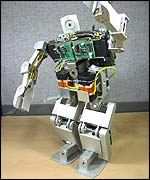
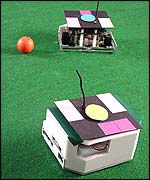
Only problem is, managers like Alex Ferguson might have to wait 50 years or so before such model professionals come rolling off the production line. Scientists believe that advances in computing technology and artificial intelligence are well on the way to delivering a team of humanoid robots capable of beating the human world football champions. "We are dreaming of such a scenario," says Jong-Hwan Kim, founder and president of Fira, one of the two main global organisations dedicated to robot football. "We hope that it will be viable a few decades down the road." Technical challenges Like their human counterparts, the world's best robot football teams are facing a busy summer, with two major tournaments coinciding with the World Cup.
But Zidane and Beckham are hardly quaking in their boots at the prospect of lining up against the sporting equivalent of R2D2 or Marvin the Paranoid Android. As Jong-Hwan Kim is the first to admit, there are formidable technical challenges to be overcome before robots can ever hope to match their human counterparts. "When the first robot soccer competition was held, the robots were rather slow and the vision processing was not effective," he said. "Since then robot teams have improved a lot in vision processing, speeds, and coordination, but there is still a long way to go." No pain, no game Gordon Dodds, a researcher in the department of electrical and electronic engineering at Queen's University, Belfast, points up another problem seldom highlighted in all the breathless talk about robotic soccer players.
"I think the problem would be convincing people to play against something which might feel no pain and may have devices which they do not have," he said. For participants in this summer's tournaments, the dream of fielding a robot team against human opponents is not their foremost concern. "Personally, I don't care if robot footballers will 'match' humans any more than I care how computer chess players compare with humans," comments Adam Bockrath, a researcher in the department of computer science at Queen Mary, University of London. Adam Bockrath, whose own tournament-winning creation "Jerky" was in action at the Fira World Championships at the end of May, believes that robot football should be made more accessible to non-specialists. "Sadly this is not currently the case with robot football and the aim of building humanoid footballers is not helping. I'd like to see lots of small, simple tournaments requiring much less expensive equipment," he said. Participants in Japan and Korea acknowledge that some people think of robot football as little more than playtime for academics, a fun diversion from the real business of scientific research. Wide-ranging skills While no one denies the sheer pleasure that comes from watching their robots run rings around the opposition, they are equally adamant that the sport has very serious applications.
"Being able to catch a ball or hit it quickly are not very useful in everyday applications of robots. "But if we convert the same skills into modelling how a robot should move flexible objects, or using two small robots to accomplish a task where a larger robot would not be appropriate, then real-time dynamic response to an unknown environment becomes important." Although the vast majority of robots today are used in factories, advances in technology will enable robots to automate many tasks in non-manufacturing industries and applications such as agriculture, construction, health care, military and exploration. It is also anticipated that robots will be widely deployed for household tasks or as companions for the elderly or infirm. "The world around us is changing in unprecedented ways and with unimaginable speed," concludes Jong-Hwan Kim. "A robot age only dreamed about and depicted in science fiction novels and movies will become a reality soon." You can hear more about robot football tournaments on the BBC World Service programme Go Digital. | | See also:  17 Jun 98 | UK Education 02 Jul 98 | Science/Nature 27 Nov 98 | Asia-Pacific 28 Jul 99 | Europe 10 Sep 01 | Artificial intelligence 25 Apr 02 | Science/Nature Internet links: The BBC is not responsible for the content of external internet sites Top Science/Nature stories now: Links to more Science/Nature stories are at the foot of the page. | |||||||||||||||||||||||||||||||||||||||||||||||||||||||||||||||||||||||||||||||||||||||||||||||||||||||||||||||||||||||||||||||||||||||||||||||||
| |
|  E-mail this story to a friend E-mail this story to a friend |
| |
| Links to more Science/Nature stories |
| | | ||
 | ||||
 | | Back to top
| ||
| ---------------------------------------------------------------------------------- To BBC Sport>> | To BBC Weather>> | To BBC World Service>> ---------------------------------------------------------------------------------- © MMIII | News Sources | Privacy |