|
 |
 | | | | | | ||||||||||||||||||||||||||||||||||||||||||||||||||||||||||||||||||||||||||||||||||||||||||||||||||||||||||||||||||||||||||||||||||||||||||||||||||||||||||||||||||||||||||||
| | | You are in: Europe | ||||||||||||||||||||||||||||||||||||||||||||||||||||||||||||||||||||||||||||||||||||||||||||||||||||||||||||||||||||||||||||||||||||||||||||||||||||||||||||||||||||||||||||||
|
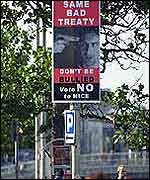
| | Thursday, 3 October, 2002, 09:47 GMT 10:47 UK Can Ireland stop EU enlargement?  The Vote Yes campaign is better organised this time
About 20 Irish journalists have been spending a couple of days in Brussels this week at the invitation of the European Commission and Parliament.
"Not a single critic of the Nice Treaty is allowed to meet the journalists visiting Brussels," says Danish eurosceptic MEP, Jens-Peter Bonde. "This programme spends European taxpayer's money in an undemocratic and biased manner." Last obstacle It is hardly surprising, however, if the EU's institutions are pulling out all the stops to influence the Irish to vote Yes to Nice on 19 October.
And, as is endlessly emphasised in Brussels, without it the whole process of EU enlargement - the accession of probably 10 new countries and 75 million people - will be jeopardised. When they were first asked, in June last year, 54% of Irish voters rejected the treaty. So what will happen if they do it again? The European Commission says it has no "Plan B". The Irish Prime Minister, Bertie Ahern, has told voters they would effectively be telling the waiting 75 million to "go to hell". But is that just bluff? Could enlargement actually go ahead without Nice? Nice's flaws Nice is often described as the treaty "on enlargement". This is not strictly true.
The point of Nice was simply to make the decision-making process less cumbersome when the EU becomes a much larger collection of states. And in that it can scarcely be said to have been a great success. On the one hand, qualified majority voting (QMV) was extended to some additional policy areas, "streamlining" decision-making by making it easier to overrule individual countries. But the rules governing what constitutes a "qualified majority" were made so complicated that a maths degree will be required to work out whether a policy has been adopted or not. The mixture of "weighted" votes and "blocking minorities" could make progress almost impossible. A way out? The President of the Commission, Romano Prodi, has never concealed his disappointment with the detail of the Nice Treaty, and he also once admitted to the Irish Times that "legally" enlargement could go ahead even if the Irish reject it again.
It is the prospect of six or more that causes problems (though only because it would be a technical breach of the Amsterdam Treaty). It still might be possible for the nitty-gritty of how many votes and members of the European Parliament each new member would get simply to be included in their accession treaties. The Union would then muddle on, with the existing rules on QMV, until a new treaty is negotiated. Not perfect, of course - but then neither, by a long chalk, is Nice. New constitution
A new Intergovernmental Conference, which will finalise the new arrangements, is already scheduled for 2004. So what, Irish voters might justifiably ask, is all the fuss about? Many of them may well note that this is not the be-all and end-all for enlargement (which a large majority of Irish people favour). But it is another opportunity to stick one's tongue out at the EU. | | See also:  30 Sep 02 | Europe 27 Sep 02 | Europe 27 Sep 02 | Europe 08 Jun 01 | Europe 18 Sep 02 | Europe 08 Jun 01 | Europe 13 Jun 01 | Europe Internet links: The BBC is not responsible for the content of external internet sites Top Europe stories now: Links to more Europe stories are at the foot of the page. | ||||||||||||||||||||||||||||||||||||||||||||||||||||||||||||||||||||||||||||||||||||||||||||||||||||||||||||||||||||||||||||||||||||||||||||||||||||||||||||||||||||||||||||
| |
|  E-mail this story to a friend E-mail this story to a friend |
| |
| Links to more Europe stories |
| | | ||
 | ||||
 | | Back to top
| ||
| ---------------------------------------------------------------------------------- To BBC Sport>> | To BBC Weather>> | To BBC World Service>> ---------------------------------------------------------------------------------- © MMIII | News Sources | Privacy |