|
 |
 | | | | | | ||||||||||||||||||||||||||||||||||||||||||||||||||||||||||||||||||||||||||||||||||||||||||||||||||||||||||||||||||||||||||||||||||||||||||||||||||||||
| | | You are in: Business | ||||||||||||||||||||||||||||||||||||||||||||||||||||||||||||||||||||||||||||||||||||||||||||||||||||||||||||||||||||||||||||||||||||||||||||||||||||||||
|
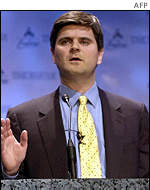
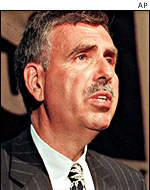
| | Monday, 13 January, 2003, 19:43 GMT AOL chief resigns amid heavy criticism  In happier days: Case and Levin in January 2000
Steve Case's resignation from the helm of media-giant AOL Time Warner is remarkable not only for its timing but also for its suddenness. Analysts had been expecting Mr Case to leave some time this year, though his departure comes sooner then thought.
But it was the prospect of such a battle that prompted Mr Case to announce his resignation, he said on Sunday. "We need to focus on [the challenges we face], not some debate about Steve Case," he said about his decision. Third resignation While Mr Case will no longer serve as chairman, he will still serve on the firm's board and co-chair its strategy committee, although the level of influence he can wield is questionable. In recent months, his presence at the head of AOL Time Warner and within the firm's boardroom had become far more of a liability than an asset.
Shareholder anger with AOL management, and Mr Case in particular, has been palpable for many months. In reflecting personally on his decision to leave his post in May, Mr Case said he had concluded the firm would fare better without his leadership. "Case was clearly ineffective, and I didn't see any direction coming out the company under his leadership," said Tim Ghriskey, president, Ghriskey Capital Partners, a fund manager that has sold its stake in AOL Time Warner. Mr Case's departure follows those of former chief executive Gerald Levin and former chief operating officer Robert Pittman, all three architects of the AOL/Time Warner merger. The resignation also comes two days after the third anniversary of the announcement of the $106bn (�66.1bn) merger. It has been a huge disappointment, a fact reflected in the firm's share price, which has fallen nearly 70% to about $15 a share since the acquisition was completed in January 2001. "More importantly," says Professor Irwin Kellner of Hofstra University: "[The company] didn't achieve the synergies that were envisioned by Steve Case and Gerald Levin." Failed merger At the time of the announced merger, then-AOL chairman Case and Time Warner chief executive Levin were lauded as visionaries, marrying both old and new media in a way that promised to "fundamentally change the way people get information, communicate with others, buy products and are entertained". But the efficiencies they both imagined failed to materialise. More recently, a drop-off in new subscribers and a depressed advertising market have relegated AOL to little more than small contributor to the parent firm's bottom line. Ad sales, on which AOL relies heavily, are expected to shrink to $800m this year, well below the $2.7bn the firm made in 2002. 'Swapping' Adding to financial woes is the expectation of a charge against profits later this month, possibly in excess of $10bn, on top of a $54bn write down by AOL Time Warner last month to account for a decline in America Online's value.
Aside from a falling share price, the company has also been dragged down by an investigation in AOL's accounting methods. The Securities and Exchange Commission (SEC) and the Department of Justice are investigating the firm's accounting technique. AOL and other technology firms in the high-flying 1990's stand accused of employing "swapping", a form of accounting that allowed the companies to book bogus revenue. Despite his failings, Mr Case can already claim success in changing the way people communicate through the invention of America Online, the precursor to which he co-founded in 1985. Case's millions AOL eventually became the US' largest provider of online services with more than 35 millions subscribers worldwide. As the firm grew, it gobbled up assets, including competitor CompuServe and software maker Netscape Communications, then the maker of the most popular web browser. And in merging his firm with Time Warner, some argue, Mr Case may have saved his firm from the fate of other internet stocks, which now trade for mere pennies a share or are relegated to the smouldering heaps of history. It is also the reason Mr Case remains a multi-millionaire, despite the sharp drop in AOL's share price. His 11.5 million shares of AOL common stock, and options to buy millions more, mean he is likely to sustain his wealth whether or not he has a job in AOL's boardroom. | | See also:  03 Dec 02 | Business 12 Nov 02 | Business 24 Oct 02 | Business 10 Sep 02 | Business 23 Aug 02 | Business 21 Aug 02 | Business 15 Aug 02 | Business 06 Aug 02 | Business Top Business stories now: Links to more Business stories are at the foot of the page. | ||||||||||||||||||||||||||||||||||||||||||||||||||||||||||||||||||||||||||||||||||||||||||||||||||||||||||||||||||||||||||||||||||||||||||||||||||||||
 | |
|  E-mail this story to a friend E-mail this story to a friend |
| |
| Links to more Business stories |
| | | ||
 | ||||
 | | Back to top
| ||
| ---------------------------------------------------------------------------------- To BBC Sport>> | To BBC Weather>> | To BBC World Service>> ---------------------------------------------------------------------------------- © MMIII | News Sources | Privacy |