|
 |
 | | | | | | |||||||||||||||||||||||||||||||||||||||||||||||||||||||||||||||||||||||||||||||||||||||||||||||||||||||||||||||||||||||||||||||||||||||||||||||||||||||||||||||||||||||||||||||||||||||||||||||||
| | | You are in: Americas | |||||||||||||||||||||||||||||||||||||||||||||||||||||||||||||||||||||||||||||||||||||||||||||||||||||||||||||||||||||||||||||||||||||||||||||||||||||||||||||||||||||||||||||||||||||||||||||||||||
|
| | Monday, 2 September, 2002, 23:06 GMT 00:06 UK Struggle to identify NY dead 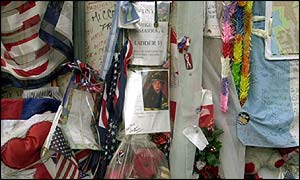 Many families are still waiting on formal identifications
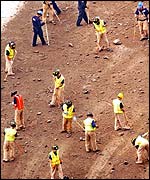
One year on, the task of identifying victims from the World Trade Center is still far from being completed. With 2,819 people on the list of the dead and missing, it is the biggest challenge ever faced by forensic scientists. To date, 1,377 victims have been identified, a figure that investigators hope will eventually reach 2,000. The grim search through the debris of the Twin Towers, only recently completed, led to the recovery of almost 20,000 body parts. Some victims have been identified by traditional means, using medical and dental records, jewellery and tattoos. But the devastation at Ground Zero means that in many cases the only hope of positive identification lies with DNA. In recent years, the techniques developed for crime detection have been used in the recovery of bodies after airline disasters.
But after a plane crash, investigators have a passenger list, and the number of victims who cannot be identified by conventional methods is often quite small. In New York, there is still uncertainty about who was actually inside the Twin Towers when the planes struck. It has tested the skills of laboratory technicians across the United States. Their task has been to match the human remains with DNA extracted from items like combs and toothbrushes used by the victims, and samples provided by family members. Adding to the problems facing the scientists is the way the DNA from victims has often been degraded, after being subjected to intense heat, water and bacteria.
"It is an amazing story," says Ellen Borakove, spokeswoman at the Office of the Medical Examiner. "The technology is literally changing under our fingertips. People are rising to the challenge of identifying all these people, and it is wonderful." But even using the most advanced techniques known to forensic science, many of the remains have not yet yielded a DNA profile good enough to make identification possible. So the families of many people missing since September 11 remain in a terrible limbo, without final confirmation of the death of a loved one, and unable to hold a funeral. Everyone is acutely aware of the strain on those still waiting for news. "We know how important it is to the families to get an identification," says spokeswoman Ellen Borakove. "We want to give them hope that we will make the final identification, because they need an answer, one way or another. "If we don't have anything for them, then that is not a good place for them to be. So we feel very good about it when we can make an identification and inform a family that we have remains." There have been remarkable successes. Against expectations, it has been possible to identify the remains of 43 people who were on board the jets that crashed into the Twin Towers. DNA tests Present scientific tests are likely to be exhausted early next year, but that will not be the end of efforts to identify the dead. New techniques, using fragments of DNA, are being actively developed. All unidentified body parts are being preserved and stored in the hope that scientific advances will allow further identifications to be made in the future. The remains are currently being kept in refrigerated trailers on a closed site that has become known as Memorial Park. Relatives of the dead can make private visits at any time, and talk to staff about the progress of the investigation. Still unresolved is the nature of a permanent memorial for the dead. Arguments continue about whether there should be any commercial re-development at Ground Zero. Some argue that turning the entire site into a memorial would be wrong, because those who died in the Twin Towers would have wanted the business community to recover and rebuild. But the city's former mayor, Rudy Giuliani, has made it clear where his sympathies lie. Writing in Time Magazine, he says that the site should be first and foremost a memorial. "Ground Zero is a cemetery," he says. "It is the last resting place for loved ones whose bodies were not recovered and whose remains are still within that hallowed ground." And he says he would devote the entire 16 acres to a memorial for the victims: "A soaring structure should dominate the site, taking its place along New York City's wonderful skyline. "It should be visible for miles, to demonstrate the spirit of those who gave their lives to defend freedom."
| |
Top Americas stories now:  Links to more Americas stories are at the foot of the page. | |||||||||||||||||||||||||||||||||||||||||||||||||||||||||||||||||||||||||||||||||||||||||||||||||||||||||||||||||||||||||||||||||||||||||||||||||||||||||||||||||||||||||||||||||||||||||||||||||
| |
|  E-mail this story to a friend E-mail this story to a friend |
| |
| Links to more Americas stories |
| | | ||
 | ||||
 | | Back to top
| ||
| ---------------------------------------------------------------------------------- To BBC Sport>> | To BBC Weather>> | To BBC World Service>> ---------------------------------------------------------------------------------- © MMIII | News Sources | Privacy |